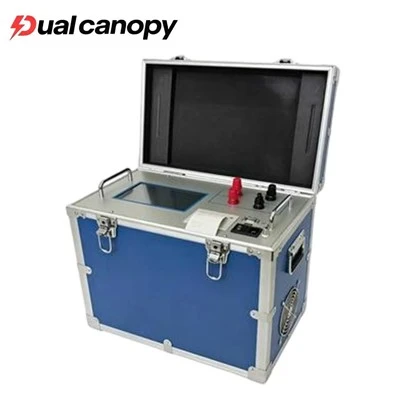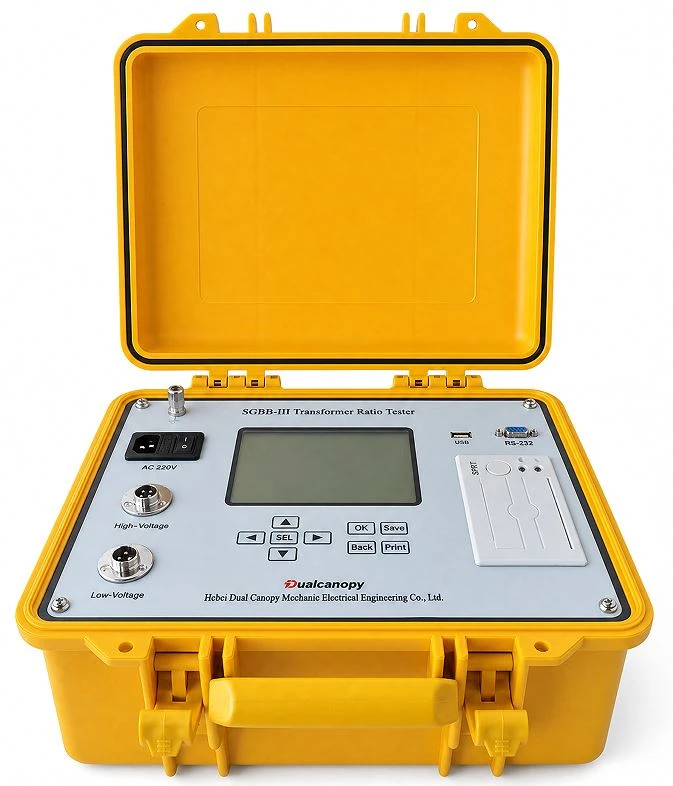
Dual Canopy Mechanic Electrical Engineering Co., Ltd. is one of the leading manufacturers and suppliers of transformer turns ratio test instrument in China. Please feel free to wholesale discount products for sale here and get quotation from our factory. Customized orders are welcome.
What Is a Transformer Turns Ratio Test Instrument?
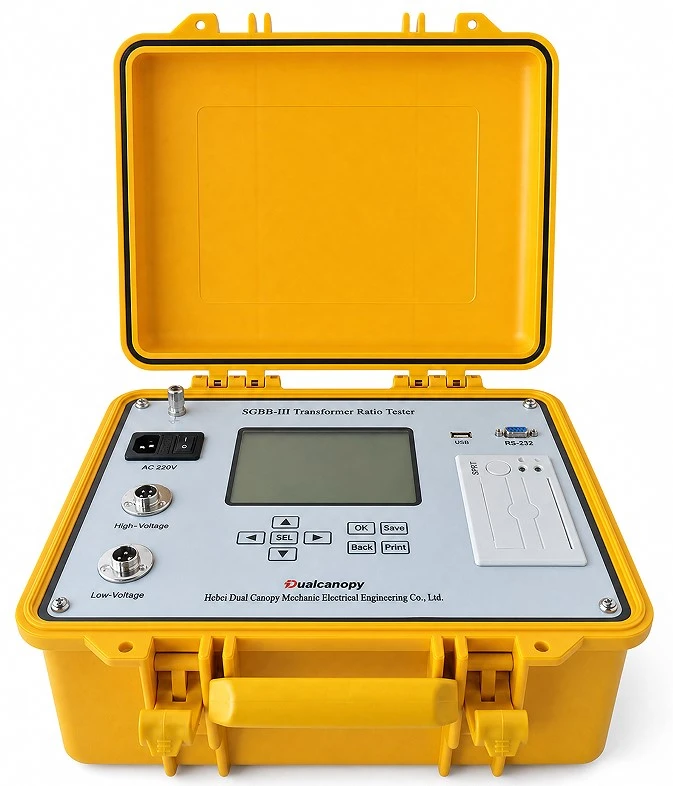
A turns ratio test is a pass/fail comparison between the windings and the nameplate. The instrument applies a low voltage to one side of the transformer, measures the other side, and divides the two readings. That quotient is the turns ratio. Set against the nameplate value, it tells you whether the winding, taps, and phase connection are as designed. A transformer turns ratio tester automates the division, timestamps the result, and prints it. The SGBB-III featured on this page is our Class 0.2 unit: a 0.9–10,000 range, 0.0001 resolution, built-in three-phase supply, and about 10 seconds per three-phase run.
SGBB-III Specifications at a Glance
| Item | SGBB-III | ZS6810A / ZS6810E (our other series) | Two multimeters, manual method |
|---|---|---|---|
| Measurement range | 0.9 – 10,000 | 0.8 – 10,000 | limited by meter range |
| Accuracy | 0.2 class | 0.1% (0.8–500) to 0.5% (2001–10000) | a few percent at best |
| Phase angle | vector-group identification | 0 – 360°, 0.2° resolution | calculated by hand |
| Excitation | built-in 160 V three-phase digital supply | built-in, auto-adjusting | via the grid or a bench supply |
| One run | about 10 s, three-phase | about 10 s, three-phase | minutes, and twice the people |
| Records | memory, USB, printer | printer, USB, RS232 | a paper notebook |
| Weight | 5 kg | 5 kg (main unit) | lightest |
What Features Does the SGBB-III Instrument Offer?
Ratio range 0.9–10,000, in 0.0001 steps, at Class 0.2 accuracy.
Vector group comes out automatically: leave the group field at "XX" and the unit identifies it.
Handles Z-connection (zigzag) windings-a case that trips up many generic testers.
Blind-test mode ignores preset nameplate data and reports the actual ratio and vector group.
Three-phase test completes in about ten seconds.
Full-transmission LCD stays legible in direct sunlight.
Low-noise thermal printer for immediate on-site printouts.
HV/LV reverse-polarity and short-circuit protection.
USB export, with a clock that keeps running after power-down.
Single-Phase or Three-Phase: Which Test Mode Do You Need?
Single-phase mode wires one phase pair; the unused leads simply hang off. It suits distribution transformers and voltage transformers.
Three-phase mode wires all three phases. The instrument adds up the measured phase angles to work out the group number, then runs the ratio test against it. You can enter the group yourself, or set it to "3" with auto-identification switched on and let the unit decide. On standby power there is no auto-identification – the group has to come from the nameplate.
Z-connection and blind testing get their own paths inside ThreeTest: the zigzag (Zinoviev) connection is tested as its own case, and a blind test skips the nameplate assumptions entirely, so you can see what the winding actually is. That second mode earns its keep on incoming stock and on units whose paperwork has wandered off.
What Should You Watch Out for When Using a Ratio Tester?
The earthing rod goes to earth before every test. No exceptions.
The supply is AC 230 V ±10%, 50 Hz. Do not feed any other voltage.
Keep the unit on a stable platform; the case is not drop-rated.
Nothing goes inside the chassis. A dropped screw can short the supply.
Current running high on a legitimate (non-short) circuit? Switch the supply to the 10 V option.
Mains out and the backup running? Group auto-identification is unavailable, so type the group number from the nameplate.
How Do You Operate the SGBB-III Step by Step?
Earthing rod to earth.
Connect the leads per the wiring diagram.
Pick the mode from the main menu: SingleTest, ThreeTest, History, SystemSet.
Enter the parameters:
| Field | What to enter |
|---|---|
| Rated_HV | rated HV voltage, from the nameplate |
| Rated_LV | rated LV voltage, from the nameplate |
| TapNumber | total number of taps (0 = the instrument will not judge tap position) |
| Prin-Tap | rated tap position (defaults to the middle tap; change it if yours is not) |
| Tap_Inte | tap interval, from the nameplate |
| SeriaNum | your own record number for this test |
For repeat jobs, save the set as default and select "skip parameter setting".
Press OK, wait about 10 seconds, read the result screen (measured ratio, ratio error, tap position). "Retest" repeats the measurement; SEL opens parameter correction; Save and Print keep the record.
How Should You Maintain and Care for the Instrument?
Store the unit somewhere dry and well ventilated, clear of direct sun and dust.
Before every job, trace the leads and ground clamp and check for wear.
Keep the printer slot clean. Even a scrap of torn paper can jam it.
The fuse is tucked inside the panel; keep the area around it clear and make sure people know where it is.
If a standby battery is fitted, charge it at regular intervals.
For periodic calibration, return the unit to our factory, where the full-range check is run again.
How to Cooperate With Us?
Send your nameplate samples (or a transformer list) plus the quantity you need.
We confirm the technical fit: range, tapping data and group logic against your transformer types.
You receive a quotation: price, lead time, calibration certificate, and a suggestion on spare print paper.
Production and QC: full-range check on every unit, with a photo of the packed unit before dispatch.
Delivery and support: export packing, English manual, the 24-hour line, and firmware updates over RS232.
.

FAQ
Q1: Is the display readable outdoors?
A: The LCD is full-transmission and sized for direct-sun conditions; it is the standard choice for substation yard work.
Q2: The screen stays dark when I switch it on. What do I do?
A: Check the internal fuse first – it is hidden in the panel. If the fuse is fine, stop and contact us; that is an internal fault, not a user fix.
Q3: What comes in the box?
A: The instrument, test leads, print paper, adapter, carrying case, English manual and a calibration certificate.
Hot Tags: transformer turns ratio test instrument, China transformer turns ratio test instrument manufacturers, suppliers, factory, sf6 analyzer, sf6 test equipment, sf6 test gas, sf6 tester, SF6 Testing, sf6 Type in transformers