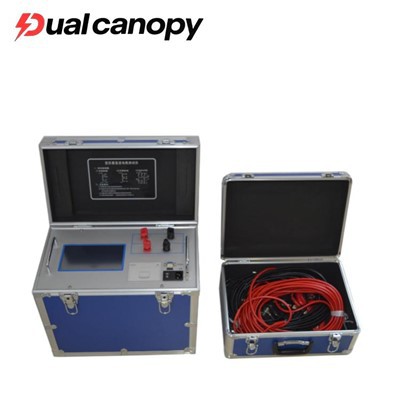
Dual Canopy Mechanic Electrical Engineering Co., Ltd. is one of the leading manufacturers and suppliers of direct current resistance tester in China. Please feel free to wholesale discount products for sale here and get quotation from our factory. Customized orders are welcome.
What is Direct Current Resistance Tester?

The Direct Current Resistance Tester (also referred to as a High-Current Micro-Ohmmeter) is a high-precision, stationary instrument designed for accurate measurement of very low resistance values in inductive and resistive loads. Unlike portable handheld testers, benchtop models are engineered for continuous operation, higher test currents (typically 10A to 100A or more), and superior accuracy in controlled environments such as manufacturing plants and calibration laboratories.
Utilizing the four-wire Kelvin measurement method combined with advanced constant current source technology, this tester eliminates lead resistance errors and provides stable, repeatable results. It is the industry standard for Factory Acceptance Testing (FAT) of power transformers, reactors, and large rotating machinery, ensuring compliance with strict quality control standards before equipment leaves the factory.
Our benchtop series offers exceptional resolution (down to 0.1 μΩ) and accuracy (up to 0.01%), making it suitable for measuring not only windings but also busbars, contacts, shunts, and precision resistors.
What precautions should be observed during use?
1. Safety Warnings
High Back-EMF: When testing large transformers or reactors, an extremely high back-EMF (which may exceed 1000V) is generated the instant the test leads are disconnected. It is strictly forbidden to touch the test leads or the device under test while testing is in progress or before the discharge process is complete. You must wait until the instrument indicates "Discharge Complete" before proceeding with any operations.
Grounding Protection: The instrument's chassis must be reliably grounded to prevent the accumulation of static electricity and to guard against electric shock caused by leakage current.
High-Current Heating: During high-current testing, poor contact at the test clamps can lead to severe overheating or even burn out the clamps. Ensure that the test clamps are securely fastened and that the contact surfaces are clean.
2. Environmental Requirements
Stable Power Supply: Benchtop high-current testers consume significant power (especially in the 100A range); therefore, they must be connected to a stable industrial AC power source to prevent voltage fluctuations from affecting measurement accuracy.
Ventilation Space: Sufficient clearance for heat dissipation must be maintained at the rear and sides of the instrument (a minimum of 20 cm is recommended) to prevent internal overheating that could lead to component aging.
Avoid Vibration: The precision measurement environment should be free from strong vibrations to ensure contact stability.
3. Wiring and Operation
Correct 4-Wire Connection: Wiring must strictly adhere to the 4-wire method: the current leads (source) should be connected to the outer terminals, while the voltage leads (sense) should be connected to the inner terminals. The voltage leads must not carry high current, as doing so will result in measurement errors.
Eliminating Thermoelectric Potential: When measuring very low resistances, temperature differences at the contact points can generate a thermoelectric potential (the thermocouple effect), which interferes with DC measurements. It is recommended to use the "Forward/Reverse Current Method" or the instrument's built-in "Thermoelectric Potential Elimination Function" to perform measurements.
Temperature Compensation Settings: Before performing precise measurements, you must correctly configure the type of material being tested (Copper/Aluminum) and the current ambient temperature, or connect a dedicated temperature sensor.
1. Model Selection Support: Based on your transformer specifications (e.g., 50 MVA, 220 kV), winding material (copper/aluminum), and testing requirements, we calculate the necessary test current magnitude and recommend the most cost-effective model. For instance, when measuring the low-voltage windings of large transformers, we typically recommend selecting a 50A or 100A model.
2. Customization Services: We provide customized hardware and software development services to address unique requirements (e.g., higher currents up to 200A, specialized measurement ranges, or specific interface protocols).
3. Automation Integration Solutions: We provide PLC communication protocols and trigger signal interface definitions for automated production lines, assisting clients in seamlessly integrating the testing phase into their automated workflows.
4. Technical Consultation: We provide detailed wiring diagrams and recommendations for testing procedures, assisting clients in optimizing their manufacturing processes.

FAQ
Q1: What is the fundamental difference in accuracy between benchtop testers and handheld testers?
A: Benchtop testers typically employ higher-precision reference sources and more stable measurement circuitry, achieving an accuracy of 0.01% to 0.05% and a resolution of up to 0.1 μΩ. Handheld testers, constrained by battery power and compact size, generally offer an accuracy of 0.1% to 0.2% and a resolution in the 1 μΩ range. Benchtop instruments are ideal for factory outgoing inspections and metrological calibration, while handheld units are better suited for on-site maintenance and inspection rounds.
Q2: What is the "Thermoelectric Potential Elimination" function? Why is it important?
A: When two different metals come into contact and a temperature difference exists between them, a thermoelectric potential (thermoelectric effect) is generated. When measuring minute DC resistance, this tiny electromotive force-potentially just a few microvolts-can severely interfere with the measurement results. The "Thermoelectric Potential Elimination" function automatically cancels out the influence of this thermoelectric potential by performing measurements with both forward and reverse excitation currents and then averaging the results, thereby ensuring the integrity and accuracy of the measurements.
Q3: Can this device be integrated into an automated test line?
A: Yes. Our benchtop testers come standard with RS232, USB, and LAN interfaces, supporting the standard SCPI command set as well as the Modbus TCP protocol. You can remotely control the instrument-including charging, measuring, and discharging operations-and retrieve measurement results via a PLC or host computer software, allowing for seamless integration into automated production lines.
Hot Tags: direct current resistance tester, China direct current resistance tester manufacturers, suppliers, factory, DC Winding Resistance Test kit, dc low resistance analyser, DC handheld resistance test set, transformer dc resistance analyzer, DC handheld resistance analyser, DC handheld resistance tester