

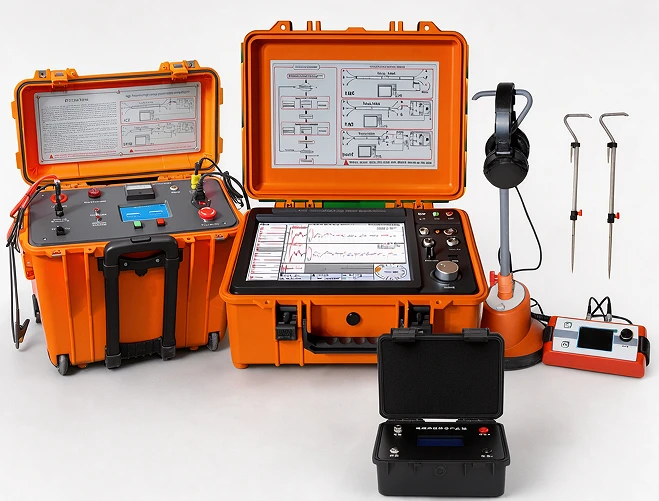
Dual Canopy Mechanic Electrical Engineering Co., Ltd. is one of the leading manufacturers and suppliers of sgft cable fault location system in China. Please feel free to wholesale discount products for sale here and get quotation from our factory. Customized orders are welcome.
What Is an SGFT Cable Fault Location System?
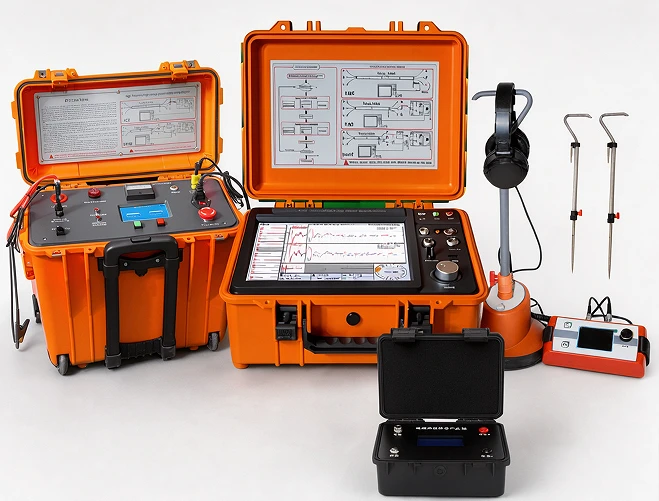
The SGFT Cable Fault Location System is a field-oriented solution for locating faults in power cables before excavation or repair work begins. It combines fault prelocation, waveform analysis, cable route tracing, and final pinpointing into one coordinated workflow.
Instead of relying on a single test method, the system helps technicians select an appropriate approach for open circuits, short circuits, low-resistance faults, high-resistance leakage faults, and flashover faults. It can be used on power distribution cables as well as selected railway, airport signal-control, and street-lighting cable networks.
The system is designed for trained electrical personnel who need to narrow a fault from a long cable section to a practical excavation area..
What Problems Can This Cable Fault Location System Help Solve?
A cable fault rarely begins as a visible problem on the ground. A cable may be buried under asphalt, soil, pavement, factory floors, or congested utility corridors. The SGFT system supports a step-by-step process that helps identify the fault type, estimate the distance, trace the cable route, and confirm the final fault point.
Typical fault conditions include:
Open-circuit and conductor-break faults
Short-circuit and low-resistance faults
High-resistance leakage faults
High-resistance flashover faults
Phase-to-ground faults
Phase-to-phase faults
Cable sheath or insulation-related fault investigation
How Does the SGFT System Locate a Cable Fault?
The normal field workflow is divided into several stages:
Assess the cable condition
The technician identifies the suspected cable section, voltage class, cable structure, and likely fault type.
Measure cable length and wave velocity
A low-voltage pulse test can be used to confirm cable length and calibrate propagation velocity.
Prelocate the fault distance
Depending on the cable condition, the operator may use low-voltage pulse, high-voltage flash, or multiple-pulse testing.
Trace the buried cable route
The optional route tracing unit helps identify the cable path and estimate burial depth before pinpointing.
Pinpoint the fault location
Acoustic and magnetic signals generated during impulse discharge are used to identify the final fault position.
Save waveform records
Test waveforms and measurement data can be stored for comparison, reporting, maintenance records, or remote technical review.
What Are the Main Features of the SGFT Cable Fault Location System?
Multiple fault test methods
Supports low-voltage pulse, high-voltage flash, and multiple-pulse testing methods.
Integrated field workflow
One system can combine prelocation, route tracing, and acoustic-magnetic pinpointing.
High-resolution waveform acquisition
The main tester supports sampling frequencies from 3.125 MHz to 400 MHz for different cable lengths and test conditions.
Automatic waveform analysis support
The system can assist with waveform inflection-point recognition and fault-distance display.
Waveform storage and replay
Operators can save historical test data, reopen waveform files, and compare results during troubleshooting.
Optional cable route tracing
The route locator can support path identification and burial-depth assessment before excavation.
Noise-reduction pinpointing
The pinpointing receiver uses acoustic and magnetic signal information to help distinguish the real discharge point from surrounding interference.
Portable field design
The main prelocator uses a shock-resistant and moisture-resistant engineering plastic enclosure for outdoor testing work.
What Configurations Are Available?
| Typical Configuration | Main Components | Suitable For |
|---|---|---|
| Basic Prelocation Package | Cable fault prelocator, test leads, waveform analysis function | Cable length testing, open circuits, short circuits, low-resistance faults |
| High-Resistance Fault Package | Prelocator, multiple-pulse generator, high-voltage surge source | High-resistance leakage and flashover fault prelocation |
| Route Tracing Package | Signal transmitter, route receiver, locating accessories | Underground cable route identification and burial-depth estimation |
| Full Fault Location Package | Prelocator, surge generator, path locator, pinpoint receiver | Complete field workflow from diagnosis to final pinpointing |
Product Specifications
| Item | Specification |
|---|---|
| Test Methods | Low-voltage pulse, high-voltage flash, multiple-pulse method |
| Prelocation Range | 5 m to 100 km |
| Minimum Test Distance / Blind Zone | 5 m |
| System Test Error | Less than ±1% |
| Precise Positioning Error | ±0.2 m |
| Sampling Frequencies | 3.125, 6.25, 12.5, 25, 50, 100, 200, 400 MHz |
| Main Display | 12.1-inch industrial LCD |
| Main Tester Storage | 32 GB electronic storage |
| Gain Adjustment | -20 dB to +40 dB |
| Pulse Width / Amplitude | 100 ns to 10 μs / 120 V |
| Output Impedance Matching | 120 Ω |
| Multiple-Pulse Generator Impulse Voltage | Up to 40 kV |
| Path Locator Transmission Frequency | 9.6 kHz |
| Path Locator Detection Distance | Up to 5 km |
| Path Locator Detection Depth | Up to 3 m |
| Route Detection Error | Approx. 5 cm |
| Main Unit Working Temperature | -20°C to +40°C |
| Relative Humidity | ≤80% |
Where Can the SGFT System Be Used?
The system is suitable for cable maintenance and fault investigation in:
Power distribution networks
Industrial plants and manufacturing facilities
Substations and electrical service departments
Municipal street-lighting networks
Railway signal cable systems
Airport signal-control cable networks
Large commercial buildings and campuses
Utility contractors and electrical maintenance service providers
Underground cable installation and repair projects
FAQ
Can the SGFT system test both low-resistance and high-resistance faults?
Yes. Different methods are used for different fault conditions. Low-voltage pulse testing is normally suitable for cable length measurement, open circuits, short circuits, and low-resistance faults. High-resistance and flashover faults may require multiple-pulse or high-voltage flash testing.
Does the system include cable route tracing?
Cable route tracing can be included as an optional configuration. The route locator uses a transmitter and receiver to help identify the buried cable path and estimate burial depth.
What is the difference between prelocation and pinpointing?
Prelocation estimates the distance from the test end to the fault area. Pinpointing is the final field process used to identify the actual ground position where excavation or repair should take place.
Hot Tags: sgft cable fault location system, China sgft cable fault location system manufacturers, suppliers, factory, SF6 AC HI POT TESTER, sf6 analyzer, sf6 test equipment, sf6 test gas, SF6 Testing, sf6 Type in transformers


