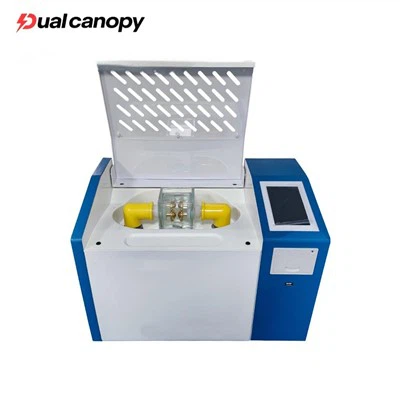
Dual Canopy Mechanic Electrical Engineering Co., Ltd. is one of the leading manufacturers and suppliers of Oil Dielectric Test Sets in China. Please feel free to wholesale discount products for sale here and get quotation from our factory. Customized orders are welcome.
What exactly does the "Oil Dielectric Test Sets" test?

Those who perform oil testing know that measuring the Oil Dielectric Test Sets (BDV, dielectric strength) of insulating oil is to check for the presence of moisture, fibrous impurities, or free carbon. This is the "lifeline" for determining whether transformer oil or cable oil can continue to be used. However, many testers complain that the same cup of oil, tested six times consecutively, yields data that fluctuates wildly with alarmingly large standard deviations; or new oil that appears (qualified) fails the test as soon as it's run. Why? Because oil withstand voltage testing has extremely stringent requirements for "electrode smoothness, oil cup cleanliness, voltage ramp-up uniformity, and breakdown arc extinguishing speed." Our Oil Dielectric Tester are specifically designed to solve these "mysterious" problems, using meticulous hardware and algorithm optimization to ensure consistently accurate breakdown data for every test.
How should I choose the style based on the occasion?
1. Single Cup Portable Set
(Power Supply Bureau On-site/Small Factory Daily Mainstay) Lightweight and durable. Built-in lithium battery, easy to carry with one hand. Suitable for on-site sampling inspections at substations and daily quality inspections in small transformer factories. Complies with standard GB/T 507 or IEC 60156.
2. 3-Cup Automatic Set (Highly Recommended)
(Standard Equipment for Oil Processing Centers/Third-Party Testing) Three oil cups with independent temperature control and independent testing. Automatically calculates the average and standard deviation, and automatically determines if dispersion exceeds the standard. 3 times more efficient than the single cup, suitable for throughput of dozens or hundreds of samples per day.
3. 6-Cup Multi-Standard Set
(Preferred by Major Transformer Manufacturers/Electrical Research Institutes/Overseas Companies) Supports simultaneous testing of 6 samples and includes a built-in global mainstream standard library. It can not only replace flat plates, but also VDE mushroom-shaped electrodes and ASTM ball-shaped electrodes, seamlessly switching between IEC, ASTM, and GB standards, and is specially designed for various export inspections and rigorous scientific research.
How to maintain and extend the lifespan of the Oil Dielectric Test Sets?
An oil dielectric test set is not a complicated instrument, but it is a high-voltage instrument. The way you treat it between tests usually determines whether it lasts five years or fifteen. Here is what we have learned about keeping these units reliable for the long haul.
1. Clean the cell and electrodes immediately after every test.
Do not let used oil sit in the cup while you finish paperwork. Once oil cools, sludge and carbon particles stick to the electrode surface, and the next breakdown will be harder to clean. We rinse the cup with clean, dry test solvent, wipe the electrodes with lint-free tissue, and leave the cell open to air-dry before storage.
2. Protect the electrode gap like a calibration standard.
The gap is a mechanical dimension, not a software setting. If the electrodes get knocked or the micrometer screw gets gritty, your readings will drift before you notice. After cleaning, check the gap with a feeler gauge. Never use the electrodes to stir oil or scrape residue-that is the fastest way to ruin the edge radius.
3. Calibrate with something real, not just the display.
Once a month, or at least before a critical testing run, verify the output voltage with a traceable high-voltage divider or a certified reference oil. The display can read correctly while the actual waveform is off. Record the result; if you see a trend of even 3–5 kV deviation, call service before it becomes a problem.
4. Inspect the high-voltage path.
Look at the HV cable, the connections, and the inside of the oil cup for tracking marks, corrosion, or oil residue. A small carbon trace near the high-voltage electrode is an early warning. If the unit has a spark gap or safety interlock, test it. These parts prevent small failures from becoming expensive ones.
5. Use the right oil, and keep it clean.
The oil you use for cleaning or flushing is just as important as the oil you test. We keep a separate container of filtered, dry mineral oil for rinsing, never use recycled transformer oil, and never mix different oil types. One bad sample can contaminate the cell for days.
6. Control the environment.
Humidity and dust are the two biggest killers of high-voltage equipment. If the unit lives in a service truck, keep it in a sealed case with desiccant. In a lab, do not store it near a window where condensation can form overnight. We have seen relays fail because the humidity was 90% and the lid was closed.
7. Move it like a precision instrument.
These units can survive field work, but they are not indestructible. Avoid stacking heavy cases on top of the test set, cushion it during transport, and let it reach ambient temperature before switching it on after a cold night. Thermal shock can affect both the HV transformer and the measurement electronics.
8. Keep the power clean.
Voltage spikes from generators or remote sites can damage the input supply and the control board. If you are running from a portable generator, use a stabilized source or a line conditioner. Always ground the unit properly; a floating ground is dangerous and hard on the electronics.
9. Follow the manufacturer's PM schedule.
Replace gaskets, O-rings, and electrodes on the interval the manual recommends, not when they finally fail. The HV relay is a common wear item; if it starts chattering or breakdown repeatability drops, that is often the first sign. A one-hour PM every six months is cheaper than a board-level repair.
10. Train the next operator.
Most premature failures come from misuse, not old age. Make sure anyone who picks up the set knows the cleaning routine, the correct oil fill level, and why the interlocks are there. A five-minute walkthrough at handover prevents a two-week repair.
What are some things to keep in mind when applying this technology in practice?
Oil dielectric testing looks simple on paper-raise the voltage across a sample until it breaks down, read the kV, done. But in the field, the number you see is only as trustworthy as the steps that came before it. Here are the practical things we always keep in mind when using an Oil Dielectric Test Set.
1. The sample is half the test.
We've seen perfectly good oil fail simply because the sample bottle was still damp, or because the oil sat in a hot service truck for six hours. Use a clean, dry glass or stainless-steel container, fill it to the brim to minimize headspace, and let the oil settle at the test temperature before you begin. If you can't test within a few hours, seal it and keep it cool.
2. Clean electrodes and a verified gap.
The 2.5 mm or 1 mm electrode gap is the single most critical dimension in this test. A tiny carbon track or a speck of lint changes the field enough to drop the breakdown voltage by 30–50%. Wipe electrodes with lint-free tissue and clean solvent before each run, and check the gap with a gauge at the start of every shift or whenever the operator changes.
3. Temperature matters more than people think.
Breakdown voltage is sensitive to temperature, but it doesn't move in a neat straight line. Don't test oil straight out of a hot transformer if you can avoid it. Most labs report at 20 °C. If you're testing at ambient, record the temperature and trend the results rather than comparing raw numbers taken in different seasons.
4. Ramp rate and rest time are part of the standard.
ASTM D877, D1816, and IEC 60156 each specify a voltage rise and a rest period between breakdowns. Rushing the test to save time will give you higher-or oddly scattered-readings. We usually rest the oil at least one minute between strikes, longer if the sample looks heavily contaminated.
5. Calibrate against the measurement, not just the display.
The digital kV readout can drift, but so can the electrode geometry, oil cup alignment, and the waveform. Run a reference oil or use a certified high-voltage divider check at least monthly. If your test set has a voltage verification kit, use it.
6. One number is not a diagnosis.
A low BDV tells you something is wrong, but not what. Combine it with moisture, acidity, particle count, and dissolved gas analysis before you decide to reclaim or replace the oil. We treat BDV as a screening tool, not the final verdict.
7. Safety is non-negotiable.
These testers generate tens of kilovolts. Use the interlocks, wear appropriate PPE, and ground the cell before handling electrodes. If the unit is on a service truck, bond the truck to the transformer tank before sampling.
8. Keep records someone can actually read next year.
A year from now, someone will want to know why the value dipped in March. Record sample location, temperature, oil type, test standard, electrode condition, operator, and weather. A quick photo of the oil sample and electrodes can save a lot of arguments later.
9. Train the operator, not just the instrument.
The same BDV set can produce two different results in two different hands. Build a short checklist and make sure the team follows it every time. Consistency beats speed.
10. Know when to stop and call a full lab.
If the results are erratic, the oil is foaming, discolored, or contains free water, pause. Field BDV is useful, but some samples need a full lab suite before you can trust the diagnosis.
In short, treat the BDV value as the end of a chain that starts with a clean sample, a calibrated setup, and a disciplined procedure. Get the upstream steps right, and the downstream number will actually mean something.
.
After-sales Service
Warranty Policy: 24-month warranty on the entire machine (excluding damage caused by human error and consumables).
Lifetime Maintenance: Lifetime paid repair service provided after the warranty period, charging only the cost of materials.

How can stable Oil Dielectric Test Sets be manufactured through rigorous production processes?
Three-coordinate measuring machine (CMM): After each oil cup and electrode assembly, it must be marked with a CMM to ensure that the parallelism, concentricity, and spacing errors of the electrodes are within ±0.01mm.
High-voltage linearity calibration: The factory's high-voltage laboratory is equipped with a 0.1-grade high-precision high-voltage divider and a digital high-voltage meter. Before each instrument leaves the factory, the voltage boost linearity must be calibrated across the entire range, with the error controlled within ±1%.
FAQ
1. Q: Why is there such a large data dispersion (standard deviation exceeds the limit) when testing the same cup of oil 6 times?
A: There are usually three reasons: 1) The oil cup or electrode was not cleaned properly, leaving residual fibers or free carbon; 2) Tiny air bubbles were introduced when pouring the oil; 3) The oil sample itself is uneven (e.g., water and impurities have settled due to prolonged standing time). Recommendation: Thoroughly clean the oil cup, take a new sample, pour the oil, and let it stand for a sufficient amount of time (usually 10-15 minutes) before testing.
2. Q: What is the difference between IEC 60156 and ASTM D1816? Which electrode should I buy?
A:
IEC 60156 / GB/T 507: Uses flat electrodes with a spacing of 2.5mm. Most commonly used in domestic power grids and conventional transformer factories.
ASTM D1816: Uses VDE mushroom-shaped electrodes, with a spacing typically of 1mm or 2mm. More sensitive to minute moisture and impurities in the oil, it is often used in ultra-high voltage transformers, export equipment, or scientific research.
If you are unsure, we recommend purchasing our "Multi-Standard Version" to equip both types of electrodes for easy switching.
3. Q: What does it mean when the instrument displays "Abnormal Voltage Boost" or "Alarm Before Breakdown"?
A: This is most likely due to dirt or moisture on the outside of the oil cup or the insulating supports of the high-voltage chamber, causing surface flashover (leakage) at the high voltage. The instrument mistakenly interprets this as oil sample breakdown. Please wipe all insulating components inside the high-voltage chamber with anhydrous ethanol and dry them with a hairdryer.
Hot Tags: Oil Dielectric Test Sets, China Oil Dielectric Test Sets manufacturers, suppliers, factory, bdv oil dielectric tester