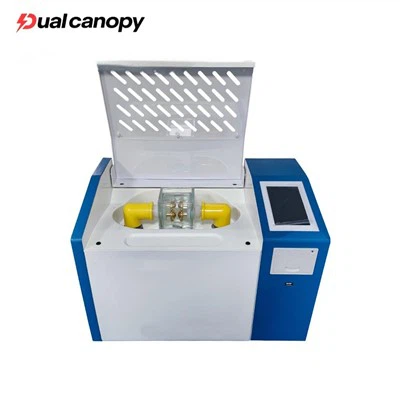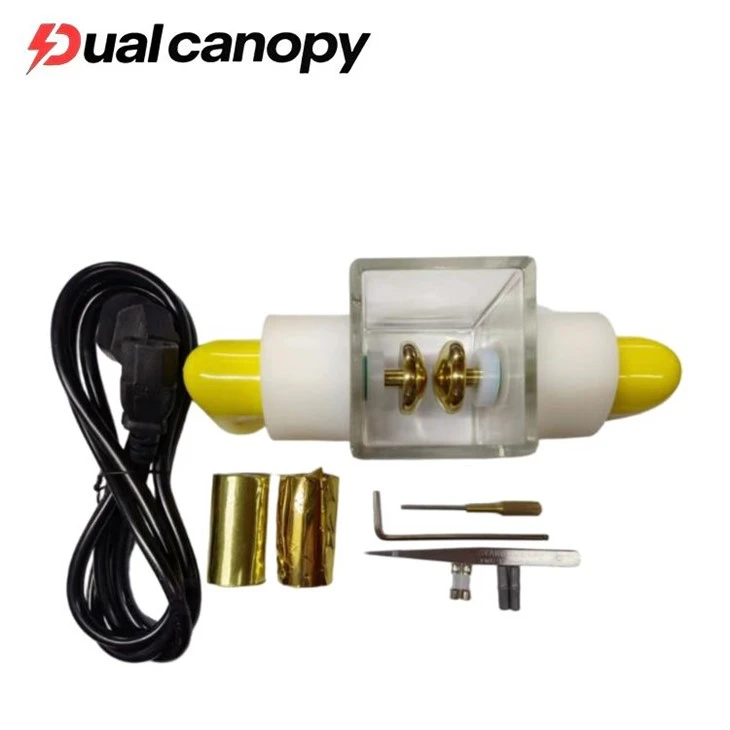


Dual Canopy Mechanic Electrical Engineering Co., Ltd. is one of the leading manufacturers and suppliers of upgraded insulation oil dielectric strength tester in China. Please feel free to wholesale discount products for sale here and get quotation from our factory. Customized orders are welcome.
What is Upgraded Insulation Oil Dielectric Strength Tester?

An Insulation oil sample is placed between a pair of electrodes. The instrument gradually increases the AC or DC voltage between the electrodes using a voltage regulator. When the voltage reaches a certain value, the dielectric molecular structure within the Insulation oil is destroyed, creating an ionization channel and a breakdown current. The voltage at this point is the breakdown voltage of the Insulation oil. By measuring the distance between the electrodes, the dielectric strength of the Insulation oil is calculated according to the formula "Dielectric strength = breakdown voltage / electrode spacing".
Fully Automated Operation:
Microcomputer-controlled, it automatically completes steps including voltage increase, stirring, settling, testing, data processing, and printing.


High-Precision Measurement:
Utilizing advanced electronic measurement technology and high-precision sensors, it accurately measures the breakdown voltage and dielectric strength of insulating oil. Some instruments also feature automatic averaging.
Safe and Reliable:
Multiple protections are provided, including overcurrent, overvoltage, and short-circuit protection, as well as automatic zero return and self-test functions.
Multiple Test Modes:
Typically, modes include fully automatic six-shot testing and fully automatic single-shot testing. Some instruments also support various electrode configurations and gap adjustments to accommodate different specifications and types of insulating oil samples.
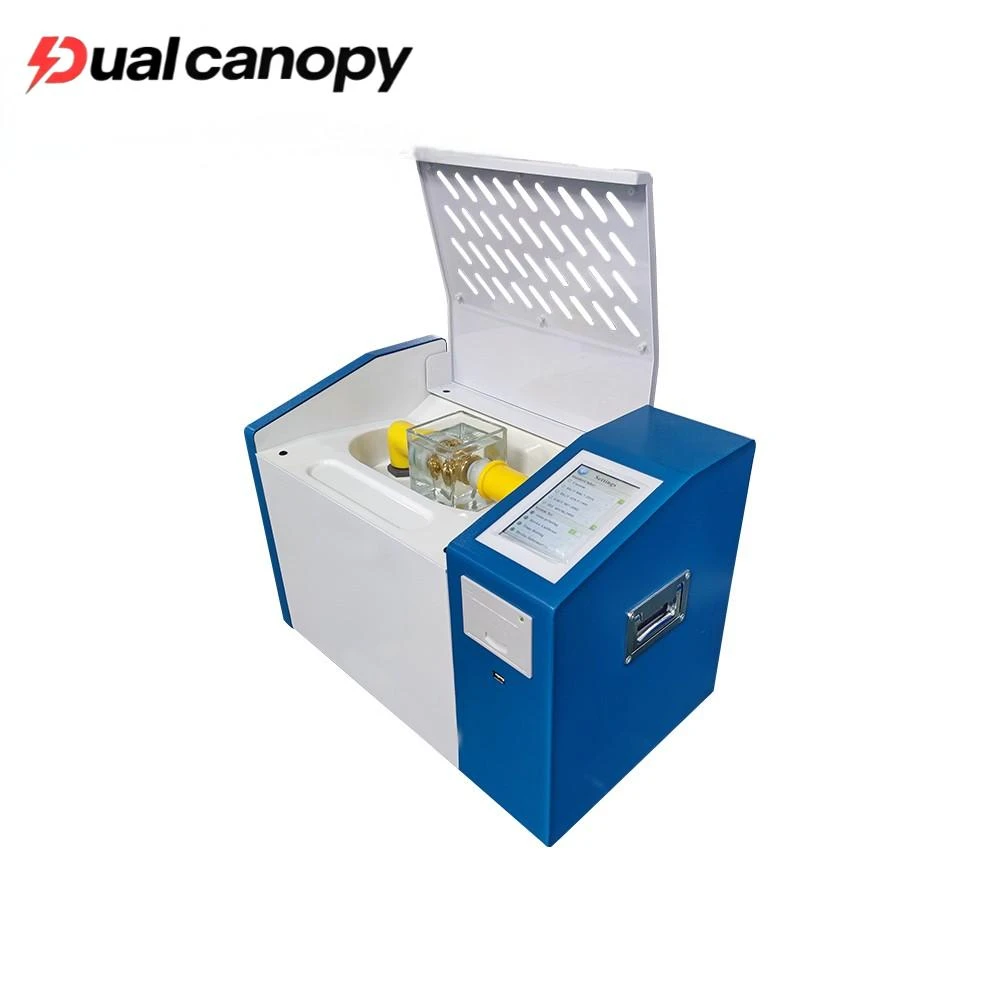
Why must customers regularly test the breakdown voltage of insulating oil?
In accordance with general guidelines such as IEEE C57.106 and IEC 60296, new transformer oil typically requires a minimum breakdown voltage of ≥ 30 kV (per ASTM D877) prior to use, while aged oil (Group 1) in service within equipment rated at ≥ 230 kV must maintain a breakdown voltage of ≥ 50 kV. Falling below these thresholds indicates the potential presence of moisture, particulates, or dissolved gases, posing safety risks such as inter-turn breakdown, phase-to-phase short circuits, or even explosions. Our equipment enables the completion of a full six-test breakdown sequence-including automatic calculation of the average value-within 2 to 10 minutes; this boosts efficiency by approximately 70% compared to manual testing while significantly reducing the physical workload and risk of electric shock for on-site personnel.
What technical features does the upgraded insulating oil dielectric strength tester incorporate?
Fully automated testing process: Voltage ramp-up → Hold → Stirring → Resting → Breakdown detection → Calculation → Printing.
Functional description: Operators simply configure the number of tests (1–9), stirring time (0–99 seconds), and resting time (0–639 seconds) via the 5-inch color touchscreen. Upon pressing "Start," the device automatically executes the entire sequence and prints the six breakdown voltage readings and their average value after testing concludes.
Significance: Traditional manual testing requires two operators-one to ramp up the voltage and another to monitor the oscilloscope-resulting in low efficiency and subjective error. By integrating a PLC/microcontroller system, SCR-based voltage regulation, and magnetic stirring, we have reduced the time for a complete test cycle from 15 minutes to under 8 minutes, while maintaining a repeatability error of ≤ 2%.
Data support: Complies with the precision requirements for automatic voltage ramp-up rates (2 kV/s ±10%) as specified in GB/T 507-2002, "Determination of Dielectric Strength of Insulating Oil."
What procedures must be followed to ensure operator safety and the accuracy of test data?
1) Reliable grounding is mandatory: The equipment comes with a dedicated grounding cable. Before operation, ensure the grounding terminal is securely connected to the laboratory earth ground (grounding resistance ≤ 4 Ω); otherwise, static electricity may damage internal components or cause reading drift.
2) Operating environment: Operating temperature 0–40°C, relative humidity < 85% RH, altitude ≤ 2000 m. Humid environments can cause discharge at high-voltage terminals; the use of a dehumidifier is recommended.
3) Power supply requirements: AC 220 V ±10%. Do not share the circuit with high-power inductive loads (e.g., electric welders, variable frequency drives) to prevent grid fluctuations from causing a loss of control during the voltage-boosting process.
4) Oil sample preparation: Before testing, rinse the oil cup at least twice with the oil sample to be tested to avoid cross-contamination. New oil cups must be cleaned with petroleum ether or benzene and dried before initial use.
5) Electrode inspection: Visually inspect the electrode surfaces every 50 tests or at least once a month. Replace immediately if edges show significant blunting or signs of arcing/pitting; per ASTM D877 Section 6.2, blunt edges can cause the Breakdown Voltage (BDV) reading to be artificially high by 8–15%.
6) Operating distance: During high-voltage testing, the operator must maintain a safety distance of at least 1 meter from the oil cup and wear insulating gloves.
7) No hot-swapping: Before replacing the oil cup or cleaning electrodes, turn off the high-voltage output, disconnect the power supply, and wait at least 30 seconds for internal capacitors to discharge completely.
8) Handling precautions: The unit weighs approximately 29 kg. Use the provided handles or a cart for transport; do not lift the unit by the front panel, as this may damage the display screen.
9) Children and unauthorized personnel: Post warning signs in the laboratory. Unauthorized personnel and children are strictly prohibited from entering within a 3-meter radius of the equipment during high-voltage testing.
Our address
Baoding Cloud Center, Hebei, China
Phone Number
+86 13483219412
Salesm@dualcanopy.com

Do you have any recommendations for upgraded insulation oil dielectric strength testers?
Available in single-cup, three-cup, and six-cup configurations.
Functional Description: We offer options tailored to specific throughput requirements:
Single-cup (1 cup): Suitable for on-site testing and small laboratories.
Three-cup (3 cups): Allows simultaneous testing of three oil samples with parallel processing.
Six-cup (6 cups): The preferred choice for high-volume factory QC testing.
Why it matters: Wholesale clients often require both on-site maintenance capabilities (portable, compact units) and factory-level batch testing (high-efficiency, larger units). Sourcing multiple models from a single supplier helps reduce procurement and management costs.
FAQ
Q1: What is the aging test and factory inspection process?
A: Every unit undergoes a mandatory 24-hour aging test, during which the voltage is repeatedly ramped up to full scale 50 times to simulate three months of field usage intensity.
Q2: What is your delivery lead time?
A: OEM/customized models: 15–25 working days (includes logo screen printing, manual layout, and color box design).
Q3: What quality certifications do you hold?
A: ISO 9001:2015 Quality Management System certification (certificate number verifiable).
CE certification (EU EMC + LVD directives).
Products comply with multiple international and domestic standards, including IEC 60156, ASTM D877, ASTM D1816, GB/T 507-2002, DL/T 846.7-2016, DL/T 474.4-2018, and DL/T 596-2015.
Hot Tags: upgraded Insulation oil dielectric strength tester, China upgraded Insulation oil dielectric strength tester manufacturers, suppliers, factory, bdv oil dielectric tester