

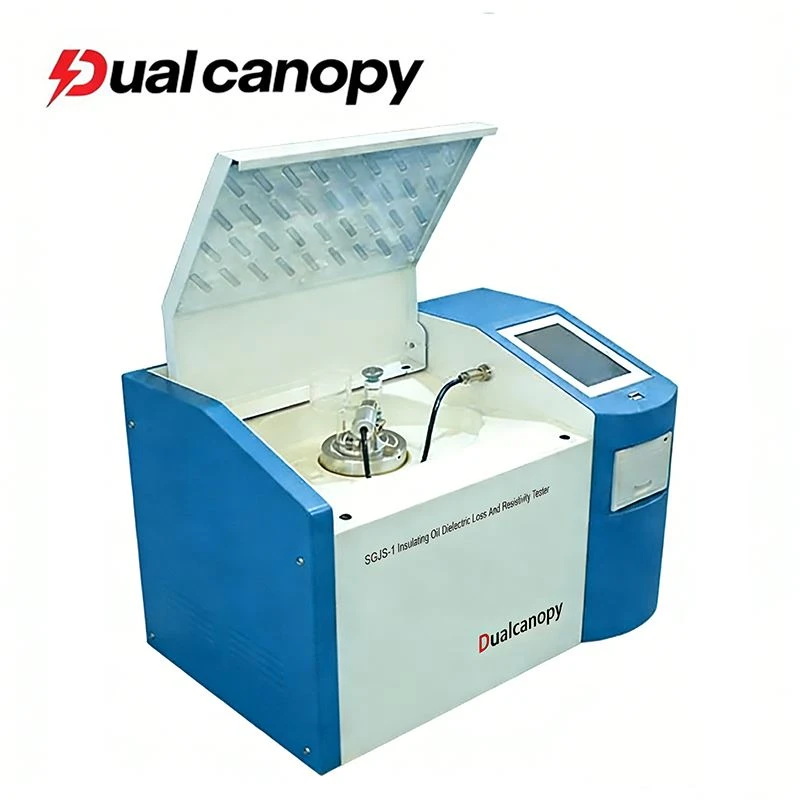

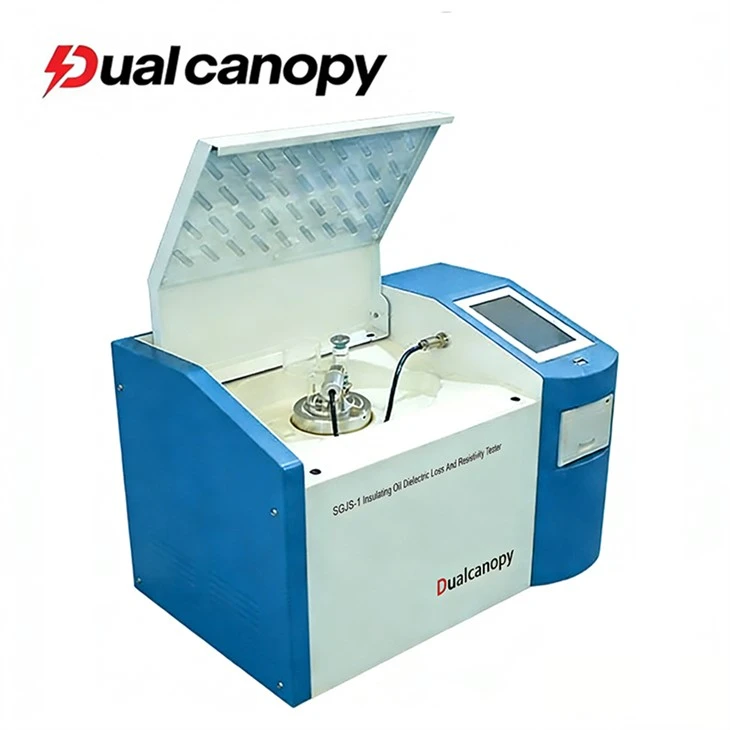

Dual Canopy Mechanic Electrical Engineering Co., Ltd. is one of the leading manufacturers and suppliers of insulating oil dielectric loss tester sgjs-1 tan delta test set in China. Please feel free to wholesale discount products for sale here and get quotation from our factory. Customized orders are welcome.
What Is an Insulating Oil Dielectric Loss Tester?
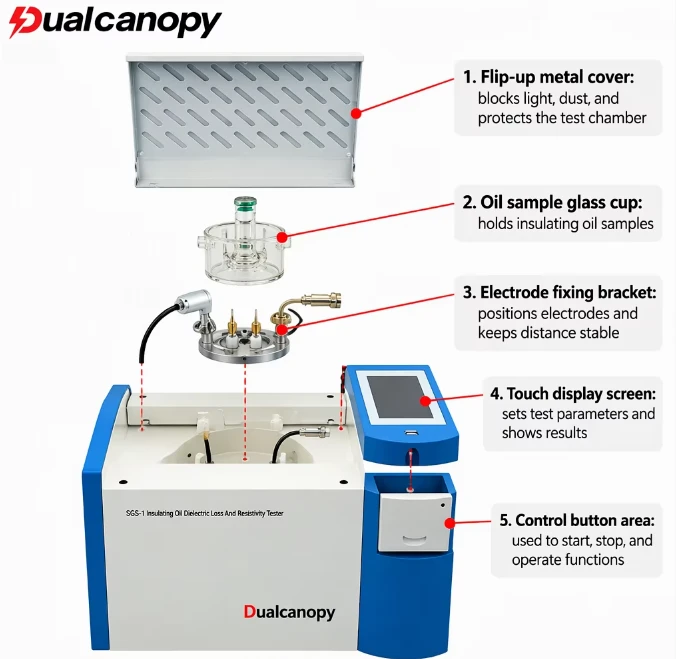
An insulating oil dielectric loss tester measures how much energy an oil sample loses as heat when it sits in an alternating electric field. That loss is reported as the dissipation factor, usually written tan δ. The same test gives relative permittivity and the capacitance of the oil cup, so maintenance staff can judge the condition of transformer and switchgear oil. The SGJS-1 handles heating, voltage application and calculation in one sequence, and the method follows GB/T 5654-2007..
What Features Does the SGJS-1 Dielectric Loss Tester Offer?
A three-electrode oil cup with 2 mm electrode spacing. The layout reduces the effect of stray capacitance and leakage on tan δ readings.
Medium-frequency induction heating with PID control. The heater does not touch the cup, so heat spreads evenly and oil temperature stays inside the preset window.
An SF gas-filled three-electrode standard capacitor. Its capacitance and loss hold steady despite changes in ambient temperature and humidity.
An AC-DC-AC test power supply. Readings stay stable when mains voltage or frequency fluctuates, including when the site runs on a generator.
A backlit color LCD with step-by-step English prompts. Each result is saved with its date and time.
What Are the Advantages of an Automatic Oil Dielectric Loss Tester?
Most error in tan δ work comes from handling, not from the bridge itself: a cup seated slightly off, electrodes that were not fully dried, or oil temperature drifting while the operator waits. The SGJS-1 removes much of that. Once the cup is clean and seated, the instrument heats the oil, sets the voltage and takes the reading without manual adjustment. If it detects overvoltage, overcurrent or a high-voltage short, it cuts the high voltage and shows a warning, which protects both the sample and the person at the bench.
What Benefits Can a Laboratory Gain From a Tan Delta Oil Tester?
Less bench time per sample, so a batch of oil moves through the lab faster.
Fewer transcription mistakes, because results are stored with date, time and test settings.
Up to 100 stored test pages for review or printing. This helps when you need to compare oil over several months.
A built-in empty cup calibration gives a documented check of cup cleanliness before a test series.
Technicians without specialized training can run it, since the menu guides each step.
What Are the Technical Specifications of the SGJS-1?
| Item | Parameter |
|---|---|
| Power supply | AC 220V ±10%, 50/60Hz ±1% |
| Capacitance range | 5 pF to 200 pF |
| Capacitance accuracy | ±(1% of reading + 0.5 pF) |
| Dissipation factor (tan δ) range | 0.00001 to 100 |
| Dissipation factor accuracy | ±(1% of reading + 0.0001) |
| Relative permittivity range | 1.000 to 30.000 |
| Relative permittivity accuracy | ±1% of reading |
| Test temperature | 0 to 120 °C |
| Temperature error | ±0.5 °C |
| AC test voltage | 500 to 2000 V, 50 Hz, adjustable |
| Power consumption | 100 W |
| Dimensions | 500 × 360 × 420 mm |
| Gross weight | 22 kg |
What Test Modes Does the Dielectric Loss Tester Support?
| Mode | What It Reports | Typical Use |
|---|---|---|
| Dissipation factor and permittivity | tan δ, εr, cell capacitance Cx | Routine oil condition checks |
| Empty cup calibration | Empty cup capacitance Ca, empty cup tan δ | Checking cup cleanliness and assembly before testing |
| DC resistivity (combined run) | Resistivity ρ | Selected together with tan δ in one session. See our insulating oil resistivity tester page for details. |
Where Is Insulating Oil Dielectric Loss Testing Used?
Condition monitoring of transformer and reactor oil at substations
Acceptance testing of insulating oil at manufacturing or delivery
Quality checks at oil filtration and reclamation plants
Maintenance laboratories at power plants and industrial sites
University and research labs studying liquid dielectrics
FAQ
What standard does the SGJS-1 follow?
It is designed according to GB/T 5654-2007, which covers measurement of relative permittivity, dielectric dissipation factor and DC resistivity of liquid insulating materials.
Why is my tan δ reading affected by the empty cup?
Dust, moisture or incorrect electrode alignment change the empty cup capacitance and loss. The empty cup calibration function checks this before testing. If the capacitance is outside 60 ±5 pF, the instrument prompts you to recalibrate.
How much oil does each test need?
About 40 mL fills the cup. Let the sample rest for at least 15 minutes after filling so air bubbles can escape.
Hot Tags: insulating oil dielectric loss tester sgjs-1 tan delta test set, China insulating oil dielectric loss tester sgjs-1 tan delta test set manufacturers, suppliers, factory


