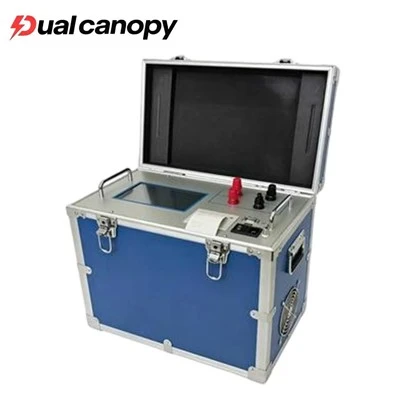
Dual Canopy Mechanic Electrical Engineering Co., Ltd. is one of the leading manufacturers and suppliers of lightning arrester/leakage tester in China. Please feel free to wholesale discount products for sale here and get quotation from our factory. Customized orders are welcome.
What is Resistive Current Testing in Zinc Oxide Surge Arresters?

Resistive Current Testing is a critical analytical procedure used to quantify the resistive component of total leakage current passing through a metal oxide arrester (MOA). An operational zinc oxide varistor block behaves primarily as a capacitor under normal grid operating voltage, conducting less than 1–2 mA of total current, of which over 85–90% is capacitive. However, when the zinc oxide ceramic microstructure deteriorates due to impulse aging, thermal fatigue, or internal moisture ingress, the resistive leakage current (Ir) increases exponentially. Measuring the fundamental resistive current peak (Ir1p) and harmonic content is the industry standard method for detecting varistor aging prior to catastrophic thermal collapse..
What Makes Advanced Fourier Harmonic Analysis Superior for MOA Diagnostics?
Precise Fundamental Wave Extraction: High-precision Fourier transform algorithms isolate the 50Hz/60Hz fundamental resistive current (Ir1p = Ix1p sinΦ) from the total leakage signal with mathematical rigor.
3rd, 5th, and 7th Harmonic Decomposition: Non-linear degradation of zinc oxide varistors produces characteristic odd-order harmonics. Quantifying the 3rd harmonic resistive peak (Ir3p) provides an early warning indicator of moisture ingress inside the arrester housing.
Active Power Dissipation (P1) Calculation: Computes the true active power loss expressed as the product of fundamental resistive current and fundamental reference voltage, reflecting the actual thermal heat generated inside the varistor column.
Immunity to Grid Harmonic Distortion: Digital filtering removes background harmonic distortion present in substation voltage busbars, ensuring that reported harmonic peaks represent true arrester condition rather than power quality noise.
Objective Diagnostic Quality Ranking: Automatically correlates the lead angle (Φ) with diagnostic condition scales (ranging from "Poor" below 75° to "Excellent" above 88°) to help technicians make immediate replacement decisions.
How Many Types of Arrester Diagnostic Instruments Are Available for Utilities?
In the global power testing equipment market, instruments designed for surge arrester maintenance are divided into three distinct diagnostic classes:
Microprocessor Fourier Harmonic Analyzers (Class I - Premium): Advanced diagnostic units like the Dual Canopy SGYB-1 that measure full current, resistive fundamental peaks, harmonics, and active power with digital touchscreen UI and Bluetooth reporting.
Basic Analog/Digital RMS Current Milliammeters (Class II - Intermediate): Basic meters that measure only the root-mean-square (RMS) value of total leakage current without phase angle separation or harmonic analysis.
Insulation Resistance & DC High-Voltage Testers (Class III - Static): Offline DC test sets used to measure 1mA DC reference voltage (U1mA) and leakage current at 0.75·U1mA during de-energized maintenance work.
Where is Resistive Harmonic Diagnostics Applied in Electrical Engineering?
High-Voltage Equipment Manufacturing: Used by surge arrester producers to conduct routine factory quality inspection and verify that resistive current leakage meets IEC C62.11 / GB 11032 specifications.
New Substation Commissioning Acceptance: Establishing baseline resistive current fingerprints for newly installed metal oxide arresters before placing them into active utility service.
Forensic Failure & Root-Cause Investigation: Analyzing decommissioned arresters in high-voltage laboratories to determine whether failure resulted from moisture sealing defects or excessive overvoltage surges.
Electrical Testing & Calibration Service Providers: Employed by third-party engineering contractors who provide preventative predictive maintenance testing for industrial plants and grid utilities.
What do software craftsmanship, interconnectivity, and data processing systems entail?
The diagnostic software embedded within Dual Canopy's analyzers is designed for seamless data governance. Users can input customized alphanumeric asset names prior to testing, ensuring every record is tied to a specific substation arrester ID. The system features bilingual firmware (Chinese/English) switchable with a single touch. Operators can view real-time voltage and current waveforms directly on screen or switch to a harmonic bar-graph display. Through an integrated Bluetooth module, technicians can connect an Android device via a dedicated WeChat Mini-Program or mobile application to control tests, log data, and generate client-ready inspection reports from the field.
Craftsmanship, Hardware Design & Core Components
The SGYB-1 is built with an industrial-grade ABS/aluminum alloy chassis that resists mechanical vibration, dust, and light moisture in harsh substation environments. Its internal architecture separates high-voltage signal processing from low-voltage microprocessor controls to prevent cross-talk. All voltage test leads are equipped with built-in 100mA protective fuses and anti-misconnection aviation plugs to safeguard the hardware against accidental over-voltage. The instrument features a precision real-time clock chip for reliable time-stamping and a standard USB host interface that allows instant export of test logs to flash drives.
Why is Dual Canopy the preferred supplier when purchasing products?
Factory-Direct Procurement Advantage: Partnering directly with Hebei Dual Canopy eliminates third-party trading company markups, allowing distributors to win competitive utility tenders with superior pricing.
Comprehensive International Certifications: Our manufacturing facility adheres to strict ISO quality standards, and our diagnostic instruments carry CE and EMC certifications for seamless customs clearance worldwide.
Full OEM/ODM Brand Customization: We offer private label customization, including custom startup logos, branded enclosure colors, and localized firmware languages for regional equipment distributors.
Flexible MOQ & Wholesale Trade Terms: Whether sourcing a single demo unit for evaluation or a bulk shipment for utility network upgrades, we support flexible minimum order quantities and secure commercial terms.
Dedicated R&D Engineering Support: Our in-house engineering team continuously updates our signal processing firmware and mobile apps, providing our B2B partners with future-ready diagnostic capabilities.

FAQ
Q1: Why does resistive current increase when a zinc oxide arrester absorbs moisture?
Answer: Moisture ingress creates a conductive electrolyte film along the outer surface of the zinc oxide varistor block or inner porcelain/silicone housing. This parallel resistive path increases resistive leakage current and elevates the 3rd harmonic component significantly.
Q2: How do I interpret the fundamental power dissipation (P1) reading?
Answer: Fundamental power dissipation P1 represents the real electrical power converted into heat inside the arrester block. A sudden rise in P1 compared to historical commissioning baseline records warns of imminent thermal runaway and indicates the arrester should be taken out of service.
Q3: What is the benefit of the Android mobile app connection via Bluetooth?
Answer: The mobile app allows operators to control the instrument from a safe distance, monitor real-time waveforms on a smartphone, store unlimited records in mobile memory, and instantly email diagnostic spreadsheets to supervisors.
Hot Tags: lightning arrester/leakage tester, China lightning arrester/leakage tester manufacturers, suppliers, factory, SF6 AC HI POT TESTER, sf6 analyzer, sf6 test equipment, sf6 test gas, SF6 Testing, sf6 Type in transformers