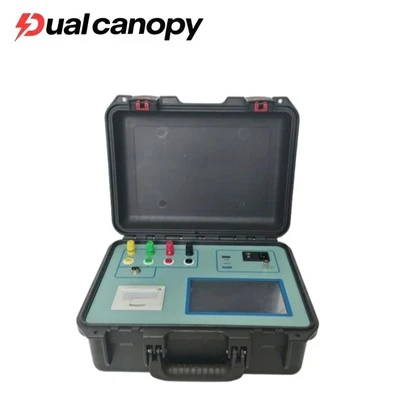
Dual Canopy Mechanic Electrical Engineering Co., Ltd. is one of the leading manufacturers and suppliers of handheld ratio tester in China. Please feel free to wholesale discount products for sale here and get quotation from our factory. Customized orders are welcome.
What is Handheld Ratio Tester?

The handheld transformer ratio tester is a portable power testing device specifically designed for measuring parameters such as the ratio (turn ratio), polarity, connection group, and excitation current of transformers. Its core function is to verify the accuracy of the turn ratio of transformer windings, ensuring the normal operation of transformers in the power system. At the same time, this device can also assist in troubleshooting issues such as winding short circuits, inter-turn faults, or incorrect wiring, which is of great significance for ensuring the stability and safety of the power system.
What steps are involved in the working principle?
Ratio measurement principle
Voltage method: The tester applies a known low-voltage alternating current signal (such as 220V or the built-in power supply of the instrument) to the high-voltage side of the transformer, and measures the induced voltage on the low-voltage side. By calculating the ratio of the voltages on the high-voltage and low-voltage sides, the transformer's transformation ratio can be determined. If the deviation of the transformation ratio from the rated value exceeds the allowable range (typically ±0.5%), it is judged as abnormal.
Current method (supported by some high-end instruments): By injecting an electrical current signal into one side of the winding, measure the current on the other side, and combine impedance parameters to indirectly calculate the transformation ratio. This method can provide more accurate measurement results under certain circumstances.
Connection group and polarity determination
Phase difference measurement: The tester compares the phase difference between the voltage waveforms on the high-voltage side and the low-voltage side, and combines vector relationships (such as 30°, 60°, etc.) to determine the connection group of the transformer (such as Yyn0, Dyn11, etc.).
Polarity verification: Through instantaneous polarity detection (such as the impulse method), it is determined whether the corresponding terminals are consistent. Polarity verification is of vital importance for ensuring the correct wiring of the transformer and its normal operation.
Excitation current measurement
Some instruments can measure the no-load excitation current, which helps to determine whether there is a local short circuit or insulation deterioration in the core or windings. The magnitude and changes of the excitation current can reflect the health condition of the transformer's core and windings.
Digital processing
Modern handheld testers integrate high-speed AD sampling, digital signal processing (DSP), and automatic calibration functions, enabling them to directly display data such as ratio error, group type, and waveform. These features give the testers higher measurement accuracy and stronger data processing capabilities.

What are the available options for test modes?

The following is the typical operation procedure for a handheld ratio tester (taking single-phase or three-phase transformers as an example):
Preparation before the test
Power off and discharge: Ensure that the transformer is completely powered off and discharge the windings to prevent residual charges from affecting the test.
Circuit connection preparation: According to the connection method of the transformer (single-phase or three-phase), connect the high-voltage side and low-voltage side of the tester to the corresponding terminals respectively. For three-phase transformers, connect the terminals of each phase according to the connection methods such as Y and D, and select the corresponding test mode.
Parameter settings
Input the rated ratio, rated frequency, connection group, etc. of the transformer. These parameters form the basis for the tester to perform calculations and make judgments.
Test execution
Automatic mode: After the test is initiated, the instrument automatically applies voltage and collects data. After the test is completed, the instrument will directly display the actual transformation ratio, the percentage error compared to the rated value, the connection group, polarity, and three-phase imbalance degree (for three-phase transformers), etc. as the results.
Manual Mode (Special Conditions): In exceptional circumstances, users can customize the test voltage or conduct step-by-step measurements. This offers greater flexibility and adaptability.
Result analysis and fault determination
Based on the test results, analyze possible causes such as ratio error, group mismatch, abnormal excitation current, etc. These causes may include inter-winding short circuits of the windings, poor contact of the tap changer, incorrect wiring, or abnormal connections of the internal windings of the transformer, etc.
What are the application scenarios for handheld ratio tester?
Transformer factory acceptance or installation and commissioning: Ensure that all parameters of the transformer meet the design requirements before it is put into operation.
Preventive tests (regular detection of ratio stability): Timely identify and handle potential faults to ensure the long-term stable operation of the transformer.
Fault detection (such as short circuit, inter-turn faults, abnormal tap changer): Quickly locate and repair faults to reduce power outage time and losses.
Verification of winding connection correctness after renovation or maintenance: Ensure that the transformer after renovation or maintenance has correct winding connections.
What are the features and advantages of this equipment?
1) Truly Handheld and Portable: Lightweight and operable with one hand
Functional Description: The unit weighs approximately 1.0–2.0 kg (including battery) and measures roughly 240 × 115 × 50 mm, allowing for full operation while held in one hand. The casing features a dual-layer shock-resistant design (engineering plastic + silicone); it has passed MIL-STD-810G vibration/shock testing and offers IP54 dust and splash resistance.
Why It Matters: Traditional benchtop transformer turns ratio bridges weigh 15–30 kg and require a cart for transport. Our handheld model enables field engineers to perform tests without bending or kneeling and allows a single operator to test over 30 transformers a day-a critical advantage for remote substations, mountainous wind farms, and overseas project sites.
Data Support: Comparable to international models in the same class, such as the Megger TTR20-1 (1.3 kg) and TTRU1 (1.0 kg); domestic models at similar price points generally weigh 5 kg or more, lagging behind in portability.
2) Ultra-Wide Turns Ratio Range: 0.8 to 20,000 (customizable up to 50,000)
Functional Description: The turns ratio measurement range spans 0.8 to 20,000 with 5-digit resolution; high-end custom versions can reach 50,000, covering all scenarios from miniature CTs (0.8:1) to UHV/EHV transformers (20,000:1).
Why It Matters: A single range cannot meet the needs of customers across diverse scenarios. For instance, a 1000 kV UHV transformer may have a turns ratio of 10,000:1, whereas a 10 kV distribution CT might be only 50:1. A single device covering the entire range means your wholesale customer base can expand from distribution maintenance companies to UHV operations and maintenance units, broadening the application scope by 3 to 5 times. Data-backed performance: Compared to the Megger TTR20-1 (10,000:1 ratio range) and TTR25-1 (20,000:1 ratio range), our device matches the range of their top-tier model while offering superior accuracy at the low end (0.8:1), making it suitable for current transformer (CT) testing.
What services do we offer?
After-sales Service
Warranty Policy: 12-month warranty on the entire machine (excluding damage caused by human error and consumables).
Lifetime Maintenance: Lifetime paid repair service provided after the warranty period, charging only the cost of materials.
Rapid Response: 24/7 technical support hotline, fault response time < 2 hours.

What are the key precautions to observe when using the Handheld Ratio Tester?
1) Power off, discharge, and ground before testing: Before testing, disconnect all transformer windings from the power grid and fully discharge them using a grounding rod (for at least 5 minutes) to prevent residual charge or induced voltage from damaging the tester or endangering personal safety.
2) Avoid connecting leads while energized: Test leads must be connected only when the transformer is completely de-energized; connecting leads while the equipment is live can cause induced voltage to instantly damage the tester's internal circuitry.
3) Check terminals: Visually inspect the test clips before each test to ensure adequate spring tension and intact insulation; oxidation on the clips increases contact resistance, which can cause the measured turns ratio to read 0.2–0.5% higher than the actual value.
4) Ambient temperature effects: Temperature has a minimal impact on turns ratio measurements (temperature drift of the core magnetization curve is < 0.05%/10°C); however, LCD response slows at low temperatures (< −10°C). If operating at −20°C, it is recommended to power on the device and let it warm up for 3 minutes first.
5) Strong electromagnetic interference: When working in 500 kV substations or near large variable-frequency drives, maintain a distance of at least 5 meters from high-voltage busbars to prevent electromagnetic radiation from interfering with A/D sampling.
6) Battery maintenance: Avoid storing the lithium battery at 0% charge for extended periods (this can permanently damage the cells); when not in use for a long time, store it with a 50–80% charge in a dry environment.
7) Do not connect/disconnect USB while powered on: Never plug in or unplug the USB data cable while a test is in progress, as this may damage the firmware.
8) Children and unauthorized personnel: Set up warning signs at the test site and ensure unauthorized personnel remain at least 2 meters away from the testing area.
9) Stop immediately in case of abnormalities: If unusual noises, odors, or smoke occur during testing, turn off the power immediately and contact the manufacturer; do not attempt to inspect the unit while it is energized.
FAQ
Q1: What quality certifications do you hold?
A: ISO 9001:2015 Quality Management System certification (certificate number verifiable).
CE certification (EU LVD + EMC directives).
Product designs comply with international and domestic standards such as IEC 61010-1:2010, IEC 61326-1, IEC 60076-1, IEEE C57.12.90-2021, GB 1094.1-2013, and DL/T 596-2021.
Q2: What are your lead times?
A: Standard models (in stock): Shipment within 7 working days for orders of up to 500 units.
OEM/Customized models: 15–25 working days (includes logo screen printing, manual layout, and color box design).
Q3: Are you a factory or a trading company?
A: We operate our own factory located in the heart of China's electric power instrumentation industrial cluster. We possess end-to-end capabilities covering R&D, production, sales, and after-sales service, and we welcome customer visits for factory inspections at any time.
Hot Tags: handheld ratio tester, China handheld ratio tester manufacturers, suppliers, factory, Transformer turns ratio testing, power turns ratio analyser, power testing equipment, 3 phase transformer turns ratio analyser, power turns ratio meter