


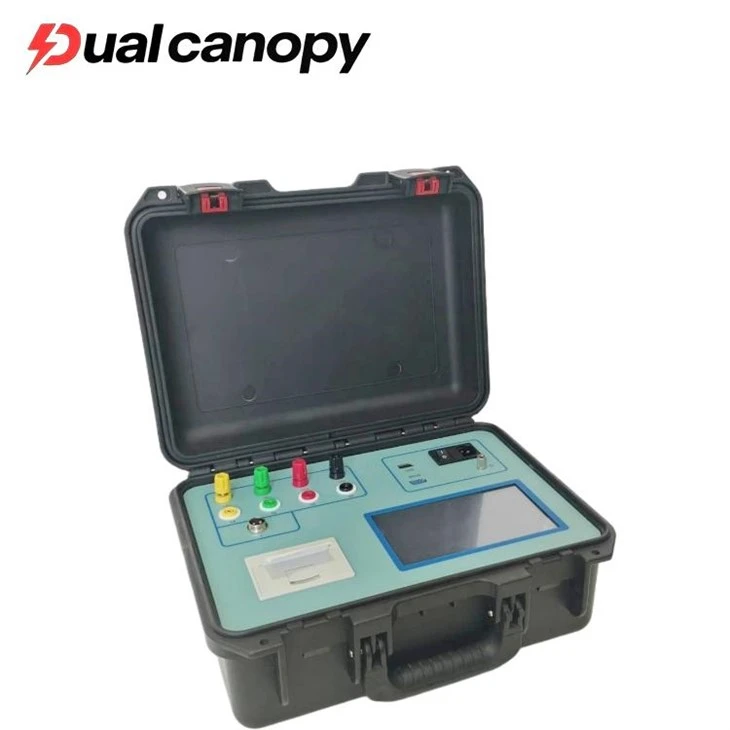


Dual Canopy Mechanic Electrical Engineering Co., Ltd. is one of the leading manufacturers and suppliers of capacitance and inductance tester in China. Please feel free to wholesale discount products for sale here and get quotation from our factory. Customized orders are welcome.
What is the Capacitance And Inductance Tester primarily used for?

Field crews responsible for substation and plant maintenance know that capacitor banks do not fail all at once. The individual units in a compensation cabinet degrade gradually-capacitance drifts downward as the dielectric ages, and internal fuses blow silently, leaving the bank unbalanced. Reactors paired with those capacitors can also shift in inductance over time, especially if they have been running hot or vibrating loose on their mounts.
A portable capacitance and inductance tester is built for checking these components without pulling them out of service. During seasonal maintenance rounds-typically the spring and autumn inspections that most utilities run-crews clamp on and verify whether each capacitor unit still delivers its rated microfarads and whether the bank as a whole is balanced. If the measured capacitance has dropped ten percent or the balance is off, you know a unit is failing before it bulges or blows.
The same instrument checks series reactors and filter inductors. You need to confirm the inductance matches the design value, particularly after a reactor has been replaced or rewound. A mismatch between the capacitor and reactor values shifts the tuning frequency, which can turn a harmonic filter into an amplifier.
In plant distribution rooms, a low power factor reading sometimes points to a controller issue, but often it is simply that the compensation capacitors have aged out and are no longer providing the vars they should. Measuring them directly separates component aging from control logic problems.
Manufacturers also use these testers on the production floor. Before a capacitor or reactor ships, the actual capacitance or inductance is verified against the nameplate, so the customer receives what the specification promises rather than a unit that has drifted during curing or winding.
Which parameters are used to determine whether the result meets the requirements?
|
Test voltage |
AC 100V±10%, 50Hz |
|
|
AC 40V±10%, 50Hz |
||
|
AC 8V±10%, 50Hz |
||
|
AC 2V±10%, 50Hz |
||
|
Battery parameters |
16.8V/5.2AH (optional) |
|
|
Dimensions |
Host: 360 x 290 x 170(mm) |
Wire box: 360 x 290x170(mm) |
|
Weight |
Host: 5KG |
Wire box: 5KG |
What are some things to pay extra attention to when using it on-site?
1. Discharge before you connect. Capacitors hold their charge after disconnection-sometimes for hours, depending on the bank size and bleeder resistor condition. Always ground the terminals with a proper discharge rod and wait for the voltage to bleed to zero. Skip this and the residual energy dumps straight into the meter input when you clip on, which usually means a fried front end and a repair invoice. The arc flash from a large bank is not pleasant either.
2. Clean your contact points. Field terminals collect oxidation, dust, and dried dielectric fluid that acts as a resistive layer between your clamp and the metal underneath. Scrape down to bare metal with a wire brush or sandpaper, then clamp firmly. A loose or dirty connection adds series resistance that the meter interprets as part of the capacitor's equivalent series resistance, throwing off both the capacitance reading and the loss tangent.
3. Match the range to the component. The protection circuits will save you from a catastrophic mistake, but relying on them is poor practice. A 100 μF capacitor on a 1 nF range gives you noise and uncertainty rather than a clean measurement. Check the manual, estimate your expected value, and select accordingly. It takes ten seconds and saves you from repeating the test.
How to maintain Capacitance And Inductance Tester to extend its service life?
1. After use, neatly organize and store the test leads. Do not pull or tug forcefully, as broken wires are the most common cause of failure.
2. The jaws of the test clamps are prone to rust or oxidation. Regularly sand them with sandpaper or spray with rust-preventive oil.
3. If storing in a warehouse for an extended period without use, take them out and charge them every one or two months to prevent the batteries from failing.
Our address
Baoding Cloud Center, Hebei, China
Phone Number/whatsapp
+86 13483219412
Salesm@dualcanopy.com

FAQ
1. Can it measure both single-phase and three-phase capacitors?
Yes, it supports single-phase measurement and can also convert three-phase parameters based on the wiring method.
2. Is an AC power supply required for testing?
The instrument has a built-in high-capacity lithium battery, so there's no need to search for power outlets or extension cords on-site.
3. Can the test data be saved and used to generate reports?
Yes, the instrument can store hundreds of data sets. It has a USB flash drive interface, so you can directly export the data to a computer for formatting. Some models even have a mini printer for on-site results.
Hot Tags: capacitance and inductance tester, China capacitance and inductance tester manufacturers, suppliers, factory, High Precision Capacitance Inductance Tester, Fully automatic capacitor and inductor detection device, Comprehensive capacitor and inductor tester


