


Dual Canopy Mechanic Electrical Engineering Co., Ltd. is one of the leading manufacturers and suppliers of closed cup flash point tester in China. Please feel free to wholesale discount products for sale here and get quotation from our factory. Customized orders are welcome.
Why Choose a Closed-Cup Flash Point Tester?
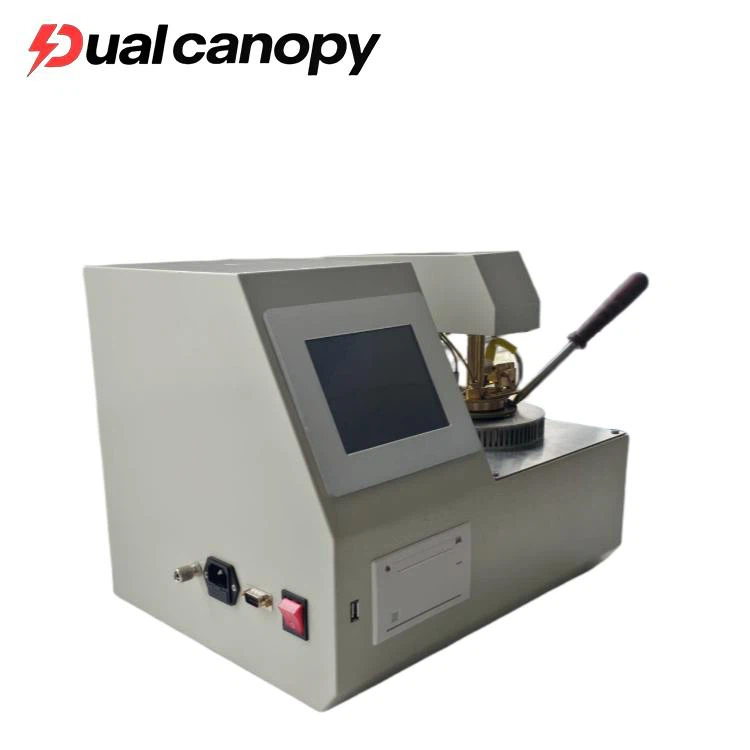
Accurate. Repeatable. Built for High-Volume Testing Environments.
Our Closed Cup Flash Point Tester is an advanced analytical instrument engineered to determine the flash point of flammable and combustible liquids using the Pensky-Martens closed-cup method. Designed in strict accordance with international standards including ASTM D93, ISO 2719, IP 34, JIS K 2265, and GB/T 261, this tester delivers laboratory-grade accuracy for quality control laboratories, petroleum refineries, power utilities, chemical manufacturing plants, and third-party inspection agencies worldwide.
What are the characteristics of the product's technical functions?
With the use of a new type of high-speed digital signal processor, the operation is reliable and the accuracy is high;
One main unit can simultaneously control multiple test furnaces to conduct tests on multiple samples, saving testing time;
Detection, opening the lid, ignition, alarm, cooling, printing, the entire experimental process is automatically completed;
Gas-electric dual ignition method, namely platinum alloy electric heating wire and gas ignition method;
Automatic detection of atmospheric pressure, automatic correction of test results, applicable to high-altitude areas;
Using the newly developed high-power high-frequency switching power supply heating technology, the heating efficiency is high, adopting adaptive PID control algorithm, automatically adjusting the heating curve;
Temperature exceeds the limit automatically stops the test and gives an alarm;

What advantages does choosing this device offer?
1. Adopt new high-speed digital signal processor, reliable and accurate operation.
2. Test, open cover, ignition, alarm, cooling, printing, the whole test process is completed automatically.
3. This instrument adopts electric ignition;
4. Atmospheric pressure is automatically measured, and the test results are automatically corrected.
5. Adopt newly developed high-power high-frequency switching power supply heating technology, high heating efficiency, and adaptive PID control algorithm to automatically adjust the heating temperature curve.
6. Automatically stop detection alarm when the temperature is too high.
7. Thermal micro printer, more beautiful and faster printing, with offline printing function.
8. Up to 50 historical test records with time stamps can be stored.
2. Working principle
Under the conditions specified by the national standard, the equipment puts the sample into the test cup, affects the heating experiment of the oil cup, and ignites the flame with the oil vapor ambient air and the lowest temperature gas as the flash point. The digital signal processor controls the heater according to the temperature change, so that the test oil temperature rises at a certain speed. Automatically control ignition and flash detection; when measuring the flash, the system stops data acquisition, displays the flash temperature, prints and records the results, and stops heating.
3. Main technical indicators
1. Temperature measurement:
Measuring range: -49.9℃-400.0℃
Repeatability: 0.029X (X-average of two consecutive test results)
Resolution: 0.1℃
Accuracy: 0.5%
Temperature measuring element: platinum resistance (PT100)
Flash detection: K-type thermocouple
Where Is the Closed Cup Flash Point Tester Used?
Flash point testing is a critical safety and quality parameter required across multiple industries. The closed-cup method is specifically preferred because it simulates real-world sealed container conditions, providing a more conservative (lower) flash point reading than open-cup methods - making it the standard method for regulatory compliance and transportation classification
1. Petroleum & Petrochemical Industry
Routine quality control of crude oil, diesel fuel, kerosene, jet fuel (Jet A/A-1), fuel oil, and gasoline blending components.
Flash point is a mandatory specification in ASTM D975 (diesel fuel) and ASTM D1655 (aviation turbine fuel) standards.
Refineries use flash point data to verify distillation cut accuracy and detect cross-contamination between product streams.
2. Power & Electrical Utilities
Testing transformer insulating oil (mineral oil, natural ester, synthetic ester) to detect thermal degradation, contamination, or dissolved gases that lower flash point - a direct indicator of in-service oil safety.
Referenced in IEC 62535 and ASTM D93 for transformer oil quality monitoring.
3. Chemical Manufacturing & Pharmaceuticals
Classification of solvents, intermediates, and finished chemicals under GHS (Globally Harmonized System) hazard communication.
Flash point determines NFPA flammability rating and UN transport hazard class (Class 3 Flammable Liquids require flash point < 60°C by closed-cup test).
4. Paints, Coatings & Adhesives
Ensuring workplace safety compliance per OSHA 29 CFR 1910.106 and EU ATEX Directive 2014/34/EU.
VOC-related flash point testing for environmental regulatory submissions.
5. Lubricants & Greases
Verifying base oil quality and detecting light-end contamination (e.g., fuel dilution in engine oils).
SAE and OEM specifications often mandate minimum flash point values.
6. Food Processing & Cosmetics
Flash point testing of food-grade solvents, essential oils, and alcohol-based formulations for safe handling classification.
7. Third-Party Testing Laboratories & Academic Research
Commercial testing labs (SGS, Intertek, Bureau Veritas) performing ASTM/ISO-accredited flash point analyses for client submissions.
How should the equipment be used to ensure safe operation?
Never test samples of unknown composition without proper PPE (safety glasses, lab coat, chemical-resistant gloves).
Ensure adequate ventilation. Connect the fume extraction port to a laboratory fume hood or local exhaust ventilation system meeting ANSI/AIHA Z9.5 standards.
Do not test near open flames or ignition sources other than the instrument's own test flame.
Do not exceed the maximum test temperature of 400°C. Entering an expected flash point beyond this range may damage the heating element.
If a gas leak is detected (by smell or soap-bubble test), immediately shut off the gas supply, ventilate the area, and do not operate the instrument until the leak is repaired.
Do not leave the instrument unattended during testing of highly volatile samples (expected flash point < 50°C).
Electrical safety: Always connect to a properly grounded outlet. Do not modify the power cord or use adapters that bypass the grounding pin.
How should maintenance and servicing be carried out?
After Every Test:
Clean the test cup and lid assembly with appropriate solvent.
Wipe the heating block surface to remove spilled sample residue.
Inspect the ignition tip for carbon buildup; clean with a fine wire brush if necessary.
Weekly (or Every 20 Tests):
Inspect gas supply tubing for cracks, discoloration, or hardening. Replace if any deterioration is observed.
Verify the flame size and color (should be a small, steady blue flame approximately 4 mm in diameter as specified by ASTM D93).
Clean the touchscreen with a soft, lint-free cloth. Do not use abrasive cleaners.
What Makes Our Closed Cup Flash Point Tester Stand Out?
We understand that wholesale buyers evaluate instruments not only on specifications but on total cost of ownership, reliability, ease of deployment, and after-sales burden. Below, we detail each key feature alongside the engineering rationale - so you can confidently communicate value to your end-users.
ASTM D93 specifies repeatability of ≤ 2°C and reproducibility of ≤ 4°C for Procedure A (standard testing). Our tester consistently meets or exceeds these benchmarks in independent validation testing.
PID-controlled heating with a temperature control accuracy of ±0.1°C, ensuring the prescribed heating rate of 5–6°C/min (Procedure A) or 1–1.5°C/min (Procedure C) is maintained within specification.
Automatic flash detection uses a thermocouple-based differential temperature sensor at the cup opening that detects the momentary temperature spike when flash occurs, eliminating subjective visual judgment.
Eliminates the need for separate low-range and high-range instruments, reducing capital expenditure by up to 40% for end-user labs.
Covers the full scope of ASTM D93 Procedures A, B, and C.
FAQ
Q1: What is the difference between closed-cup and open-cup flash point testing?
A: In closed-cup testing (e.g., ASTM D93 / ISO 2719), the sample is heated in a covered cup and the test flame is introduced through a small opening at controlled intervals. This traps vapors above the liquid surface, resulting in a lower, more conservative flash point value. In open-cup testing (e.g., ASTM D92 / Cleveland Open Cup), the sample is heated in an open vessel, allowing vapors to dissipate - producing a higher flash point reading, typically 5–25°C above the closed-cup value.
Closed-cup results are used for regulatory classification (GHS, UN transport, OSHA) because they represent the minimum temperature at which a material can form an ignitable vapor mixture - the worst-case safety scenario. For this reason, the Closed Cup Flash Point Tester is the most widely required instrument for compliance testing.
Q2: What international standards does this Closed Cup Flash Point Tester comply with?
A: Our instrument is designed, manufactured, and calibrated to comply with the following standards:
ASTM D93 - Standard Test Methods for Flash Point by Pensky-Martens Closed Cup Tester (Procedures A, B, and C)
ISO 2719 - Determination of flash point - Pensky-Martens closed cup method
IP 34 - Institute of Petroleum equivalent method
JIS K 2265 - Japanese Industrial Standard for flash point testing
GB/T 261 - Chinese national standard for closed-cup flash point determination
Each instrument ships with a factory calibration certificate referencing the applicable standard(s). For accredited laboratories, we can provide ISO/IEC 17025-format calibration reports upon request.
Q3: What is the minimum order quantity (MOQ) for wholesale purchases?
A: Our standard MOQ for wholesale buyers is [1] units. However, we maintain flexible policies for new distributors and trial orders - contact our sales team to discuss your specific requirements. Volume-based pricing tiers are available, with significant per-unit savings at quantities of [10+, 25+, 50+] units. We also support OEM/ODM customization (custom branding, software localization, modified specifications) for orders exceeding [1] units.
Hot Tags: closed cup flash point tester, China closed cup flash point tester manufacturers, suppliers, factory


