

The breakdown voltage test of insulating oil refers to applying a continuously increasing alternating voltage to the insulating oil sample under specified experimental conditions. When the insulation performance between the two electrodes in the oil fails (a breakdown occurs and an electric arc channel is formed), the lowest voltage value measured is obtained, with the unit being kilovolts (kV). In simple terms, it is a test to measure how high a voltage the insulating oil can withstand without being "electrically penetrated".
The purpose and significance of the test
Insulating oil (such as transformer oil) plays a primary role in insulating and cooling electrical equipment (transformers, transformers, circuit breakers). Its breakdown voltage is one of the most direct and crucial indicators for evaluating the purity and effectiveness of its insulation performance.
Main purpose: To detect whether there are any contaminants such as water, fibers, dust, metal particles, carbon compounds, etc. in the oil.
Importance: These pollutants will arrange themselves into "conducting bridges" under the influence of the electric field, significantly reducing the insulation strength of the oil. If the breakdown voltage of the oil is too low, the risk of internal discharge in the equipment under overvoltage or normal working voltage will increase sharply, potentially causing severe damage to the equipment, even leading to explosion and fire, resulting in major power outages.
Test principles and standards
In the standardized test oil cup, two specific-shaped electrodes are immersed in the oil sample, maintaining a fixed gap (usually 2.5 millimeters). A constant voltage (such as 2kV/s or 3kV/s) is applied at a constant rate until the current sharply increases and breakdown occurs. The voltage value at that instant is recorded, which is the breakdown voltage for that specific test.
Main international/standardized national standards:
IEC 60156: "Determination of the Breakdown Voltage of Insulating Liquids under Power Frequency" (International Standard)
ASTM D1816: Utilizing a spherical cap electrode, it is highly sensitive to moisture and impurities and is widely used.
GB/T 507: "Test Method for Breakdown Voltage of Insulating Oil" (Chinese National Standard).
ASTM D877: Uses a disc electrode. The method is relatively old and is mainly used for rapid screening, with relatively low accuracy.
Detailed testing procedures (taking IEC 60156/GB/T 507 as an example)
Sampling:
Samples are taken from the bottom sampling valve using a dedicated tool to prevent contamination by air or moisture.
Use clean, dry brown glass bottles or special syringes.
Sample Preparation:
Slowly pour the oil sample into a clean test oil cup to avoid forming bubbles.
Let it stand for 10 to 15 minutes to allow the air bubbles in the oil to escape.
Device Settings:
Make sure that the oil cup and the electrodes (which are usually spherical covers made of brass or stainless steel) have been thoroughly cleaned and dried according to the standards.
Set the electrode gap to 2.5mm.
Set the voltage boosting rate to 2 kV/s (or the standard specified value).
Carry out the test:
Start the automatic tester and the voltage will rise uniformly from zero.
When the oil gap breaks down, the equipment automatically cuts off the voltage and records the corresponding count value.
After the first breakdown, gently stir the oil sample with a mixing device (to remove the carbon particles and bubbles generated by the breakdown), and let it stand for 1-2 minutes.
Repeat this process on the same oil sample six times.
Calculation and Report:
Discard the first breakdown value (as "conditioning"), and take the arithmetic mean of the breakdown voltages of the following 5 tests as the final reported value for this oil sample. (Note: Some standards require the calculation of the average of all 6 tests.)
Insulation Oil Breakdown Voltage Testing Principle And Standard Procedures
Popular Products

Open Flash Point Tester
Product Introduction Features: Fully automatic flash point tester, with touch screen instead of keyboard operation.

Capacitance Test
Products Description This 50kVA single phase pole mounted transformer is exported to Canada inJuly,2024.The rated

TTR Transformer Turns Ratio Tester
Products Description The ZS6810A / ZS6810E transformer ratio tester is mainly used for measuring the turns ratio or

Single-phase relay protection tester
The single-phase relay protection tester is a new type of intelligent test instrument, primarily used to calibrate

Sweep Frequency Response Analysers
Products Description Overview The Transformer winding deformation tester transformer winding deformation tester is used
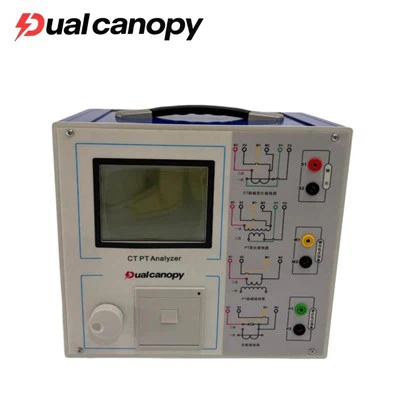
CT PT Excitation Characteristic Analyzer
Products Description The transformer comprehensive measuring instrument is an electronic device used for on-site