

The main items of transformer testing
Transformer tests are generally classified into three major categories based on their purposes:
Routine test
This is a test that must be conducted for each factory-delivered transformer to verify whether the manufacturing process and material quality are up to standard. The core items include:
Measurement of DC resistance of windings: Check the welding quality of the winding wires, the contact condition of the tap switch contacts, and whether there is any inter-turn short circuit.
Voltage ratio measurement and connection group marking verification: To confirm whether the voltage ratio and phase relationship of the transformer are correct.
Insulation characteristic test: It mainly includes measurement of insulation resistance and absorption ratio (or polarization index), which is used to preliminarily determine whether the overall insulation is damp or has a through-type defect.
Loss measurement: This includes measurement of no-load loss and no-load current (to evaluate the quality of the core), as well as measurement of load loss and short-circuit impedance (to assess the design of the windings).
Insulation strength test: This includes external applied voltage test (to evaluate the main insulation) and induction voltage test (to evaluate longitudinal insulation, such as inter-turn and inter-layer insulation).
Sealing test and oil test: Check for oil leakage, and test the electrical strength (breakdown voltage), dielectric loss factor, and moisture content of the transformer oil.
DC Resistance Tester
2. Type Test
Such tests are conducted only when the new product is finalized, the design undergoes significant changes, or the process is altered. They are used to verify whether the design meets the standards and long-term operation requirements. The main items include:
Temperature rise test: To verify whether the temperature rise of each part of the transformer exceeds the limit value under the rated operating conditions.
Insulation type test: Such as lightning impulse test and operational impulse test, to evaluate the transformer's ability to withstand overvoltage.
Sound level measurement: Measuring the noise level of the transformer during operation.
3. Special Tests
Tests conducted according to user requirements or research needs, for example:
Short-circuit withstand capability test: Verifies the transformer's ability to withstand the huge electromagnetic force generated by a sudden short circuit.
Partial discharge measurement: Detecting whether there is partial discharge inside the insulation and the amount of discharge is a key item for evaluating the insulation quality.
Zero-sequence impedance measurement: Provides parameters for calculating system short-circuit current and for protection setting.
Winding deformation test: To diagnose whether the winding has undergone mechanical displacement or deformation after being subjected to a short-circuit current impact.
Introduction to the Test Supporting Equipment
Conducting the above-mentioned experiments requires specialized instruments and equipment. Below are listed the common experiments:
Insulation resistance measurement: A high-voltage insulation resistance tester (digital megohmmeter) is required. The output voltage has multiple levels such as 500V, 1000V, 2500V, and 5000V.
DC resistance measurement: Using a DC resistance rapid tester, modern instruments mostly adopt the three-phase simultaneous measurement technology, which can significantly shorten the testing time for large-capacity transformer windings.
Ratio and group testing: Using an automatic ratio and group testing instrument, the ratio error can be automatically calculated and the group can be displayed.
No-load and load loss test: A loss testing system is required, usually including a voltage regulator, power analyzer, standard current/voltage transformers, etc.
Power frequency withstand voltage test: A power frequency withstand voltage test device is required. It mainly consists of a test transformer, a voltage regulation console, a protection resistor and a voltage divider.
Inductive withstand voltage test: The key point is to use a frequency multiplier power supply device (such as a three-times frequency generator) or a variable-frequency resonant power supply to increase the frequency to above 100Hz to avoid core saturation.
Transformer oil test: Commonly used equipment includes insulation oil dielectric strength tester (oil breakdown tester), oil dielectric loss tester, and oil chromatography analyzer (used for detecting dissolved gases).
Partial discharge measurement: A highly sensitive partial discharge detection system is required, including coupling capacitors, detection impedance, partial discharge instrument, and calibration pulse generator, etc.
Winding deformation test: The mainstream equipment is the frequency response method winding deformation tester. The deformation is determined by comparing the differences in the frequency response curves of the windings.
For manufacturing plants or large maintenance centers, integrated transformer test benches with high integration are often equipped. These test benches combine multiple testing functions such as transformation ratio, DC resistance, and loss into one, enabling automated testing and enhancing efficiency.
The prescribed standard procedures
The conduct of experiments must be in accordance with national and industry standards. The main standard systems include:
National Standard:
GB 1094 series "Power Transformers": This is the most fundamental basic standard, covering general principles, temperature rise, insulation level, test methods, etc.
GB/T 16927.1 "High Voltage Test Technology - Part 1: General Definitions and Test Requirements": Specifies the general methods for high voltage tests.
GB 50150 "Standard for Electrical Equipment Acceptance Tests in Electrical Installation Engineering": This is the authoritative procedure for acceptance and handover of transformers before their installation and commissioning.
GB/T 6451 "Technical Parameters and Requirements for Oil-immersed Power Transformers": It stipulates the specific technical requirements and tests for various types of oil-immersed transformers.
Electricity industry standards:
DL/T 596 "Power Equipment Preventive Testing Procedures": This is the "bible" for power system operation units to conduct regular preventive tests on transformers. It stipulates the test items, cycles, and criteria.
DL/T 393 "Maintenance and Testing Procedures for Transmission and Transformation Equipment": Maintenance and testing guidance based on equipment condition.
For specific types of transformers, there are also special standards such as DL/T 2835-2024 "Electrical Test Guidelines for DC Transformers".
International standard:
IEC 60076 series "Power Transformers": This standard is typically adopted when aligning with international standards or when exporting products.
Classification Of Main Test Items For Transformers And Test Standards And Procedures
Popular Products

Open Flash Point Tester
Product Introduction Features: Fully automatic flash point tester, with touch screen instead of keyboard operation.

Capacitance Test
Products Description This 50kVA single phase pole mounted transformer is exported to Canada inJuly,2024.The rated

TTR transformer turns ratio tester
Products Description The ZS6810A / ZS6810E transformer ratio tester is mainly used for measuring the turns ratio or

Single-phase relay protection tester
The single-phase relay protection tester is a new type of intelligent test instrument, primarily used to calibrate

Sweep Frequency Response Analysers
Products Description Overview The Transformer winding deformation tester transformer winding deformation tester is used
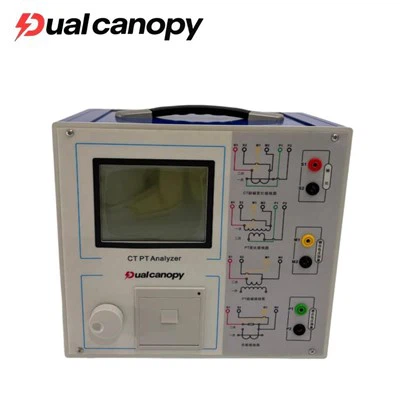
CT PT Excitation Characteristic Analyzer
Products Description The transformer comprehensive measuring instrument is an electronic device used for on-site