

Let's take a look at the classification method. The AC/DC withstand voltage tester can be classified according to different standards. Understanding these classifications will help in initially determining the type of equipment.
According to the output type, they are mainly divided into AC withstand voltage testers, DC withstand voltage testers and insulation resistance testers. The AC withstand voltage tester outputs power frequency high voltage, which can effectively test the local discharge of insulation and the weaknesses of capacitive loads, and is closest to the actual operating state. It is a relatively strict assessment method. The DC withstand voltage tester outputs DC high voltage, and during the test, the charging current is small, which is suitable for large-capacity test samples, such as cables. Moreover, it is easy to detect concentrated insulation defects. The insulation resistance tester outputs DC voltage to measure insulation resistance and belongs to a non-destructive test. It is used to evaluate insulation moisture or overall aging.
According to the degree of functional integration, it can be divided into dedicated and integrated safety test systems. The dedicated type has relatively simple functions, such as only AC or only DC withstand voltage testing. The integrated safety test system integrates various functions such as AC withstand voltage, DC withstand voltage, and insulation resistance into one, and can automatically execute the test sequence. It is the mainstream choice for modern production lines and laboratories.
AC/DC withstand voltage test device
According to the level of automation, it can be divided into manual operation type and programmable automatic type. The manual operation type requires manual adjustment of voltage, timing and judgment of results. The programmable automatic type has an internal microprocessor and supports parameter programming, automatic voltage regulation, data storage and communication, and has higher efficiency and consistency.
According to the device form, they can be classified as desktop or portable types, as well as split types. Desktop models focus on high precision in laboratories, while portable models such as handheld megohmmeters focus on the flexibility of on-site inspection. Split types usually consist of a control box and a high-voltage transformer, with high output voltage and large power, and are commonly used in on-site tests of power systems.
Now let's look at some typical application scenarios. Different application scenarios have significant differences in the requirements for the functions and parameters of the tester.
In the field of power systems and high-voltage equipment, main tests include commissioning tests and preventive tests for power transformers, high-voltage cables, GIS, insulators, etc. These tests involve high voltages and require large equipment power. Therefore, split-type or series-resonance type ultra-high voltage AC withstand voltage testers are often selected. For instance, a 6kV oil-immersed transformer might require a 20kV test voltage.
In the field of new energy and electric vehicles, with the widespread adoption of the 800V high-voltage platform, it is necessary to conduct safety regulations tests on motor controllers, OBCs, high-voltage battery packs, and high-voltage fast-charging stations. This requires equipment to have high precision, arc detection, multi-channel scanning functions, and is suitable for comprehensive safety regulations analysis instruments for 10kV-level testing.
In the field of industrial manufacturing and components, testers are widely used for the factory testing and incoming material inspection of household appliances, motors, transformers, cables, PCBs, relays, etc. Typically, a 5kV level bench-top comprehensive tester is selected, with a focus on test efficiency and automated interfaces.
In the field of research and testing institutions, it is necessary to conduct extreme performance evaluations on materials or new devices. The equipment is required to have functions such as breakdown voltage analysis, data recording and traceability, and programmable control.
Now let's look at the core selection guide. It is recommended to conduct a systematic evaluation following these steps.
The first step is to clearly define the test object and the standards. This is the fundamental basis for the selection process. First, determine what you want to test, such as a motor, cable or PCB. Then, search for the mandatory national or industry standards that apply to it. The standards will clearly specify the core parameters such as the type of test required, voltage value, duration, leakage current limit, etc.
The second step is to evaluate the core performance parameters. In terms of output voltage and capacity, the maximum output voltage of the instrument should cover the highest value specified by the standard, and it is recommended to leave a margin of more than 20%. The output capacity determines the load capacity, especially for large capacitive loads, such as long cables. Insufficient capacity can lead to voltage drop and invalid testing. The calculation formula is that the required capacity is greater than or equal to 2 times the pi value multiplied by the frequency multiplied by the square of the voltage multiplied by the capacitance of the test sample. In terms of leakage current measurement, the measurement range should cover the alarm threshold specified by the standard, and it should have sufficient resolution such as 0.1 microamps and accuracy such as plus or minus one percent of the reading plus five digits. In terms of timing control function, it should have programmable voltage rise and fall times, test duration, waiting time, etc., to meet the requirements of different standards for the voltage application process.
The third step is to select the key functions and safety features. In terms of functional requirements, arc detection can detect the weak discharge that occurs before insulation breakdown, which is an important function for identifying potential hazards. Open-circuit detection can check the reliability of the connection before testing, preventing false judgments due to poor contact. Multi-channel scanning can significantly improve the testing efficiency for multi-pin components such as transformers. In terms of automation and communication interfaces, if it needs to be integrated into the production line, it should have interfaces such as Handler, RS-232, and LAN. In terms of safety performance, the equipment must be equipped with an emergency stop button, a high-voltage start indicator light or interlock interface, a reliable grounding terminal, overcurrent protection, etc., which are basic requirements for ensuring the safety of operators' lives.
Classification, Application And Selection Of AC/DC Voltage Testing Instruments
Popular Products

Open Flash Point Tester
Product Introduction Features: Fully automatic flash point tester, with touch screen instead of keyboard operation.

Capacitance Test
Products Description This 50kVA single phase pole mounted transformer is exported to Canada inJuly,2024.The rated

TTR Transformer Turns Ratio Tester
Products Description The ZS6810A / ZS6810E transformer ratio tester is mainly used for measuring the turns ratio or

Single-phase relay protection tester
The single-phase relay protection tester is a new type of intelligent test instrument, primarily used to calibrate

Sweep Frequency Response Analysers
Products Description Overview The Transformer winding deformation tester transformer winding deformation tester is used
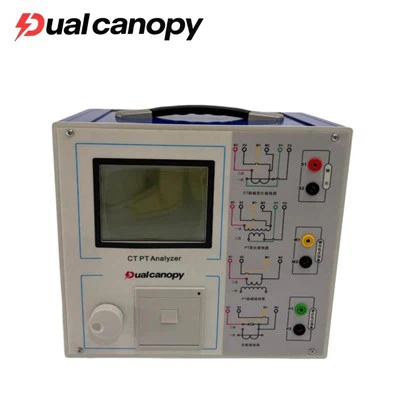
CT PT Excitation Characteristic Analyzer
Products Description The transformer comprehensive measuring instrument is an electronic device used for on-site