

The transformer capacity characteristic tester is a professional equipment used in the power system to measure key parameters such as transformer capacity, no-load loss, and load loss. It plays a significant role in electricity inspection, equipment handover tests, and operation maintenance.
Application scope of transformer capacity characteristic tester
The application of the transformer capacity characteristic tester runs throughout the entire lifecycle management of the transformer, and is mainly reflected in the following scenarios:
Electricity inspection and capacity verification: This is one of the most crucial applications of this equipment. Power supply companies or electricity inspection departments use it to conduct on-site verification of the actual capacity of users' transformers, to determine whether there are any acts such as unauthorized capacity expansion or fraudulent electricity usage, and to ensure the accuracy of electricity billing.
Transformer commissioning and preventive tests: After the installation of a new transformer or during the operation of an existing one, regular preventive tests are conducted to measure key power frequency parameters such as no-load current, no-load loss, short-circuit voltage (impedance voltage), and short-circuit loss, in order to assess whether the transformer's performance meets the standards or if there are any potential problems.
Operation maintenance and fault diagnosis: By measuring the losses of the transformer, the content of harmonics, the vector relationship of voltage and current, etc., it assists in determining whether the winding has deformed, whether the core has a fault, and analyzing the impact of harmonics on the operation of the transformer.
Field operations without large-scale test power supply: For remote substations, mining areas, construction sites, etc., where there are no three-phase large-capacity voltage regulating equipment, instruments with active functions can have built-in test power supplies. Tests can be completed without the need to connect external voltage regulators.
Transformer Capacity Tester
Selection Guidelines for Transformer Capacity Characteristic Testers
When purchasing a transformer capacity characteristic tester, it is recommended to consider the following key factors comprehensively:
Clarify functional requirements and focus on integration.
Core function: Ensure that the instrument can accurately measure basic parameters such as capacity, no-load loss, load loss, impedance voltage, etc., and possess functions such as waveform distortion correction, temperature correction, and voltage/current correction, in order to guarantee the accuracy of data under non-rated operating conditions.
Additional features: Depending on the specific working environment, it is advisable to consider whether to integrate functions such as winding deformation detection, harmonic analysis, zero-sequence impedance measurement, or oscilloscope functionality (for real-time waveform viewing).
Check the key parameters to ensure that the measurement range and accuracy are correct.
Capacity range: Ensure coverage of the types of transformers used in daily testing. Mainstream instruments typically cover small distribution transformers with a capacity of 20 kVA up to large power transformers with a capacity of 100,000 kVA.
Voltage/Current Range: Check whether the measuring instrument has a wide range. For example, can the upper limit of voltage measurement reach 750V or higher, and does the current measurement support dual ranges (such as 0-5A and 0-100A) to meet the requirements of precise measurement of small currents and short-circuit tests of large currents?
Measurement accuracy: Pay attention to the basic measurement accuracy of voltage and current (such as ±0.2%). The capacity measurement accuracy is usually a reference indicator (such as ±10%), but more importantly, focus on the measurement accuracy of parameters such as loss.
Examine the power mode and enhance on-site adaptability
Active type: The instrument is equipped with an inbuilt inverter power supply and battery. It can independently complete capacity and load tests without the need for an external voltage regulator. This type is particularly suitable for scenarios where there is no suitable power supply available on site or when quick operation is required.
Passive type: The instrument itself does not provide the testing power supply; external devices such as voltage regulators and current boosters are required. The advantage is that the technology is mature, but the wiring is complex and it has high requirements for the on-site power supply conditions.
Battery life: If you choose the active type, pay attention to the battery's endurance. Some products can be tested for over 500 cycles with a single charge.
Focus on data management and operational experience
Data storage and export: Built-in storage capacity (such as 200 sets), whether it supports USB drive export, export formats (such as Word, Excel), etc., all these factors affect the efficiency of subsequent report organization.
Operation interface: The design featuring a large-screen touch screen, Chinese menus, and conductive silicone buttons significantly enhances the convenience of on-site operation.
Portability: The weight (around 5kg) and size of the equipment are crucial factors to consider when it comes to on-site carrying and transportation.
Application And Selection Of Transformer Capacity Characteristic Tester
Popular Products

Open Flash Point Tester
Product Introduction Features: Fully automatic flash point tester, with touch screen instead of keyboard operation.

Capacitance Test
Products Description This 50kVA single phase pole mounted transformer is exported to Canada inJuly,2024.The rated

TTR Transformer Turns Ratio Tester
Products Description The ZS6810A / ZS6810E transformer ratio tester is mainly used for measuring the turns ratio or

Single-phase relay protection tester
The single-phase relay protection tester is a new type of intelligent test instrument, primarily used to calibrate

Sweep Frequency Response Analysers
Products Description Overview The Transformer winding deformation tester transformer winding deformation tester is used
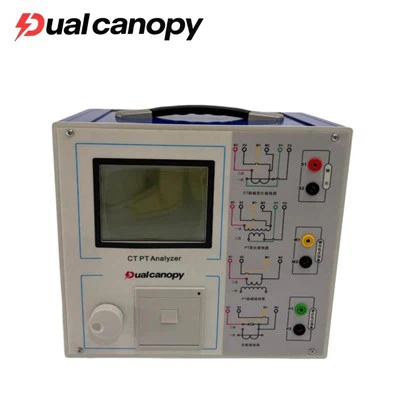
CT PT Excitation Characteristic Analyzer
Products Description The transformer comprehensive measuring instrument is an electronic device used for on-site