


Dual Canopy Mechanic Electrical Engineering Co., Ltd. is one of the leading manufacturers and suppliers of handheld dc resistance tester in China. Please feel free to wholesale discount products for sale here and get quotation from our factory. Customized orders are welcome.
What does the Handheld DC Resistance Tester ?

The Handheld DC Resistance Tester is a compact, battery-powered precision instrument designed for measuring low-value DC resistance in inductive loads such as transformer windings, motor coils, inductors, and electrical contacts. Unlike standard multimeters, this tester utilizes the 4-wire Kelvin measurement method to eliminate the resistance of test leads, ensuring high accuracy even in the micro-ohm (μΩ) range.
This device is an essential tool for field maintenance engineers and factory quality control. It addresses the critical need for a portable, rugged, and easy-to-use solution for verifying the integrity of windings and connections without the bulk of traditional bench-top equipment. By detecting issues such as shorted turns, poor soldering, or loose connections, it plays a vital role in preventing equipment failure and ensuring electrical safety.
Our handheld testers are engineered with advanced power management technology, providing high test currents (up to 10A or 20A) while maintaining a lightweight form factor and extended battery life.
What are the specifications?
|
Test current |
<20mA |
40mA |
200mA |
1A |
3A |
10A |
|
Measuring range |
100Ω-50KΩ |
1Ω-200Ω |
100mΩ-50Ω |
10mΩ-10Ω |
5mΩ-3Ω |
0.5mΩ~0.2Ω |
|
Accuracy |
±(0.5%+2) |
±(0.2%+2) |
||||
|
Minimum resolution |
0.1μΩ |
|||||
|
Operation method |
Touch screen operation |
|||||
|
Dimensions |
Host:252*160*65(mm) Outer box:425*335*210(mm) |
|||||
|
Weight |
Host:2KG Outer box:8KG |
|||||
|
Battery Specifications |
14.8V 5200mAh |
|||||
|
Test lead length |
Standard 5 meters, length can be customized |
|||||
What are the technical features of a Handheld DC Resistance Tester?
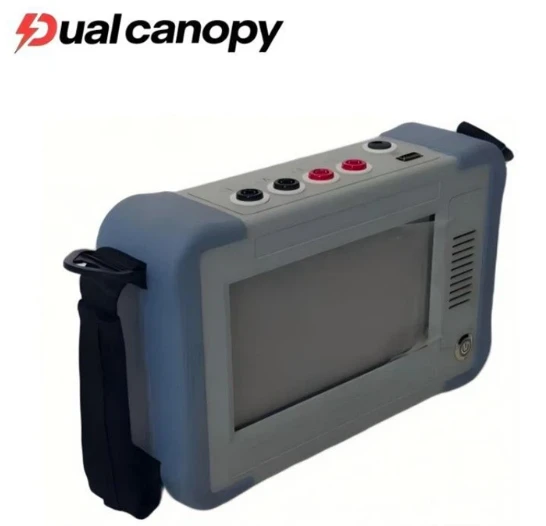
1) 4-Wire Method (Kelvin) for Low-Resistance Measurement
Employs a measurement technique that separates current injection from voltage sensing, significantly reducing errors introduced by test leads and contact points-ideal for measurements in the µΩ/mΩ range.
2) Multiple Test Current Ranges and Rapid Stabilization (Model-Dependent)
Allows users to select different test current ranges based on the object under test: low currents are suitable for delicate components, while high currents enable more stable contact assessment for switch contacts and busbar joints (subject to actual specifications).
3) Optimized Measurement Workflow for Inductive Loads (Winding Applications)
For inductive loads such as windings, the instrument offers features including reading stability detection, test timing, and end-of-test energy release/discharge alerts (depending on functional configuration), ensuring readings are highly comparable and suitable for establishing trend archives.
4) Data Storage and Project Management (Configuration-Dependent)
Supports on-device data storage, sequential numbering/ID management, and data export (via USB, Bluetooth, software, etc., depending on configuration), facilitating the archiving of acceptance records and enabling audit traceability.
5) Field-Friendly Design
Handheld and portable, making it ideal for inspections within switchgear compartments, substation field surveys, and rapid multi-point measurements; optional carrying cases and ruggedized clamp kits are available.
What services do we offer?
Selection Consultation: Based on your test object (e.g., transformer capacity, voltage level, winding material copper/aluminum), we recommend the appropriate current range (5A, 10A, 20A, etc.). For example, the low-voltage side winding resistance of large transformers is extremely low, requiring a high-current (10A or 20A) tester to obtain accurate data.
Technical Solution Comparison: We analyze the advantages and disadvantages of handheld and desktop equipment, as well as the differences between different measurement methods (e.g., bridge method vs. voltage drop method).
On-site Demonstration: For bulk purchase customers, we offer on-site demonstrations or send sample units for trial use to verify the equipment's performance under actual operating conditions.
Optional Accessories: We recommend matching test cable packages, carrying cases, Bluetooth printers, and other accessories.

FAQ
Q1: What is the difference between using a handheld tester and a multimeter to measure resistance?
A: The difference is significant:
Measurement Principle: Multimeters typically employ the two-wire method, where the resistance of the test leads is directly added to the measurement result, leading to substantial errors. Handheld testers, conversely, utilize the four-wire method, which completely eliminates the influence of lead resistance.
Measurement Range: Multimeters struggle to accurately measure resistance values in the milliohm or even microohm range. Handheld testers, however, are specifically designed for low-resistance measurements, offering a resolution as high as 0.1 μΩ.
Inductive Load Capability: Multimeters are unable to measure equipment with high inductance (such as transformers). Handheld testers, on the other hand, feature specialized charging and discharging circuits that allow for the safe measurement of inductive loads.
Q2: Why do the readings sometimes fluctuate when measuring transformers?
A: This is typically caused by poor contact or environmental interference.
Check whether the test clips are securely clamped and if the terminals being tested are contaminated with oil or covered in an oxide layer.
Verify that the test leads are not being subjected to strong electromagnetic interference (e.g., by being positioned too close to energized busbars).
If the transformer under test is currently operating in parallel with other units, its readings may be influenced by those other branches; it is recommended to take the transformer offline for measurement.
Q3: Do handheld testers require calibration?
A: Yes, they do. Although designed for field use, as precision measuring instruments, their accuracy is subject to drift over time. It is recommended to perform calibration annually-specifically verifying the accuracy of the current source and the resistance readings-to ensure the validity and reliability of the test data.
Hot Tags: handheld dc resistance tester, China handheld dc resistance tester manufacturers, suppliers, factory, DC Winding Resistance Test kit, transformer dc resistance analyzer, transformer dc resistance analyser, DC handheld resistance tester, DC handheld resistance analyser, DC Winding Resistance analyser


