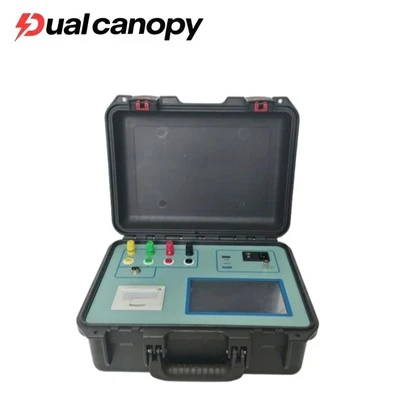
Dual Canopy Mechanic Electrical Engineering Co., Ltd. is one of the leading manufacturers and suppliers of Capacitor Inductor Tester in China. Please feel free to wholesale discount products for sale here and get quotation from our factory. Customized orders are welcome.
What is Capacitor Inductor Tester?

The Capacitor Inductor Tester is a comprehensive measuring instrument used for the precise measurement of key electrical parameters of capacitors and inductors. It can accurately measure and evaluate parameters such as capacitance (C), inductance (L), equivalent series resistance (ESR), loss tangent (tan δ), quality factor (Q), impedance (Z), and phase angle (θ).
This instrument is widely used for condition monitoring of components in power systems, including parallel compensation capacitors, filter capacitors, series resonant capacitors, transformer magnetizing inductors, and reactors. It helps users detect early defects such as decreased capacitance, increased dielectric loss, and ESR degradation, providing a basis for maintenance decisions and condition assessments.
What is Characteristics?
The SGDR-1 fully automatic capacitance and inductance tester adopts advanced measurement principles and four-terminal measurement technology, enabling precise measurement and excellent repeatability performance.
2. Large-screen LCD display (320X240 dot matrix), with Chinese character menu for operation guidance.
3. The LCD screen is equipped with touch-sensitive buttons, making the operation intuitive and straightforward.
4. Automatic current segmentation compensation ensures the linearity of the entire current range, thereby improving the measurement accuracy of the instrument.
5. The waveform and measurement data are displayed simultaneously, making the testing process more intuitive.
6. The new generation of USB communication function simplifies the connection with the PC, facilitating the transmission and management of measurement data.
7. This instrument is equipped with an overcurrent protection feature, which prevents damage to the instrument or equipment due to excessive current.

What are the common application scenarios?

Factory Inspection (QC/Factory Test): Verify whether component parameters meet design specifications. Acceptance Test: Verify parameters of newly installed capacitors/reactors before commissioning. Preventive Maintenance: Periodic condition assessment of operating components. Fault Investigation: Parameter verification of components exhibiting resonance anomalies, reactive power anomalies, or heat generation. Research and Development (R&D): Precision measurement of electrical parameters for new materials and devices.
What precautions should be taken when using it?
1. Capacitors must be fully discharged before testing.
Capacitors have energy storage characteristics. Before testing, they must be fully discharged using a discharge rod or a dedicated discharge circuit. Only connect the capacitor to the testing instrument after confirming there is no residual voltage to prevent electric shock damage.
2. Isolation is crucial when testing large power capacitor banks.
Parallel compensation capacitor banks must be disconnected from the busbar before testing. Perform voltage testing, grounding, and tagging safety measures.
3. Match the test frequency to the component under test.
Measurement results may differ at different test frequencies. Select a test frequency close to the component's operating frequency or one required by the specifications to ensure comparability of results.
4. Test lead length and contact quality affect accuracy.
Excessively long leads introduce distributed capacitance and inductance errors; poor contact leads to unstable readings. Short leads are recommended, ensuring reliable contact.
What kind of services do you provide?
Selection Recommendations: We recommend suitable models based on the type of component under test (capacitor/inductor), capacitance range, test frequency, accuracy requirements, and site conditions.
Capacitor Bank Testing Solution: We provide recommendations for testing large compensated capacitor banks unit by unit, including wiring methods and record templates.
Accessories Recommendations: Short test lead kits, open/short circuit correction fixtures, discharge rods, carrying cases, and other optional accessories.
Document Support: Product parameter tables, configuration lists, typical test report samples, and tender documents (to the extent available).
FAQ
Q1: Can the Capacitor Inductor Tester test power compensation capacitors?
A: Yes, it is suitable for testing the capacitance, tan δ, and ESR of parallel compensation capacitors. It is recommended to choose a test frequency close to the power frequency (e.g., 50Hz/100Hz).
Q2: What is ESR? What does an increase in ESR indicate?
A: ESR (Equivalent Series Resistance) reflects the total loss characteristics of a component; an increase in ESR usually indicates dielectric aging, contact deterioration, or internal component damage.
Q3: What is the difference between tan δ and ESR?
A: tan δ is the loss tangent, representing the ratio of reactive power to active power; ESR is a direct representation of equivalent series resistance. Both reflect losses, but the angles are different; it is recommended to measure both simultaneously for a comprehensive judgment.
Hot Tags: Capacitor Inductor Tester, China Capacitor Inductor Tester manufacturers, suppliers, factory, High Precision Capacitance Inductance Tester, Fully automatic capacitor and inductor detection device, Comprehensive capacitor and inductor tester