

Insulation Oil Dielectric Loss Test Explanation
Test equipment: Insulating oil dielectric loss tester
The core component is the test electrode cup (oil cup), and its design requirements are extremely high:
Structure: Usually consists of a three-electrode system (high-voltage electrode, measurement electrode, and protective electrode), to eliminate the influence of edge effects and surface leakage current, ensuring accurate measurement.
Material: The electrode itself is made of stainless steel or gold-plated material, and the insulating support is quartz or sapphire to ensure stability and low loss.
Temperature control system: Equipped with a built-in precise heater and temperature sensor, it can precisely regulate and stabilize the oil sample at the standard temperature (typically 90℃ ± 0.5℃), which is crucial for obtaining comparable data.
Measurement unit: Based on an automatic balance bridge or precise digital measurement technology, it measures the capacitance and loss of the oil cup after it is filled with the oil sample.
Insulating oil dielectric loss tester
2. Core Standard Procedures
GB/T 5654-2007 "Measurement of Relative Permittivity, Dielectric Loss Factor and DC Resistivity of Liquid Insulating Materials", a fundamental method standard, provides detailed specifications for the design of electrode cups, cleaning procedures, sample handling, measurement steps, and calculation methods. It serves as the fundamental basis for all dielectric loss tests of insulating oil.
GB/T 21216-2007 "Test Methods for Measuring Conductivity and Capacitance of Insulating Liquids to Determine Dielectric Loss Factor, which is equivalent to the IEC standard, complements and supports GB/T 5654."
DL/T 596-2021 "Preventive Test Procedures for Power Equipment" stipulates in the "Insulating Oil" section the control standards and cycles for the dielectric loss factor (at 90℃) of transformer oil, cable oil, and capacitor oil in operation. For example: For transformers of 330kV and above, the tanδ of the oil before commissioning is required to be ≤ 0.5% (at 90℃), and during operation it is required to be ≤ 2% (at 90℃).
The enterprise standards or instructions of the equipment manufacturer: will stipulate more stringent requirements before using new oil or refilling the equipment with oil.
Detailed Explanation of Other Solid/Composite Insulation Dielectric Loss Testing
Test equipment: Fully automatic anti-interference dielectric loss tester
That is the equipment we discussed earlier. It does not directly test the material samples. Instead, it applies a high-voltage alternating current signal to the insulation of the equipment and measures its overall current response.
Core components: High-voltage source, precision measurement bridge (digital type), standard capacitor (built-in or external), anti-interference unit.
Method: By using different wiring methods such as positive connection method, reverse connection method, and self-excitation method, the equipment can be adapted to different grounding conditions.
Anti-interference Inter-frequency Dielectric Loss Tester
2. Core Standard Procedures
DL/T 474.3-2018 "Guidelines for On-site Insulation Testing - Part 3: tanδ Test for Dielectric Loss Factor", the "operation manual" for on-site testing. It details the test wiring, anti-interference measures, precautions, and result judgment principles for various equipment (transformers, transformers, bushings, cables, generators, etc.).
DL/T 596-2021 "Preventive Test Procedures for Power Equipment" stipulates the test cycles, required values, and warning values for tanδ and capacitance of various specific power equipment. This is the direct basis for determining whether the equipment is qualified.
For oil-immersed current transformers with a voltage rating of 66kV to 220kV, the tanδ (at 20℃) of the main insulation should not exceed 0.8%, and there should be no significant change compared to previous data.
Equipment-specific standards:
Transformer: GB/T 1094.1, GB 50150 (Standard for Commissioning Tests of Electrical Installation Engineering)
Transformer: GB 20840, DL/T 726
Packing tube: GB/T 4109, DL/T 1001
Power cable: GB/T 3048.1
Generator: GB/T 20160, DL/T 492
Instrument standard: DL/T 962-2005 "General Technical Conditions for High Voltage Dielectric Loss Testers", which stipulates the performance of the instrument itself.
Summary and Correlation
1. Same essence, different objects: The physical quantity (tanδ) measured by both is essentially the same, as it is a characteristic used to measure the energy loss of the insulating medium under an alternating electric field. However, one is for the basic material (oil), while the other is for the engineering structure (equipment).
Diagnostic logic:
If the overall tanδ value of the transformer exceeds the standard, it is necessary to combine the "tanδ test of insulating oil" to assist in the judgment: Is it the deterioration of the oil quality that has led to an increase in overall loss, or is there a problem with the solid insulation (such as windings, paper sheets), or is it a combination of both?
The tanδ value of the oil is an important input parameter and status indicator for the insulation system of the equipment.
The equipment and standards must not be used interchangeably:
The insulation oil dielectric loss tester cannot be used to test transformers (the voltage and principle do not match).
It is not possible to directly measure the oil sample using the high-voltage dielectric loss tester (there is no standard oil cup, which makes it impossible to ensure the consistency of measurement conditions).
It is necessary to strictly follow the corresponding test method standards (GB/T 5654 and DL/T 474.3) and the judgment criteria (different chapters in DL/T 596).
The Difference Between The Insulation Oil Dielectric Loss Test And Other Dielectric Loss Tests
Popular Products

Open Flash Point Tester
Product Introduction Features: Fully automatic flash point tester, with touch screen instead of keyboard operation.

Capacitance Test
Products Description This 50kVA single phase pole mounted transformer is exported to Canada inJuly,2024.The rated

TTR Transformer Turns Ratio Tester
Products Description The ZS6810A / ZS6810E transformer ratio tester is mainly used for measuring the turns ratio or

Single-phase relay protection tester
The single-phase relay protection tester is a new type of intelligent test instrument, primarily used to calibrate

Sweep Frequency Response Analysers
Products Description Overview The Transformer winding deformation tester transformer winding deformation tester is used
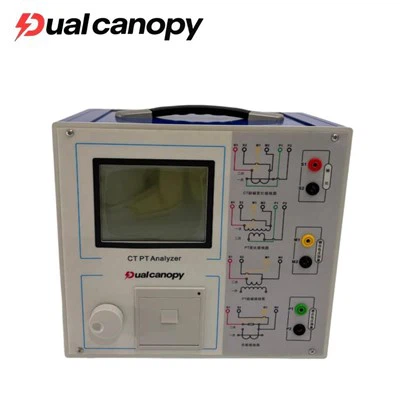
CT PT Excitation Characteristic Analyzer
Products Description The transformer comprehensive measuring instrument is an electronic device used for on-site