

All activities related to the impulse voltage test must strictly follow international and national standards to ensure the standardization, comparability and impartiality of the test.
Basic General Standards (Test Methods and Measurement Criteria)
IEC 60060-1 / GB/T 16927.1: "High Voltage Test Technology - Part 1: General Definitions and Test Requirements". This is the most fundamental and comprehensive standard, clearly defining standard waveforms such as lightning impulse and operational impulse, test procedures, as well as allowable deviations for waveform parameters (for example, the allowable deviation of standard lightning wave: front time ±30%, half-peak time ±20%).
IEC 60060-2 / GB/T 16927.2: "High Voltage Test Technology - Part 2: Measurement System". This standard specifically and elaborately stipulates the performance requirements, calibration methods and uncertainty assessment for measurement systems such as voltage dividers and digital recorders.
2. Specific product test standards
These standards, within the framework of the basic standards, specify the unique test requirements for specific equipment.
Power Transformer: IEC 60076-3 / GB/T 1094.3 specifies the specific wiring method, test sequence (such as full wave first, then truncated wave, and then full wave again) and fault judgment method (mainly using the "waveform comparison method") for the transformer's impact test.
High-voltage switchgear: The requirements for common insulation tests for high-voltage switchgear are specified in IEC 62271-1 / GB/T 11022.
Insulator: The IEC 60815 / GB/T 26218 series standards cover the relevant tests for insulators in polluted environments.
Key process of the test: Before each formal test, the measurement system must undergo unloaded waveform calibration; during the test, by comparing whether the applied voltage waveform and the neutral point current (or transmitted voltage) waveform of the test sample have distortion, the internal insulation can be sensitively determined to have been broken down.
Impulse voltage generator
Precautions for the impact voltage test site
Control of the experimental area
The test area must be physically isolated by fixed safety fences, and warning signs reading "High Voltage Hazard, No Entry Allowed" should be hung at the entrance.
During the test period, a clearance procedure was implemented. Only after the test supervisor confirmed that all non-test personnel had evacuated to a safe area and the sound and light alarm system was activated, could the pressure increase command be issued.
Grounding and Discharge Specifications
All the test equipment (the impact generator body, the voltage divider, and the grounding switch) as well as the outer shell of the test sample must be connected to an independent and low-impedance dedicated grounding system.
Mandatory discharge procedure: Before making any wiring changes, touching the test sample or conducting equipment maintenance, the principle of "discharge first, then operate" must be followed. Operators must use dedicated grounding rods with insulation levels compatible with the equipment, and discharge the high-voltage end, each level of energy storage capacitor, and the high-voltage terminals of the test sample to the ground in sequence, ensuring complete discharge and short circuit. This procedure must be implemented as a mandatory standard operating procedure and cannot be simplified.
Fire Prevention and Emergency Preparedness
The test area should be equipped with fire-fighting equipment suitable for electrical fires (such as carbon dioxide fire extinguishers).
For oil-immersed test samples, it is necessary to check the pressure release device and the breathing apparatus in advance, and monitor whether any abnormal gases are released during the test.
Preparation and verification before the experiment
Equipment status check
Check whether the gap distances of each stage of the impact generator are in accordance with the preset values. The surface of the insulation support structure should be clean, dry and free from any damage.
Inspect all high-voltage connection conductors and shrouds, ensuring reliable connections and smooth surfaces to eliminate the interference of corona discharge on the measurement.
Confirm that the measurement cable on the low-voltage side of the voltage divider is double-layer shielded and has good single-point grounding to avoid interference introduced by ground loops.
Standardization of environmental conditions
Before the formal test, the environmental temperature, relative humidity and atmospheric pressure must be recorded. And according to the IEC 60060-1 / GB/T 16927.1 standard, the test voltage values should be corrected to the standard atmospheric conditions.
Standard Procedures And Precautions For Impact Voltage Test
Popular Products

Open Flash Point Tester
Product Introduction Features: Fully automatic flash point tester, with touch screen instead of keyboard operation.

Capacitance Test
Products Description This 50kVA single phase pole mounted transformer is exported to Canada inJuly,2024.The rated

TTR Transformer Turns Ratio Tester
Products Description The ZS6810A / ZS6810E transformer ratio tester is mainly used for measuring the turns ratio or

Single-phase relay protection tester
The single-phase relay protection tester is a new type of intelligent test instrument, primarily used to calibrate

Sweep Frequency Response Analysers
Products Description Overview The Transformer winding deformation tester transformer winding deformation tester is used
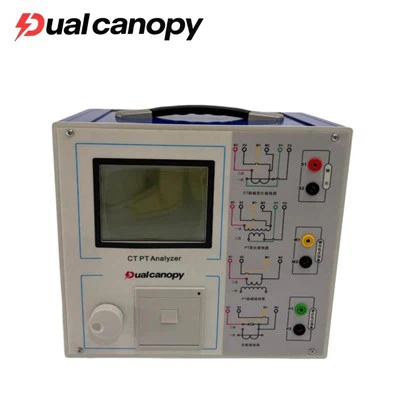
CT PT Excitation Characteristic Analyzer
Products Description The transformer comprehensive measuring instrument is an electronic device used for on-site