

The ratio group tester is an indispensable testing tool in the power industry, and it is applied throughout the entire life cycle of transformers.
Transformer manufacturing process: Before leaving the factory, each transformer must undergo testing to verify whether its parameters such as winding turns ratio, connection group type, and polarity fully comply with the design drawings. This is a crucial step in product quality control.
Engineering installation and handover acceptance: After the new transformer is installed, a handover test must be conducted. Through the ratio and group type test, it is possible to verify whether the internal windings of the transformer have shifted during transportation and installation and whether the wiring is correct, ensuring that it can be safely and compliantly put into grid operation.
Preventive tests and regular maintenance: According to national and industry regulations, transformers in operation need to be inspected regularly. By measuring the transformation ratio and group number, comparisons can be made with historical data to effectively monitor potential faults such as winding deformation, inter-turn short circuits, and contact burnout of the tap changer inside the transformer.
Fault diagnosis and troubleshooting: When abnormalities occur during the operation of a transformer, such as increased load loss or abnormal rise in oil temperature, the transformation ratio and group identification test is one of the important methods for diagnosing whether there are electrical connection faults inside the transformer.
Ratio group tester
The applicable equipment types are diverse, mainly including:
Power transformers (three-phase and single-phase, oil-immersed type and dry-type)
Distribution transformer
Special transformers (such as rectifier transformers, electric furnace transformers)
Voltage Transformer (PT)
(Current Transformer (CT) for some models are supported)
The standards and procedures followed
The transformer ratio group testing work must strictly follow the standards and regulations issued by the state and the industry. These regulations serve as the legal basis for the operation of the tests and the determination of the results.
The core procedures for conducting the experiment:
GB 50150-2016 "Standard for Electrical Equipment Commissioning Tests in Electrical Installation Engineering": This is the most authoritative standard that must be followed after the installation of new equipment. It clearly stipulates the testing methods, technical requirements, and qualification standards for the transformation ratio and group type of transformers and transformers. For example, it requires measurements at all tap positions, and the allowable error of the transformation ratio compared to the nameplate value under the rated tap position is ±0.5%.
DL/T 596-2021 "Power Equipment Preventive Testing Procedures": This is a guiding document for conducting regular inspections of operating power equipment. It specifies the testing cycle, items, and criteria for determining whether the equipment can continue to operate.
2. Reference standards for instruments and equipment:
GB 1094.1-2013 "Power Transformers - Part 1: General Principles": As the basic standard for transformers, it stipulates the performance parameters and design requirements of transformers, serving as the foundation for understanding the significance of transformation ratios and transformer groups.
JJG 314-2010 "Measurement Voltage Transformer" and JJG 313-2010 "Measurement Current Transformer": When using a tester to calibrate voltage or current transformers, this metrological verification procedure must be followed.
The Application Scope And Standard Procedures Of The Transformer Ratio Group Tester
Popular Products

Open Flash Point Tester
Product Introduction Features: Fully automatic flash point tester, with touch screen instead of keyboard operation.

Capacitance Test
Products Description This 50kVA single phase pole mounted transformer is exported to Canada inJuly,2024.The rated

TTR Transformer Turns Ratio Tester
Products Description The ZS6810A / ZS6810E transformer ratio tester is mainly used for measuring the turns ratio or

Single-phase relay protection tester
The single-phase relay protection tester is a new type of intelligent test instrument, primarily used to calibrate

Sweep Frequency Response Analysers
Products Description Overview The Transformer winding deformation tester transformer winding deformation tester is used
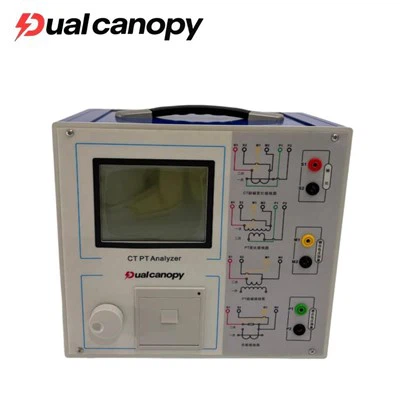
CT PT Excitation Characteristic Analyzer
Products Description The transformer comprehensive measuring instrument is an electronic device used for on-site