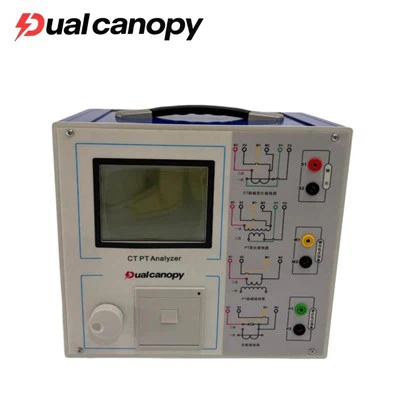
The lightning arrester discharge counter tester is mainly used in the following scenarios:
Routine preventive test:
Routine inspections of all AC non-dispersive metal oxide surge arresters (MOA) with counters and gap-type surge arresters in power plants, substations, and converter stations.
Periodic inspection of lightning arresters for power transmission lines.
New Installation Acceptance:
The newly put into operation lightning arresters and their counters must be tested before being put into operation to ensure that the counters function properly. This is used as the basis for acceptance.
Fault diagnosis and troubleshooting:
When the operation record indicates that overvoltage has occurred in the system but the counter has not acted, it is used to determine whether the fault lies with the counter itself or other reasons.
When the counter indicates an abnormality (such as blurred glass window, stationary pointer, etc.), perform a functional verification.
After the lightning strike incident, the counters of the relevant lightning arresters were checked to verify the operation status.
Resistor Discharge Counter Tester
Scientific research and equipment manufacturing:
Factory inspection and type testing for manufacturers of lightning arresters or counters.
The power research institute is conducting relevant technical research.
Standards and Procedures
When conducting the test of the arrester counter, relevant national and industry standards must be followed.
Main national standards:
GB/T 11032-2020 "AC Non-Dispersive Metal Oxide Surge Arresters": This standard includes the technical requirements and technical tests for the discharge counters used in surge arresters.
DL/T 474.5-2018 "Field Insulation Test Implementation Guidelines - Part 5: Test Procedures for Surge Arresters": This is the core regulation for guiding on-site testing, detailing the methods, steps, and judgment criteria for counter tests.
Preventive test procedure:
The national grid/southern grid enterprise standards such as Q/GDW 1168-2013 "Test Procedures for State Maintenance of Transmission and Transformation Equipment" clearly include the counter inspection as a project for the state maintenance of lightning arresters, and stipulate the test cycle and requirements.
Core requirements of the procedure:
Test cycle: Usually carried out in conjunction with the disconnection and maintenance of lightning arresters. It generally lasts for 1 to 3 years, or during the period before and after the thunderstorm season, or when there is suspicion that the counter is not functioning properly.
Passing criteria: Under the specified standard impact current (such as 100A, 500A), the counter should be able to operate reliably and count accurately. At the same time, the residual voltage of the counter itself should be within the allowable range.
Notes for Attention
The test of the lightning arrester discharge counter involves instantaneous high current, and strict adherence to safety regulations is mandatory.
Power outage and voltage testing: The test must be conducted only after the lightning arrester has been completely powered off, the two sides have been isolated, and voltage has been tested and grounding wires have been hung.
Reliable grounding: The grounding terminal of the testing instrument must be connected using a thick and short wire, and firmly connected to the grounding grid of the substation or a reliable grounding electrode. This is crucial for protecting the safety of equipment and personnel.
Correct wiring:
Disconnect the grounding lead at the upper end of the counter.
Connect the high-voltage output terminal of the tester to the upper end of the counter (on the side of the lightning arrester), and connect the grounding terminal of the tester to the lower end of the counter (on the side of the grounding network). Make sure the connections are correct and the contacts are good.
Personnel safety distance: During the test, the operators should maintain an adequate safety distance from the counter and the test leads, and shout loudly. Other irrelevant personnel should stay away from the test area.
Equipment inspection: Before testing, check whether the instruments and test cables are in good condition and free from any damage or cracks.
Discharge: After each test is completed, the output voltage of the instrument should be reset to zero first. Then, the power supply should be turned off. After that, the counters should be fully discharged before the wires can be disconnected.
Restoring the site: After the test is completed, the original wiring of the counter must be restored, and the connection must be checked and confirmed to be firm and reliable before the work can be concluded.