The transformer ratio test is a very important basic test in the handover test, preventive test and fault diagnosis of power transformers. Below, I will explain in detail its principle, purpose, method, standards and precautions for you.
Test purpose
Verification of design values: Check whether the actual transformation ratio is consistent with the marked nominal value on the nameplate.
Determine the position of the tap changer: Confirm whether the tap changer is installed correctly and whether it is indicating the intended position.
Check the winding ratio: Check whether there are faults such as inter-winding short circuits, incorrect connections, or broken wires in the windings. Inter-winding short circuits will cause abnormal phase-to-phase ratios.
Evaluate three-phase balance: Check whether the phase ratios of the three-phase transformer are balanced, which helps to identify any internal winding asymmetry or connection issues.
For reference for other tests: The transformation ratio test results serve as an important reference basis for subsequent tests such as winding DC resistance test and no-load loss test.
Testing standards and result evaluation
The main basis is the China National Electric Power Industry Standard DL/T 596-2021 "Preventive Test Procedures for Electric Power Equipment" and GB 50150-2016 "Standard for Commissioning Tests of Electrical Equipment in Electrical Installation Projects".
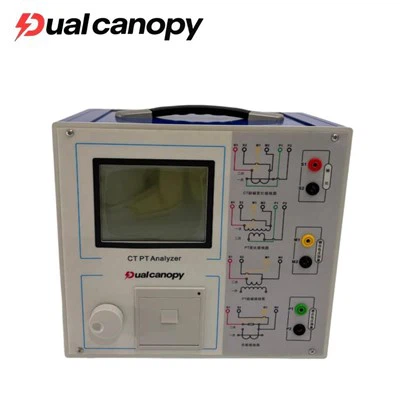
Transformer Ratio and Grouping Tester
Core judgment criteria:
Ratio error:
For all the tap positions, the measured transformation ratio should be within the allowable range of ±0.5% (for transformers up to 35kV) or ±0.25% (for transformers above 35kV) compared to the marked value.
For the gear shifting ratio, it is required that there should be no significant difference compared with the factory test data.
Three-phase balance: The transformation ratios of each phase at the same tap position should be basically the same, and the deviation should not be too large.
Phase angle: The measured phase angle should be consistent with the angle corresponding to the connection group marked on the transformer nameplate (for example, Yd11 corresponds to 30°, Yy0 corresponds to 0°).
The transformer ratio and group type tester is a portable instrument that integrates a signal source, a high-precision measurement module and an intelligent analysis system. It can automatically apply the test voltage, simultaneously measure the voltage amplitude and phase relationship on the high-voltage and low-voltage sides of the transformer, and automatically calculate the ratio, ratio error, connection group type through the built-in microprocessor, and determine whether the results are qualified.
The working principle of the instrument is based on the synchronous and precise measurement of voltage amplitude and phase.
Signal application: An internal instrument generates a low-frequency (such as 50Hz/60Hz) and low-voltage (typically several volts to several tens of volts) three-phase or single-phase test signal, which is applied to the high-voltage winding of the transformer.
Synchronous sampling: The high-precision ADC (analog-to-digital converter) of the instrument synchronously samples the voltage waveforms on the high-voltage side and the low-voltage side.
Digital Analysis:
Amplitude calculation: Through algorithms such as Fourier analysis, the true effective values of each phase voltage are calculated.
Phase calculation: Calculate the phase difference between the corresponding line voltages on the high-voltage side and the low-voltage side (for example, AB and ab).
Logical reasoning:
Ratio: It is obtained by dividing the effective values of the corresponding line voltages (or phase voltages) on the high-voltage side by those on the low-voltage side.
Connection group: It is determined based on the measured phase difference. The standard connection groups of power transformers have phase differences that are integer multiples of 30 degrees.
For example: When the phase difference is 0° or 360° → The group number is 0 (Yy0, Dd0)
Phase difference of 30° → Group number 1
...
Phase difference of 330° → Group number is 11 (Yd11, Dyn11)
The transformer ratio and group type tester is a "powerful tool" for power test personnel. It makes a complex and risky test safe, simple, fast and highly automated. Its core value lies not only in measuring the ratio, but also in its precise phase measurement and automatic group type discrimination function, which is crucial for the acceptance of newly installed transformers, the verification after rewinding windings, and fault diagnosis. Mastering its principles and standard operation is a basic skill for electrical test personnel.