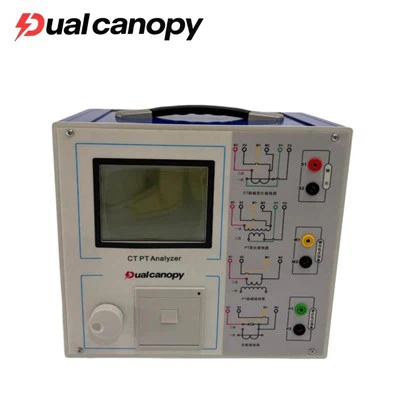
The grounding conduction resistance tester is a core detection device for ensuring the safe operation of electrical systems. It is specifically designed to measure the resistance value of the connecting conductor between the grounding terminal of an electrical equipment and the grounding network (or grounding busbar). The main objective is to verify the integrity of the low-resistance path of the grounding circuit and ensure that fault current can be quickly conducted to the ground. It is widely used in various fields such as power, communication, and industrial production. Mastering the application scenarios, selection methods, operation procedures, and precautions of this device is crucial for enhancing the level of electrical safety operation and maintenance.
Application scenario
The grounding conduction resistance tester focuses on detecting the reliability of grounding connections. It is applicable for the acceptance, regular maintenance, and fault diagnosis of grounding systems of various electrical equipment. The core application scenarios are as follows:
Power Industry: Operation and Maintenance of Substations and Transmission Equipment: In the maintenance of 110kV and above substations and transmission line towers, it is used to detect the conduction status of grounding leads and the grounding grid. For example, when a certain power company used a 10A specification tester for detection, it was found that the grounding lead at a certain location had an increased resistance to 1.2Ω (normal value ≤ 0.5Ω), and timely handling was carried out to avoid the risk of lightning strike trip. At the same time, it can also be used for the integrity detection of grounding connections on the shells of transformers, circuit breakers, etc., and to check for issues such as poor contact and damaged wires.
Grounding Conductor Downlead Conductivity Resistance Tester
Communication industry: Lightning protection and grounding inspection for communication base stations: The conductivity of the lightning protection and grounding system of communication base stations directly affects the safety of the equipment. In mountainous areas, base stations are prone to resistance exceeding the safe threshold due to dry soil. A certain operator detected through a tester that the grounding resistance rose to 3Ω, far exceeding the safety threshold. After adding anti-resistance agent for reinforcement, it was restored to 0.8Ω, ensuring the stability of signal transmission and avoiding damage to equipment from lightning strikes.
Industrial production: Explosion-proof and compliance checks: In flammable and explosive environments such as petrochemical plants and chemical workshops, the grounding conductance resistance of equipment like reaction vessels and distribution cabinets must strictly meet the safety standard of ≤ 4Ω. During the annual inspection of a certain chemical plant, the resistance of multiple devices exceeded the limit as detected by the tester. After repair, they successfully passed the acceptance inspection by the safety supervision department, eliminating the risk of explosion caused by leakage. Additionally, the grounding conductance detection of equipment such as machine tools and motors in manufacturing workshops also relies on this instrument.
Construction industry: Acceptance of temporary grounding system: The grounding reliability of the temporary power distribution system in construction projects is crucial for the safety of construction workers. It is necessary to test the conduction status of the temporary grounding electrodes using a tester. During an inspection at a construction site, it was found that the resistance at some points exceeded 10Ω. After re-burial of the grounding electrodes, the resistance dropped below 2Ω, effectively preventing electrical accidents caused by construction power usage.
Selection Guide
The selection process should be based on comprehensive consideration of factors such as application scenarios, precision requirements, and safety standards. Avoiding test errors or safety hazards caused by insufficient equipment compatibility is crucial. The key points for core selection are as follows:
Test current matching: Select the current specification based on the tested object and industry standards. For routine equipment maintenance, models with 1A or 5A current can be chosen. For tests in substations and large grounding grids, models with 10A, 25A or higher current should be selected to ensure the detection of hidden connection problems. At the same time, it is necessary to confirm that the current range complies with relevant standards to avoid unstable data due to exceeding the measurement range.
Measurement range and accuracy: Ensure that the range covers the expected measured values. For routine conduction resistance measurements, a range of 0 to 10Ω or 0 to 100mΩ is required. The resolution should be at least 0.1mΩ. In terms of accuracy, for laboratory calibration and high-end equipment testing, models with an accuracy of ±0.5% or higher should be selected. For ordinary operation scenarios, an accuracy of ±2% to ±5% can meet the requirements.
Safety and Protection: Opt for models with overload protection and overvoltage protection functions. The safety level should comply with CAT III and CAT IV standards, and be compatible with the corresponding electrical environment. The instrument itself should have a reliable grounding design to prevent interference from induced electricity and reduce the risk of accidental operation.
Portability and Function Adaptation: For on-site mobile testing, a lightweight and compact device with strong battery life should be selected. The battery capacity must be sufficient to meet the requirements of multiple consecutive tests. Functionally, the basic model should support the four-wire method measurement (to eliminate the interference of test line resistance). For more advanced requirements, one can choose a device with data storage, USB transmission, on-site printing, and over-limit alarm functions to enhance the operation efficiency.
Environmental adaptability: For outdoor and humid environment tests, models with waterproof and dustproof ratings of IP65 or higher should be selected; in scenarios with strong electromagnetic interference (such as near transformers or transmission towers), models with strong anti-interference capabilities should be chosen to ensure data accuracy.