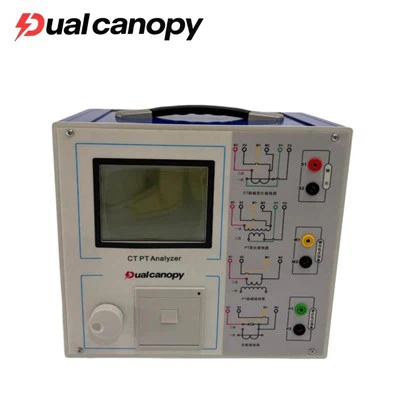
The circuit breaker vacuum degree detector is a specialized high-voltage electrical testing equipment specifically designed for detecting and evaluating the vacuum degree inside the vacuum interrupter chamber of a vacuum circuit breaker.
Vacuum circuit breakers rely on a high degree of vacuum (typically below 10^-4 Pa) as the arc-extinguishing and insulation medium. The core component is the vacuum interrupter chamber (commonly referred to as the "vacuum bubble").
Safety hazard: If the vacuum level decreases (meaning the internal pressure increases), it will result in:
Opening failure: The circuit breaker fails to extinguish the arc properly during the opening process, which may cause the equipment to explode.
Insulation breakdown: Breakdown can occur under normal operating voltage, resulting in inter-phase short circuits or grounding faults.
Concealment: The decrease in vacuum level is a slow, internal process that cannot be observed from the outside. Even conventional electrical tests (such as insulation resistance tests) are difficult to effectively detect it.
Preventive maintenance: Regular inspections can detect potential problems in advance, preventing catastrophic failures, and is an important guarantee for the safe operation of the power system.
Breaker Vacuum Degree Detector
When choosing the instrument, please consider the following factors:
Measurement principle: The magnetron discharge method is preferred to ensure accurate and reliable measurement.
Measurement range: Ensure that it can cover the required vacuum range (for example, from 10^-5 to 10^-1 Pa).
Accuracy: The higher the accuracy, the better. It is usually better than 10% - 15%.
Built-in curve library: The more vacuum interrupter models preset by the instrument, the more convenient it is to use, and there is no need to manually draw the curves.
Human-computer interaction and data management: Large screens, Chinese menus, data storage and export functions (USB/Wi-Fi) will significantly enhance work efficiency.
Portability and Power Supply: Are the weight and size suitable for on-site carrying? Is it powered by AC electricity or an internal battery?
Brand and after-sales service: Choose well-known brands, such as Wuhan Hezhong Electric, to ensure technical support and after-sales maintenance.
Basic testing steps (taking the magnetron discharge method as an example):
Power outage, isolation, voltage check, grounding wire installation: Strictly follow the safety operation procedures.
Disconnect the connection: Disconnect the busbars on both sides of the vacuum circuit breaker to completely isolate the arc extinguishing chamber.
Connecting devices:
Wrap the excitation coil evenly around the exterior of the vacuum interrupter to be tested.
Connect the red and black clips of the high-voltage test line to the moving and static contacts of the arc extinguishing chamber (the circuit breaker is in the open position).
Set parameters: On the main unit, select the correct "arc extinguishing chamber model" or enter its relevant parameters (the instrument has built-in vacuum-to-current curves for common models).
Start the test: Initiate the test. The instrument will automatically apply a magnetic field and high voltage, measure the discharge current, and calculate the corresponding vacuum degree value.
Judgment result: The instrument will directly display the measurement result and compare it with the built-in standards (such as DL/T 846.9-2004 "General Technical Conditions for Testing Instruments for High Voltage Switchgear"). Based on this comparison, it will provide a conclusion of "qualified" or "unqualified".
Record and Report: Save or print the test data.