

Classification of Zinc Oxide Surge Arresters Test Instruments
Based on the differences in test principles, functional integration degree and application scenarios, zinc oxide surge arresters testers can be mainly classified into the following categories:
1. According to the testing principle and function classification
DC Parameter Tester (Mainstream):
Principle: Apply high-voltage direct current to the lightning arrester, and measure its leakage current and reference voltage.
Features: The technology is mature, and it has relatively strong anti-interference capability. It is currently the most commonly used type in the preventive tests of the power system. The main measurements are U1mAU1mA (the reference voltage under 1mA DC) and 0.75U1mA0.75U1mA under this condition, as well as the leakage current.
Communication Parameter Tester (Electrical Testing Instrument / Resistive Current Analyzer):
Principle: Without power outage, by measuring the leakage current at the terminal of the lightning arrester and the secondary voltage of the voltage transformer (PT), harmonic analysis is conducted to extract the fundamental wave and third harmonic components of the resistive current.
Features: Primarily used for online monitoring or live detection to assess the aging and moisture content of lightning arresters under operating voltage.
Power frequency reference voltage tester:
Principle: Specifically designed to measure the reference voltage under power frequency conditions when the lightning arrester passes through power frequency current (typically 1mA or equivalent current).
Feature: It is not as widely used as the DC parameter tester in specific scenarios.
Zinc oxide arrester tester
2. Classified by usage scenarios and portability
Portable/Handheld (Field Maintenance):
Small in size and light in weight, usually powered by batteries, it is suitable for on-site climbing operations or testing in confined spaces.
Desktop / High Precision Type (Laboratory / Maintenance Center):
More comprehensive functions, greater output power, higher precision. Usually requires an external 220V power supply. Suitable for detailed diagnosis and analysis of lightning arresters.
Online monitoring device (fixed installation):
It is fixedly installed at the bottom of the lightning arrester and continuously uploads data to the background, which is part of the status monitoring system.
Application scope of zinc oxide arrester tester
The zinc oxide arrester tester is mainly used to assess the insulation condition of the arrester, and to determine whether it is damp, aged or has deteriorated valve plates.
Handover test (for new installation acceptance)
Check whether all the parameters of the newly installed lightning arrester comply with the factory standards, and ensure that the equipment is healthy before being put into operation.
Must-measure items: DC reference voltage (U1mA U1mA) and leakage current at 0.75U1mA and 0.75U1mA.
2. Preventive tests (regular maintenance)
The periodic power outage tests conducted by the power system (transformers, power plants) in accordance with the regulations (such as DL/T 596 "Power Equipment Preventive Testing Procedures").
By comparing data from previous years, analyze the changing trend of the performance of the lightning arrester.
3. Live detection (condition diagnosis)
Without affecting the power supply, conduct tests on the in-service lightning arresters.
It is mainly used to detect the increase in resistive current in the arrester due to internal moisture or surface contamination. It is an important means for condition-based maintenance.
4. Fault Analysis (Post-Accident Inspection)
When a lightning arrester explodes, breaks down, or the line is struck by lightning and trips, tests should be conducted on adjacent or related lightning arresters to determine if they have been damaged by overvoltage.
Applicable equipment types:
High-voltage lightning arresters for substations (110kV, 220kV, 500kV and above).
Fuses for distribution lines (10kV, 35kV).
Lightning arresters for generators and capacitor banks.
Classification And Application Of Zinc Oxide Surge Arrester Testers
Popular Products

Open Flash Point Tester
Product Introduction Features: Fully automatic flash point tester, with touch screen instead of keyboard operation.

Capacitance Test
Products Description This 50kVA single phase pole mounted transformer is exported to Canada inJuly,2024.The rated

TTR Transformer Turns Ratio Tester
Products Description The ZS6810A / ZS6810E transformer ratio tester is mainly used for measuring the turns ratio or

Single-phase relay protection tester
The single-phase relay protection tester is a new type of intelligent test instrument, primarily used to calibrate

Sweep Frequency Response Analysers
Products Description Overview The Transformer winding deformation tester transformer winding deformation tester is used
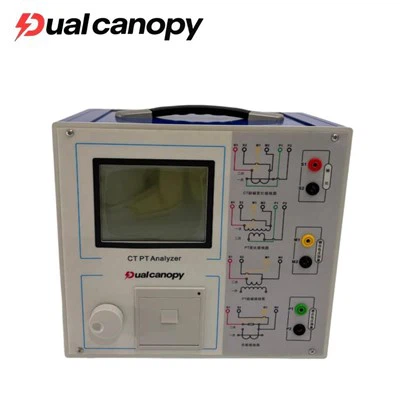
CT PT Excitation Characteristic Analyzer
Products Description The transformer comprehensive measuring instrument is an electronic device used for on-site