

For 10kV cross-linked polyethylene (XLPE) insulated cables, both internationally and domestically, it is generally recommended to use a variable-frequency series resonance AC withstand voltage test system as the main preventive test equipment. It has largely replaced the traditional DC withstand voltage test.
Core equipment includes:
Frequency conversion power cabinet:
Function: Converts the 380V industrial frequency power supply into a single-phase power supply with adjustable frequency (typically ranging from 30 to 300 Hz) and adjustable voltage.
Feature: It is the control core of the entire system, featuring functions such as voltage boosting, timing, and protection.
Excitation Transformer:
Function: Increase the output voltage of the variable-frequency power supply to provide energy for the resonant circuit.
Inductors (one or more):
Function: Core component, forming a series resonant circuit with the capacitance of the test cable.
Selection: Based on the length (capacitance) of the cable and the test voltage, select the combination mode (series or parallel) of the reactor to meet the resonance conditions.
Capacitive voltage divider:
Function: It is used to precisely measure the high voltage applied to the cable during the test, and also serves as the compensation capacitor of the resonant circuit.
Feature: Its measurement accuracy is much higher than that obtained through the conversion method using the low-voltage side of the transformer.
Cable AC withstand voltage test equipment
Compensation capacitor (optional):
Function: If the cable is short and the capacitance is too small, making it difficult to meet the resonant conditions, this capacitor can be used for parallel compensation.
High-voltage connection lines and accessories:
Including dedicated cables for connecting the equipment and cables, as well as equalizing balls, etc.
Why use AC withstand voltage instead of DC withstand voltage?
The distribution of electric fields is different: under direct current voltage, the electric field intensity is distributed according to the insulation resistance; under alternating current voltage, it is distributed according to the capacitance. The latter is more in line with the actual operating conditions of the cable.
The drawbacks of DC testing: The DC withstand voltage test will cause a spatial charge effect in the insulation of XLPE cables, which is likely to cause irreversible damage to the insulation and may mask existing insulation defects. Moreover, it may lead to breakdown even after the test is completed and the cable is put into operation.
Effective defect detection: AC withstand voltage testing can more effectively identify concentrated defects in cable accessories, such as air gaps in terminations and intermediate joints, and insulation moisture damage.
Test method (taking the variable frequency series resonance method as an example)
Preparation before the experiment:
Safety measures: Obtain work permits, confirm that the cables have been de-energized, have been tested for electricity, and have been grounded. Set up safety barriers in the test area and assign dedicated personnel for supervision.
Cable insulation inspection: First, use an ohmmeter (2500V or 5000V) to measure the main insulation resistance of each phase of the cable and the insulation resistance of the outer sheath and inner lining. Ensure that they meet the requirements before conducting the withstand voltage test.
Connection:
Connect one phase core wire of the test cable to the high-voltage output terminal, and ground the non-tested phase core wire, the metal shielding layer (or metal sheath), and the steel armor together.
Connect the measurement signal lines of the voltage divider correctly to the control box.
Make sure that all grounding wires are securely and reliably connected.
Test steps:
System connection and inspection: Ensure that all equipment connections are correct, grounding is reliable, and the voltage regulator is at zero position.
Parameter settings: On the frequency conversion power supply control box, set parameters such as test voltage, withstand voltage time, overvoltage protection value, and overcurrent protection value.
Automatic tuning: When the device is activated, it will automatically scan within a certain frequency range to find the resonance point (at this time, the loop current is the largest, the voltage is the highest, and the power supply output current is the smallest).
Voltage boosting: After the tuning is completed, the equipment will automatically or manually slowly increase the voltage to the target test voltage. During the voltage boosting process, it is necessary to closely monitor whether there are any abnormal discharge sounds in the high-voltage circuit and the cable terminals.
Timing: When the voltage reaches the specified test voltage value, start timing and maintain this voltage for the specified period of time.
Blood pressure reduction and judgment:
When the pressure resistance time is over, gradually and evenly reduce the voltage to zero, and then cut off the power supply.
Test result judgment: If the cable insulation does not break down within the specified test voltage and time, and there are no abnormal discharges, burnt smells, etc. during the test, then it is considered that the withstand voltage test of this phase cable is qualified.
Discharge: Use a dedicated discharge rod to fully discharge the tested cable and ground it.
Phase change: Repeat the above steps and conduct tests on the other two phases in sequence.
10kv High-voltage Cable Withstand Voltage Test Equipment And Test Methods
Popular Products

Open Flash Point Tester
Product Introduction Features: Fully automatic flash point tester, with touch screen instead of keyboard operation....

Capacitance Test
Products Description This 50kVA single phase pole mounted transformer is exported to Canada inJuly,2024.The rated...

TTR transformer turns ratio tester
Products Description The ZS6810A / ZS6810E transformer ratio tester is mainly used for measuring the turns ratio or...

Single-phase relay protection tester
The single-phase relay protection tester is a new type of intelligent test instrument, primarily used to calibrate...

Transformer Winding Deformation Tester Sweep Frequency Analyzer
Products Description Overview The Transformer winding deformation tester transformer winding deformation tester is...
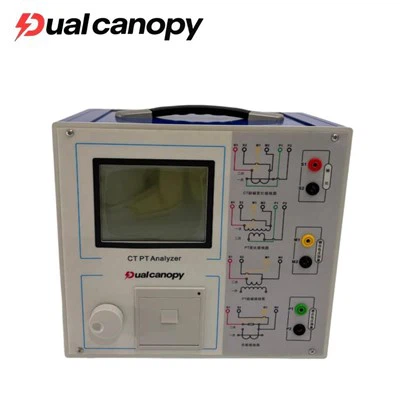
CT PT Excitation Characteristic Analyzer
Products Description The transformer comprehensive measuring instrument is an electronic device used for on-site...