

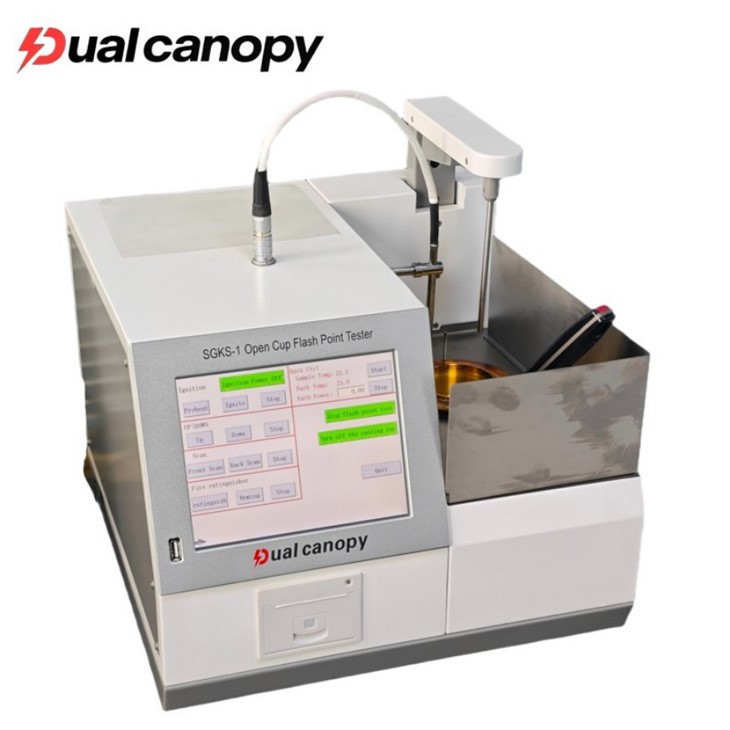
Dual Canopy Mechanic Electrical Engineering Co., Ltd. is one of the leading manufacturers and suppliers of open cup test in China. Please feel free to wholesale discount products for sale here and get quotation from our factory. Customized orders are welcome.
Why do wholesale customers choose this open cup test?

Heavier petroleum products-lubricating oils, transformer oils, bitumen fractions-tend to flash high enough that closed-cup methods give you a reading that is too conservative for practical use. The Cleveland Open Cup under ASTM D92 is the standard workaround. Because the cup is open to air, the vapor mixes naturally, so you get a flash point that reflects real-world handling rather than a confined-space worst case. The instrument also captures the ignition point, where the vapor sustains combustion for five seconds or more. For heavy fuels, that sustained burn number is often more relevant than the initial flash.
Power utility labs use this to track in-service transformer oil. After years of topping off and thermal cycling, the oil can pick up lighter contaminants that drag the flash point down. The COC test catches that drift earlier than a closed-cup method would, giving you a heads-up to investigate before the oil becomes a fire risk. Petrochemical labs run it for product certification on heavier cuts, and independent testing houses need it for the occasional fuel oil sample that does not fit their lighter-methods portfolio.
The instrument is designed for labs that process volume. It handles the heating ramp automatically, detects the flash with a sensor rather than an operator's eye, and logs the temperature. That consistency between operators is the real selling point-one technician gets the same result as the next, which matters when you are certifying batches for customers who will reject the load if the paperwork looks inconsistent.
For distributors or project buyers, the logistics are simpler than you might expect. Electronic ignition means no gas cylinders to ship, which clears customs faster and removes the headache of local propane sourcing. The hardware is built for freight handling, and minimum orders for OEM branding or voltage configuration are low enough that regional dealers can bring in five units to test demand without committing to a full container.
Why is a fully automated testing process important??
Manual open-cup flash point testing is inherently subjective. One operator catches the blue flame at the instant it propagates across the surface; another registers it a half-second later when the vapor cloud has already heated further. In round-robin studies, that human variation routinely produces spreads of ±12 °C between trained technicians on the same sample.
The automated approach replaces the eye with a dual-wavelength infrared and ionization sensor pair. The infrared channel watches for the thermal signature of a flame front, while the ionization detector picks up the sudden conductivity change in the vapor space above the oil. Together they register a flash event within roughly 50 milliseconds-faster than human reaction time, and without the hesitation or anticipation that biases manual calls. This does not eliminate every source of error; sample preparation and heating rate still matter. But it removes the largest variable in the chain, which is the operator.
In a comparative run across fifty production units, the automated system held repeatability within ±2 °C. For context, ASTM D92 allows a repeatability limit of ±8 °C and a reproducibility limit of ±17 °C for manual Cleveland open-cup testing. The tighter spread means that when a lab runs the same sample twice, or when two different labs compare results, the numbers actually agree rather than overlapping within a wide tolerance band. That consistency matters for custody transfer, for spec compliance, and for catching a genuine shift in product quality rather than chalking it up to operator variation.
What are the decisive factors for precise PID temperature control in open cup test??

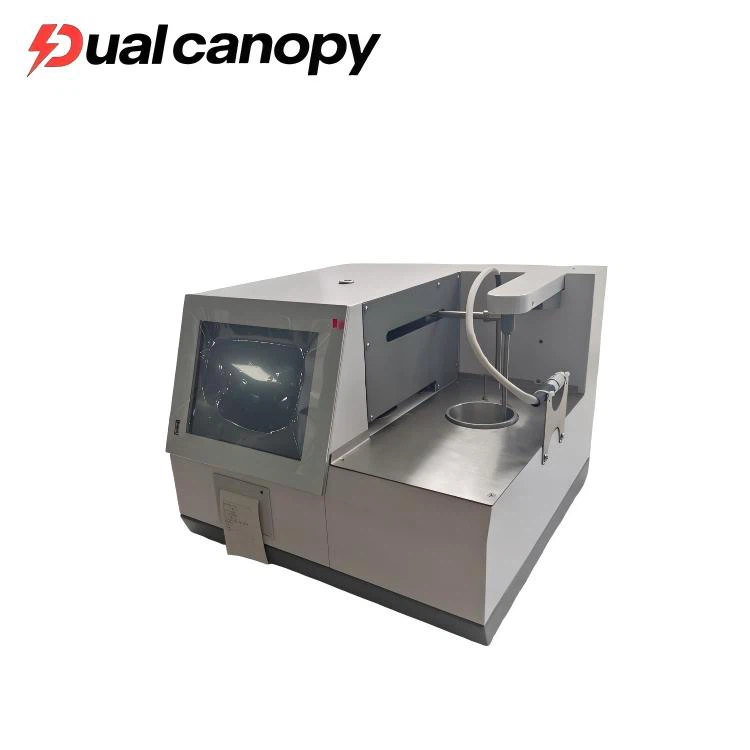
The heating profile under ASTM D92 is not as simple as "turn it on and wait." The standard calls for a faster initial ramp-between 5 and 17 degrees per minute-then a switch to a slower, controlled rate of 5 to 6 degrees per minute once you are within 28 degrees of the expected flash point. That slowdown matters because if you are still racing upward when the sample is close to flashing, you blow past the ignition temperature and record a number that is artificially high. The controller handles that transition automatically, so the operator is not sitting there with a stopwatch trying to guess when to flip the switch.
Temperature accuracy is another place where cheap instrumentation falls apart. The unit uses a Pt100 Class A sensor, which under IEC 60751 keeps its error to within ±(0.15 + 0.002|t|) degrees. At 300 degrees, that works out to about ±0.75 degrees. For context, the instrument itself is rated to ±1 degree, so the sensor is not the limiting factor. That margin matters because a flash point test that is off by two or three degrees can shift a product from one shipping classification to another, or make used transformer oil look worse than it actually is.
What benefits can this device bring to customers??
If you run a lab that handles oil certification or condition monitoring, the daily reality is not glamorous. It is twenty samples queued up, a technician who called in sick, and a customer demanding results by tomorrow morning. The right instrument changes the rhythm of that day.
First, there is the throughput problem. Manual flash point testing consumes attention. Someone has to stand over the bath, watch the flame, judge the moment. Automate that step and the same technician can prep the next sample, review yesterday's data, or handle the paperwork that always piles up. The lab processes more samples without adding headcount, which matters when margins are tight and skilled techs are hard to hire.
Then there is the consistency issue. Two experienced operators can look at the same flash event and disagree by a few degrees. That variation becomes a problem when you are certifying product for export or disputing a rejection with a supplier. Automated detection with a sensor gives you a number that holds up under scrutiny. It is not just about accuracy; it is about having data that both parties trust enough to sign off on.
For smaller labs or remote sites, the logistics matter too. Eliminating gas cylinders means no hazmat shipping headaches, no local supplier contracts, and no safety inspections for flammable storage. The unit ships, plugs in, and runs. That simplicity translates to lower operating costs and fewer reasons for the instrument to sit idle while you wait for consumables.
Finally, there is the safety angle. Open-cup testing with a live flame and hot oil is inherently risky. Electronic ignition and automatic shutoffs remove the human element from the most dangerous part of the sequence. Technicians go home with their eyebrows intact, and the lab avoids the incident reports that drive up insurance premiums.
In which scenarios is the open cup test frequently used?
1. Power Industry: Transformer oil monitoring tracks flash point as a degradation indicator, though closed-cup methods (IEC 60156/ASTM D93) are more common than open-cup for this application. When a used oil sample drops significantly below the new oil baseline-say 10–15 degrees or more-it usually signals thermal stress or contamination by lighter fractions. At that point you investigate further with dissolved gas analysis and acidity tests before deciding on replacement, rather than jumping straight to oil change.
2. Oil and Petrochemical: Refineries run flash points on crude fractions, base stocks, and finished fuels as part of routine QC. The open-cup method (ASTM D92) sees use for heavier fractions and lubricants where the closed-cup would be overly conservative, though the specific method depends on what the product spec calls out.
3. Transport and Safety: For hazmat classification, flash point determines the packing group under UN and DOT rules. The thresholds are specific: materials at or below 60 °C generally trigger flammable liquid classification, with sub-divisions at 23 °C and 35 °C driving packaging requirements and shipping labels. Getting this wrong means rejected shipments or regulatory fines.
4. Third-Party Labs:** Independent testing houses need equipment that handles multiple methods because their clients span industries. One day it is ASTM D92 for a lubricant client, the next it is GB/T 3536 or IP 36 for an export certificate. The instrument needs to switch standards without recalibration headaches.
5. Research and Education: University labs use flash point data for characterizing bio-based or synthetic lubricants where traditional baselines do not exist. Students learn that flash point is not just a safety checkbox-it reveals volatility profiles that affect formulation stability.
What are the key security considerations?
Grounding is where most close calls start. I have seen technicians clip the ground lead to a painted handrail because the proper earth stud was twenty meters away across muddy gravel. The instrument chassis floated at induced voltage from nearby buswork. Nobody died that day, but the guy who touched the panel got knocked back hard enough to sprain his wrist. A proper ground means a dedicated wire back to a verified low-impedance earth point, not a convenient pipe or railing. If you are on a concrete pad or compacted fill, the surface resistance to ground is higher than it looks. Test it if you are unsure.
Discharging before you disconnect is non-negotiable. Transformer windings and large capacitor banks store energy that does not care about your schedule. The "discharge" light on the panel is there for a reason. Wait for it. I know a technician who pulled leads early on a 150 MVA transformer because his supervisor was shouting about the outage window. The back-EMF arced across the terminals, fried the analyzer's mainboard, and threw him into the relay rack. He was lucky-bruises and a scare. The instrument was not lucky. Thirty seconds of patience costs nothing compared to that.
Know what must never be open and what must never be shorted. Current transformer secondaries are the classic trap. Open the secondary on an energized CT and you generate lethal voltages across the terminals-hundreds or thousands of volts from a few amps of primary current. I have heard stories of guys getting knocked across rooms. On the flip side, shorting a voltage transformer secondary blows fuses and can inject noise into protection schemes that trip breakers you did not intend to touch. Verify your terminal numbers with a second pair of eyes before you clip anything.
The environment around you matters more than the test itself. Flash point testing puts flammable vapor into the air. Do it in a closet with poor ventilation and you are building a bomb, not running a quality check. Open-cup methods especially need a fume hood or strong cross-ventilation. For high-voltage work, humidity above seventy-five percent changes the rules. Moisture in the air, on your hands, or on the equipment surface creates leakage paths that defeat your insulation and can make a "safe" voltage suddenly bite. And never set up in a space where you are working alone with no line of sight to someone who can hit an emergency stop.
Physical proximity to live parts is the silent killer. When you are staring at a tablet screen under an arrester stack or next to a breaker cabinet, you stop noticing the energized bus three meters above your head. Step backward to find shade or better footing, and you are in the phase-to-ground clearance zone without realizing it. Look up before you move. Every single time. The cable you are dragging across the yard is also a trip hazard that can send you into live conductors.
Sample handling has its own hazards. Oil testing seems tame until you remember you are heating flammable liquid under an ignition source. Even "automatic" testers need a human watching for abnormal behavior. And those capacitor banks you are testing? They hold a charge after disconnection. Always ground them with a discharge rod before you connect your meter. The rod is not optional equipment; it is the difference between a routine test and a fireball.
Cable and clamp integrity is easy to ignore. Damaged insulation on a voltage lead, a cracked alligator clip boot, or a loose connector in a 400 V cabinet turns a measurement error into an arc flash risk. Inspect your leads before every use. If the insulation is nicked or the clip is loose, swap it before you open the cabinet door. It takes ten seconds and saves you from explaining to an emergency room physician why your hand looks like that.
Pre-sales oversight:
Free Technical Consultation - Our engineers help you match the most suitable model based on your testing standards (ASTM D92 vs. ASTM D93).
Custom Branding and Packaging - We support private label manufacturing, including your logo, brand colors, boot animation, and customized user manual.
After-sales guarantee:
One-year warranty on the entire machine, lifetime maintenance. Free replacement of parts for non-human-caused damage within the warranty period;

FAQ
Q1: What is the difference between an open-cup flash point tester and a closed-cup flash point tester?
A: The open-cup method (Cleveland method, ASTM D92) exposes the sample surface to the atmosphere and is suitable for high flash point materials with a flash point above 79°C, such as lubricating oils, transformer oils, and asphalt. The closed-cup method (Pensky-Martin method, ASTM D93) uses a sealed cup with a small opening and is designed for low flash point liquids such as diesel, solvents, and kerosene. Because vapors can escape in the open cup, the open-cup flash point of the same sample is typically 5–15°C higher than the closed-cup flash point. The appropriate test method should be selected according to the applicable product standards and regulations.
Q2: How are the instruments packaged to ensure safe international transport?
A: Each instrument is lined with custom-made EPE foam and placed in a thickened export-grade plywood crate (compliant with ISPM-15 standards – heat-treated, fumigation-free, and does not delay customs clearance). The packaging has undergone ISTA 3A standard testing (simulating road, rail, and sea vibration and drop).
Q3: How often does an open-face flash point tester need calibration? Can I calibrate it myself?
A: We recommend annual calibration verification using a certified reference material (CRM) with a known flash point. If your laboratory is ISO/IEC 17025 accredited, the accreditation body may require a calibration interval of 6 or 12 months. Users can perform verification checks using the CRM themselves; however, traceable formal calibration should be performed by a CNAS/ILAC accredited laboratory or our factory calibration service. We offer calibration kits (CRM oil + operating instructions) for wholesale purchase.
Hot Tags: open cup test, China open cup test manufacturers, suppliers, factory, cleveland flash fire point testing kit


