

The construction, performance and testing of the high-voltage partial discharge shielding chamber need to follow a series of international, national and industry standards. These standards mainly stipulate the requirements for shielding effectiveness, background noise and the testing methods for partial discharge themselves.
Electromagnetic shielding effectiveness standard
These standards specify the attenuation capabilities of the shielding room for various frequency electromagnetic waves.
International standard:
IEEE 299.1: "Standard for Measuring Shielding Effectiveness of High Frequency (300 MHz to 50 GHz) Shielding Rooms". This is currently the most authoritative and comprehensive standard for measuring shielding effectiveness, covering a wide range of frequencies.
IEC 61000-4-3: Mainly concerns radiation, radio frequency, and electromagnetic field immunity tests, but its requirements for the test environment are also indirectly applicable to the shielding room.
MIL-STD-188-125: This is an American military standard with extremely high requirements for shielding effectiveness. It is often used in situations with specific needs.
Chinese national standard:
GB/T 12190-2021: "Measurement Methods for Shielding Effectiveness of Electromagnetic Shielding Rooms". This is the most crucial shielding effectiveness testing standard in China, equivalent to IEEE Std 299.
Arcing Shielding Chamber
2. Local Discharge Measurement Standards
These standards specify how to conduct partial discharge tests and set requirements for the background noise of the test environment (i.e., the shielding chamber).
International standard:
IEC 60270: "High Voltage Test Technology - Partial Discharge Measurement". This is the most fundamental and authoritative international standard for partial discharge measurement. It explicitly requires that the background noise of the test circuit (including the environment) should be sufficiently low. Usually, it is required to be at least 6 dB lower than the specified partial discharge limit (that is, half of the limit), and it is recommended to verify the background noise without the test sample.
IEC 60076-series: Standards for Power Transformers, among which some stipulate the acceptance criteria and testing requirements for transformer partial discharge tests.
Chinese national standards / industry standards:
GB/T 7354-2018: "High Voltage Test Technology - Partial Discharge Measurement". This standard is an equivalent adoption of IEC 60270 and is the core reference for partial discharge testing in China.
GB/T 16927.1-2011: "High Voltage Test Technology - Part 1: General Definitions and Test Requirements", contains general provisions regarding the test environment.
DL/T 417-2022: "Guidelines for On-site Measurement of Partial Discharge in Power Equipment". This is a field standard in the power industry. Although it is targeted at the field, its requirements for background noise and control have reference significance for shielded rooms.
Equipment standards: such as GB 1094.3 (transformer), GB/T 11017 (cable), GB 1207 (transformer mutual inductor), etc. These product standards all include provisions for partial discharge tests, indirectly requiring that the test environment must comply with the regulations of IEC 60270.
3. Safety and Construction Standards
Electrical safety: It must comply with national electrical safety regulations, such as grounding in high-voltage laboratories, safety distances, warning systems, etc.
Architecture and Fire Safety: The architectural structure, fireproof materials, and fire-fighting facilities of the isolation room must comply with the national building and fire safety standards.
Summary of the core requirements of the standard procedures
For a qualified high-voltage partial discharge shielding chamber, the standard procedures mainly focus on:
Shielding effectiveness: Within a specific frequency range (such as 10kHz ~ 1GHz or higher), the shielding effectiveness should reach the specified value (for example, > 80dB at 1MHz and > 100dB at 1GHz). The specific value depends on the accuracy level of the laboratory.
Background noise: When the test circuit is set up but no voltage is applied, or when a "dummy sample" without partial discharge is connected, the background noise measured by the measurement system should be much lower than the partial discharge limit value of the tested equipment (typically requiring at least 50% reduction). A high-performance partial discharge shielding room can have a background noise level of < 1-2 pC.
Test method compliance: The partial discharge test conducted in the shielded room must strictly follow the provisions of IEC 60270 (GB/T 7354) regarding calibration, wiring, and measurement procedures.
Therefore, when designing, constructing and inspecting a high-voltage partial discharge shielding chamber, all the above standards must be comprehensively considered to ensure that it can not only provide excellent electromagnetic shielding performance, but also meet the safety requirements of high-voltage tests and the international standards for partial discharge measurement.
Standards And Regulations Related To The Construction Of High-voltage Partial Discharge Shielding Chambers
Popular Products

Open Flash Point Tester
Product Introduction Features: Fully automatic flash point tester, with touch screen instead of keyboard operation....

Capacitance Test
Products Description This 50kVA single phase pole mounted transformer is exported to Canada inJuly,2024.The rated...

TTR transformer turns ratio tester
Products Description The ZS6810A / ZS6810E transformer ratio tester is mainly used for measuring the turns ratio or...

Single-phase relay protection tester
The single-phase relay protection tester is a new type of intelligent test instrument, primarily used to calibrate...

Transformer Winding Deformation Tester Sweep Frequency Analyzer
Products Description Overview The Transformer winding deformation tester transformer winding deformation tester is...
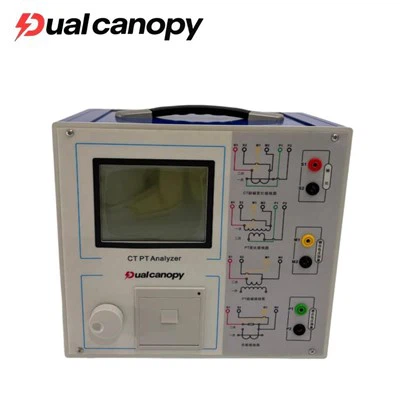
CT PT Excitation Characteristic Analyzer
Products Description The transformer comprehensive measuring instrument is an electronic device used for on-site...