

The core principle of the selection process is: to meet the current testing requirements and to be appropriately ahead to adapt to future development. The main considerations include the following aspects:
Core performance parameters
Output channel count:
Current channel: At least three-phase current (Ia, Ib, Ic) is required. It is recommended to choose 4-phase or 6-phase. The additional channels can be used as zero-sequence current (Io) or for differential protection testing as compensation current, significantly improving the testing efficiency and flexibility.
Voltage channel: At least 4-phase voltages (Va, Vb, Vc, Vn) are required, where Vn can be used as the zero-sequence voltage or the line tap voltage. For more complex tests such as transformer differential, more voltage channels (such as 6-phase voltages) would be more convenient.
Output capacity:
Current output: For regular tests, a current of 30A to 50A per phase is generally required. If the test object is a large transformer or if a high current is needed in a certain situation (such as busbar protection, overcurrent relays), a more powerful model should be selected, such as 75A or higher. Pay attention to the duration of continuous output, as long-term high current output may have an impact on the instrument.
Voltage output: The standard output is 120V per phase or 100V per phase (corresponding to line voltage 57.74V), which is sufficient for most protection tests. If special scenarios such as generator protection testing are required, a higher voltage output might be necessary.
Integrated Relay Protection Test Instrument
Output accuracy:
This is the core of the tester. The accuracy of current, voltage, phase and frequency directly determines the reliability of the test results. Generally, the following requirements are imposed:
Current/voltage accuracy: ≤ 0.1% - 0.2%
Phase accuracy: ≤ 0.1°
Frequency accuracy: ≤ 0.001Hz
Power amplifier technology:
Modern testers generally adopt linear amplifiers or D-class switching amplifiers. Linear amplifiers have high precision and low distortion, but they are large in size and have low efficiency; D-class amplifiers have high efficiency and small size, and the technology is mature. They are currently the mainstream.
2. Software Functionality and Usability
Pre-set test module: Does the instrument offer a wide range of pre-set test templates, such as:
General relays (overcurrent, undervoltage, overvoltage, direction, frequency, synchronization)
Differential protection (transformer, generator, busbar, line)
Distance Protection (Impedance Characteristic Curve Scanning)
Harmonic testing
Fault playback (COMTRADE format)
Operation interface:
External computer software type: Powerful functions, friendly interface, easy to generate reports, suitable for laboratories and fixed locations.
Built-in industrial control computer touchscreen type: Integrated design, convenient to carry, suitable for on-site debugging.
Report generation capability: Whether it is possible to automatically record test steps, parameters and results, and generate test reports in a standard format, which is crucial for standardized management and traceability.
3. Portability and Power Supply
Volume and weight: Choose based on the application scenario (laboratory vs. field use). For field use, a lightweight and sturdy model should be preferred.
Power supply method: Most models require an AC 220V power supply. Some models support DC power supply or have built-in batteries, which are suitable for substations without an AC power source.
4. Brand and After-sales Service
Choose brands with good reputation in the industry and strong technical capabilities. For example: Wuhan Hezhong Electric Co., Ltd.
The after-sales service includes technical training, software upgrades, and response speed for repairs, which are all very important.
The relevant standards stipulate
The production, inspection and use of relay protection testers must comply with a series of international, national and industry standards. These standards ensure the accuracy and comparability of the test results.
Product design and manufacturing standards
GB/T 7261-2016 "Basic Test Methods for Relay Protection and Safety Automatic Devices": This is the most core standard in China, which details the test conditions and methods for various protection devices. The design of the tester must meet its requirements.
DL/T 624-2010 "Technical Conditions for Microcomputer-Based Test Equipment for Relay Protection": This is a specialized technical standard for microcomputer-based relay protection testers in the power industry, specifying its technical parameters, functions, safety, and inspection rules, etc.
IEC 60255 series "Electrical Relays" international standard: This is an internationally recognized relay standard that has been adopted by many countries.
IEC 61000-4 series of "Electromagnetic Compatibility (EMC)" standards: Ensure that the tester can operate stably in a complex electromagnetic environment and does not cause interference to other devices.
2. Inspection and Calibration Standards
JJG (Electric Power) 01-94 "Verification Regulations for Microcomputer-Based Test Equipment for Relay Protection": This is a domestic regulation used for the periodic verification/calibration of test instruments, ensuring the accuracy of the value transmission.
Users should send the tester to a qualified metrology institution for calibration on a regular basis (typically once a year), and obtain the calibration certificate.
3. On-site Testing Work Standards
DL/T 995-2016 "Inspection Procedures for Relay Protection and Grid Security Automatic Devices": This is a guiding document for on-site personnel to conduct regular inspections of protection devices. All tests conducted using test instruments should follow this procedure, including the items, methods, and criteria for determining qualification.
Selection And Standard Procedures For Relay Protection Comprehensive Test Instruments
Popular Products

Open Flash Point Tester
Product Introduction Features: Fully automatic flash point tester, with touch screen instead of keyboard operation.

Capacitance Test
Products Description This 50kVA single phase pole mounted transformer is exported to Canada inJuly,2024.The rated

TTR Transformer Turns Ratio Tester
Products Description The ZS6810A / ZS6810E transformer ratio tester is mainly used for measuring the turns ratio or

Single-phase relay protection tester
The single-phase relay protection tester is a new type of intelligent test instrument, primarily used to calibrate

Sweep Frequency Response Analysers
Products Description Overview The Transformer winding deformation tester transformer winding deformation tester is used
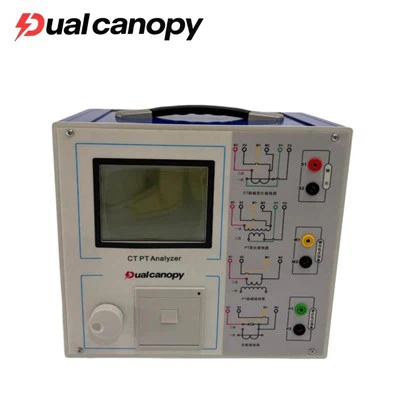
CT PT Excitation Characteristic Analyzer
Products Description The transformer comprehensive measuring instrument is an electronic device used for on-site