




Dual Canopy Mechanic Electrical Engineering Co., Ltd. is one of the leading manufacturers and suppliers of Electrical Insulation Testing in China. Please feel free to wholesale discount products for sale here and get quotation from our factory. Customized orders are welcome.
What does electrical insulation testing look like now?
Anyone who works in the electrical field knows that measuring insulation resistance (commonly known as "insulation testing") is to check equipment for moisture, dirt, aging, or through-hole defects, preventing breakdowns and explosions when power is supplied.
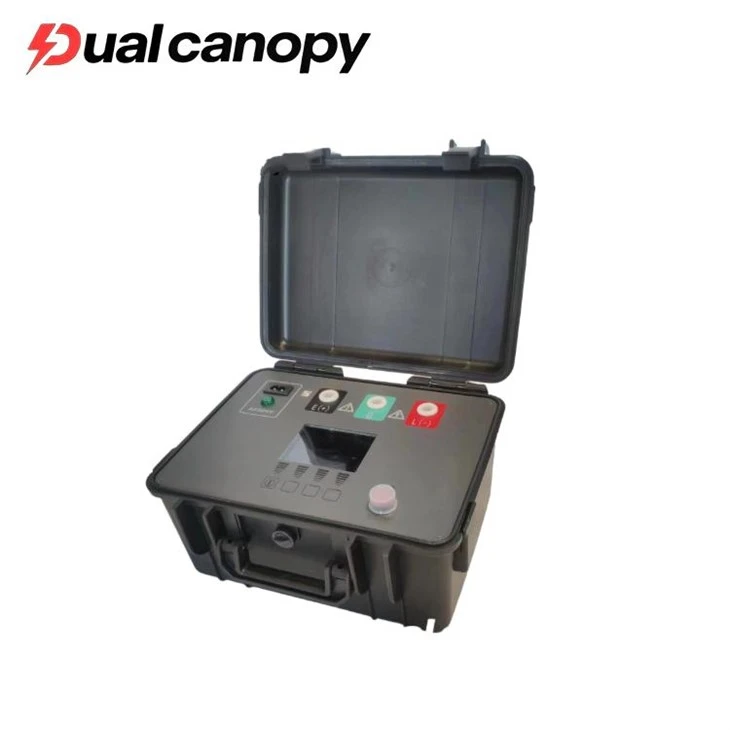
In the past, experienced technicians used hand-cranked megohmmeters, cranking them until their arms ached, and readings were done by eye; calculating the absorption ratio (PI) and polarization index (DAR) could be a frustrating ordeal. Our Insulation Resistance Tester (digital high-voltage insulation resistance tester) has a built-in high-frequency high-voltage generator, automatically boosting voltage with one button, automatically timing, automatically calculating the absorption ratio and polarization index, and automatically discharging after the test. Simply put, it uses stable, clean high-voltage DC power to "force" out hidden dangers in the equipment's insulation.

How to choose the right equipment for the right scenario without blindly buying it?

1. Low-voltage standard version (500V / 1000V / 2500V)
(Mainstay for factory and mining electricians/property management/low-voltage switchgear) Lightweight and inexpensive. Suitable for testing the insulation of 380V low-voltage motors, household appliances, control cables, and secondary circuits. Short-circuit current of 1mA~3mA is sufficient.
2. High-voltage mainstay version (2500V / 5000V)
(Standard configuration for power supply bureaus/power plants/high-voltage switchgear manufacturers, highly recommended) Suitable for 10kV/35kV transformers, high-voltage motors, SF6 circuit breakers, and short-distance high-voltage cables. Short-circuit current up to 3mA/5mA, with automatic absorption ratio/polarization index calculation function.
3. Ultra-high voltage/large capacitor version (5kV / 10kV / 15kV)
(Dedicated for extra-high voltage/long cables/large generators) Designed for 110kV and above main transformers, long-distance high-voltage cross-linked cables, and large generator stators. The short-circuit current can reach 10mA or even 20mA. Large capacitor devices charge extremely quickly, without waiting for half a day for the data to stabilize.
What problems can users solve by using it?
1. No "slow and steady" operation with large capacitors: High short-circuit current allows for instantaneous charging of transformers or long cables to the set voltage, resulting in stable and fast data, eliminating the need for on-site waiting.
2. Say goodbye to false breakdowns: High induced voltage on-site can cause ordinary meters to fluctuate wildly or even trigger alarms. Our anti-interference circuit filters out noise, providing the true insulation resistance value.
3. Life-saving discharge design: After testing large capacitors, residual charge inside can be fatal. Our forced discharge function is a "safety talisman" for on-site operations.
How to select Electrical Insulation Testing parameters?
|
Voltage Range |
250V |
500V |
1000V |
2500V |
5000V |
| Accuracy: |
<100k |
<100k |
<100k |
<100k |
<100k |
|
5% |
100k-5G |
100k-10G |
100k-20G |
100k-100G |
100k-100G |
|
20% |
5G -50G |
10G -100G |
20G-200G |
100G-1T |
100G-1T |
| R |
> 50G |
> 100G |
> 200G |
> 1T |
> 1T |
What processes are involved in transforming equipment into a testing instrument?
High-voltage module potting process: The internal high-voltage transformer and voltage multiplier rectifier module are all integrally potted with vacuum epoxy resin. This provides moisture protection and partial discharge prevention, ensuring uninterrupted insulation even in humid environments such as the rainy season in southern China or at high altitudes, eliminating internal sparking.
Weak current sampling: Utilizing a high-precision electrometer-level operational amplifier with a Teflon-insulated bracket, leakage current remains accurate even when measuring resistances of 100GΩ or even above 1TΩ.
How to maintain equipment to extend its service life?
Battery Management: For models with built-in lithium batteries, charge them every 2-3 months when not in use to prevent battery depletion.
Test Lead Inspection: High-voltage wires must be free of damage or cracks. After each use, wipe them clean with a dry cloth, coil them up, and store them away from sharp tools.
Regular Calibration: It is recommended to have the wires calibrated annually by a metrology institute, especially for high resistance ranges (e.g., above 100GΩ) to ensure accuracy.
After-sales Service
Warranty Policy: 24-month warranty on the entire machine (excluding damage caused by human error and consumables).
Lifetime Maintenance: Lifetime paid repair service provided after the warranty period, charging only the cost of materials.
Rapid Response: 24/7 technical support hotline, fault response time < 2 hours.

FAQ
1. Q: What are the Density Absorption Ratio (DAR) and Polarization Index (PI)? Why are they measured?
A: When a high DC voltage is applied to an insulating material, it undergoes a process of "absorbing" charge. The current decreases over time, and the resistance increases.
DAR = Insulation value at 60 seconds / Insulation value at 15 seconds.
PI = Insulation value at 10 minutes / Insulation value at 1 minute.
If the insulation is damp or has penetrating defects, the absorption phenomenon is not obvious, and these two ratios will be lower (typically, DAR > 1.3, PI > 1.5 is required). They are important indicators for judging the moisture content of the insulation in large equipment (such as transformers and generators).
2. Q: Why does the voltage drop after my insulation meter is connected to the equipment, failing to reach the set value?
A: There are two reasons: First, the equipment's capacitance is too large, while the insulation meter you purchased has a short-circuit current rating that is too small, preventing it from charging properly. We recommend replacing it with a model that has a larger short-circuit current rating. Second, the equipment's insulation does indeed have a serious defect or short circuit, causing excessive leakage current that pulls down the voltage. This indicates a problem with the equipment itself.
3. Q: During testing, the resistance value on the screen keeps fluctuating upwards and doesn't stabilize. Is this normal?
A: For equipment with large capacitance (such as long cables or large transformers), due to the dielectric absorption effect, the insulation resistance will slowly rise over a long period (even tens of minutes). This is normal. This is why we look at the polarization index over 10 minutes, rather than just the instantaneous value.
Hot Tags: Electrical Insulation Testing, China Electrical Insulation Testing manufacturers, suppliers, factory, Megohmmeters