



Dual Canopy Mechanic Electrical Engineering Co., Ltd. is one of the leading manufacturers and suppliers of On-Load Tap Changer Tester in China. Please feel free to wholesale discount products for sale here and get quotation from our factory. Customized orders are welcome.
What is On-Load Tap Changer Tester?

The On-Load Tap Changer Tester (OLTC Tester) is a specialized diagnostic instrument designed to evaluate the performance and condition of On-Load Tap Changers (OLTCs) in power transformers. Unlike standard winding resistance testers that measure static resistance, the OLTC tester focuses on the dynamic behavior of the tap changer during its switching operation.
The OLTC is the only moving part connected to the transformer windings during operation and is statistically one of the most failure-prone components. This tester utilizes the dynamic resistance measurement method (also known as the "current method") to analyze the transition process between taps. By injecting a DC current and measuring the voltage drop across the winding during a tap change, it calculates the transition resistance and plots the resistance-vs-time waveform.
This analysis reveals critical mechanical and electrical issues such as contact wear, spring tension loss, insulation degradation, and timing deviations, enabling predictive maintenance and preventing catastrophic transformer failures.
Main Functional Characteristics
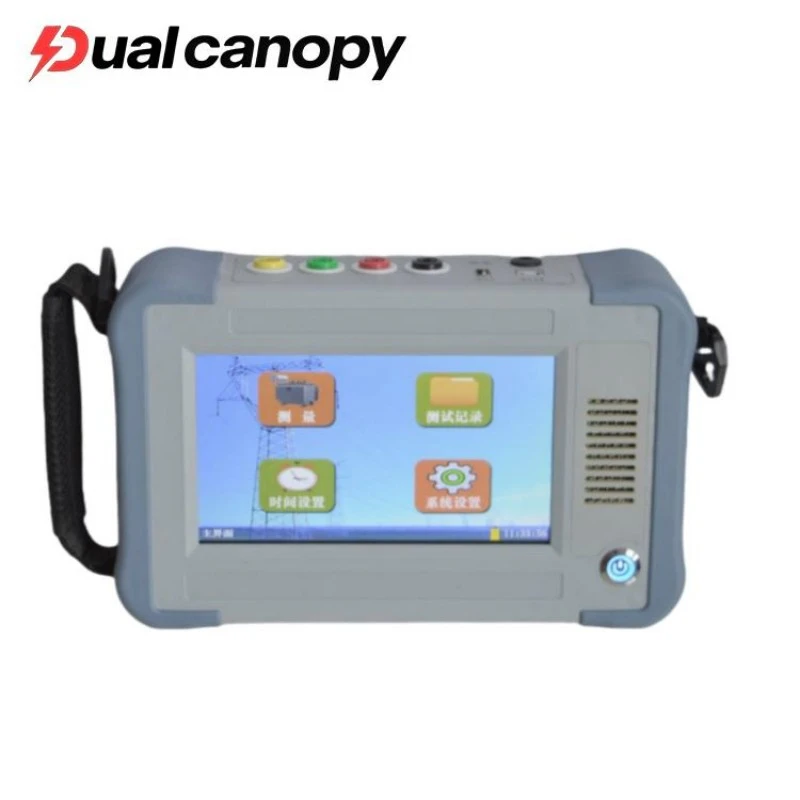
Handheld On-Load Tap Changer Tester
1. The device can cost a large output current, the device weighs less
2.Test YN, Y, D type transformer, resistance value without conversion directly display
3.This device has winding and don't has the measurement of winding .
4.The amplitude of resistance and time values can automatically adjusts according to the sampling values.
5.The device can display clearly in bright light with a seven-inch high brightness touch color LCD features , allowing users to switch between Chinese and English.
6.The device can automatically save 500 groups of data.
7.The instrument has a built-in lithium battery power supply, which is convenient for outdoor use.
8.The instrument can be connected with external printer to print measurement data, which is convenient for paperless office.(optional)

Where can this equipment be used?
1. Substation Preventive Maintenance
Routine Inspection: In accordance with preventive testing regulations for power equipment, dynamic testing is periodically performed on the on-load tap changers (OLTCs) of in-service main transformers to establish comprehensive health records.
Condition Assessment: By comparing historical waveforms, the degree of contact wear and trends in transition resistance are evaluated, enabling the early detection of potential fault risks.
2. Fault Diagnosis and Troubleshooting
Anomaly Handling: When a transformer experiences gas relay activation, abnormal Dissolved Gas Analysis (DGA) results (e.g., elevated acetylene levels), or voltage regulation failures, a dedicated tester is utilized to rapidly pinpoint whether the issue stems from an internal fault within the tap changer.
Fault Type Identification: Waveform analysis enables the identification of characteristic fault signatures, such as "contact sintering," "spring breakage," "insulation breakdown," and "mechanism jamming."
3. New Equipment Commissioning and Overhaul Acceptance
Factory/Incoming Inspection: Verifies that the factory performance of the tap changer on a newly acquired transformer meets acceptance criteria.
Post-Overhaul Acceptance: Following a major overhaul or component replacement of the tap changer, dynamic testing is conducted to validate the quality of the repair and ensure safe operation upon re-commissioning.
4. Tap Changer Type Compatibility
Resistor-Type Tap Changers: Measures transition resistance values and waveforms during the switching process.
Reactor-Type Tap Changers: Analyzes the switching sequence and current waveforms of the reactor branch.
Vacuum/Oil-Immersed Types: Applicable for testing tap changers utilizing various arc-extinguishing media.
What precautions should be observed during use?
What precautions should be observed during use?
Safety Warnings
Testing Under Load Strictly Prohibited: It is absolutely forbidden to conduct tests while the transformer is operating under load. For testing purposes, the transformer must be taken out of service, and it must be ensured that both the high-voltage and low-voltage sides have been disconnected from their respective loads.
Reliable Grounding: Prior to testing, it is mandatory to ensure that the transformer's neutral point, its enclosure, and the test instrument's enclosure are reliably grounded.
High-Voltage Discharge: Upon completion of testing, residual inductive charge may remain within the transformer windings. It is essential to fully discharge these windings-either by utilizing the test instrument's discharge function or by employing a dedicated discharge rod-to prevent injury caused by back electromotive force.
Model Selection Consultation: Based on the user's transformer capacity, voltage level, and tap changer type (e.g., brands such as MR, UC, ABB), we recommend the appropriate test current ranges and functional configurations.
Customized Technical Solutions: For specialized tap changer models (e.g., specific reactor-type designs), we provide customized test wiring schemes and waveform analysis templates.
Standard Compliance Guidance: We address inquiries regarding the requirements of standards such as DL/T 846.6, *Guidelines for Testing of On-Load Tap-Changers*, and assist users in formulating test plans that comply with relevant specifications.
Product Demonstrations: We offer on-site or video demonstrations to illustrate how to identify typical faults-such as contact erosion or broken springs-through waveform analysis.

FAQ
Q1: Why is the "dynamic resistance" of an on-load tap changer (OLTC) measured rather than its static resistance?
A: Static resistance measurement (such as that performed by a DC resistance tester) can only reflect the contact resistance once the contacts have closed; it cannot reveal the condition of the device during the actual switching process. During the instant of switching, an OLTC passes through a transition resistor; if the contacts are faulty or the mechanical mechanism jams at this moment, arcing or overheating may occur. Dynamic resistance measurement records the resistance variation curve throughout the entire switching process, thereby enabling the detection of mechanical faults and transition contact issues that static measurements would fail to identify.
Q2: What does the "transition resistance" peak in the test waveform represent?
A: During the switching process of a resistive tap changer, the current must flow through a transition resistor to facilitate commutation. The peak in the waveform represents the actual resistance value of this transition resistor. If the peak is excessively high, it indicates poor contact or ablation of the transition contacts; conversely, if the peak is too low or absent, it may suggest a short circuit in the transition contacts or an abnormal mechanical operation (such as a skipped step).
Q3: Can this tester detect "mechanical faults" within the tap changer?
A: Yes, it can. Although the test specifically measures the resistance waveform, mechanical faults are directly reflected in the characteristics of that waveform. For example:
Insufficient spring tension: This results in a prolonged switching time and a widening of the "steps" within the waveform.
Mechanism jamming: This causes jittering or stagnation to appear on the rising edge of the waveform.
Contact bouncing: This manifests as high-frequency spikes or "glitches" on the waveform.
Therefore, waveform analysis serves as an effective method for diagnosing mechanical faults.
Hot Tags: On-Load Tap Changer Tester, China On-Load Tap Changer Tester manufacturers, suppliers, factory, Transformer On Load Tap Changer Tester, transformer tap changer test equipment oltc tester, on load tap changer switch tester


