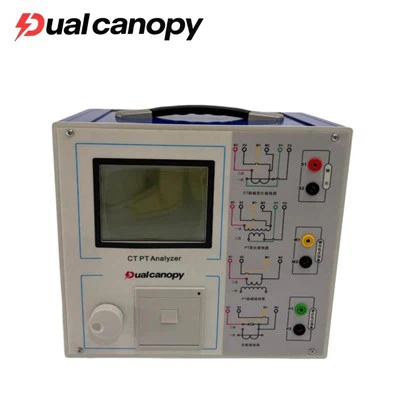
Dual Canopy Mechanic Electrical Engineering Co., Ltd. is one of the leading manufacturers and suppliers of CT PT Analyzer in China. Please feel free to wholesale discount products for sale here and get quotation from our factory. Customized orders are welcome.
What is this CT PT analyzer device used for?

Anyone who works in electrical testing knows that previously, measuring the volt-ampere characteristics, turns ratio, and polarity of current transformers (CTs/PTs) required carrying heavy voltage regulators, current boosters, and step-up transformers, along with a bunch of meters. The on-site wiring was incredibly complicated, and a few people working on it all day would be exhausted.
Our CT PT Analyzer (Instrument Transformer Integrated Tester) allows one person to automatically complete all acceptance and preventative tests on CTs (current transformers) and PTs (voltage transformers), including volt-ampere characteristics, turns ratio, polarity, secondary DC resistance, phase angle difference, ratio difference, and 10% error curves. After testing, it automatically plots curves and generates reports, completely freeing up the hands of the relay protection and high-voltage teams.
Where are the main users of this equipment located?
Power utilities and generation plants are primary users-specifically relay protection crews and high-voltage testing teams at supply bureaus, plus electrical testing groups at power stations handling acceptance checks and pre-commissioning work.
In the construction and installation sector, transmission and transformation engineering firms and electrical contractors rely on this equipment for project delivery.
On the manufacturing side, transformer and instrument transformer producers use it for factory-floor quality verification and R&D validation.
Independent testing bodies, including electric power research institutes and certified installation/repair/testing agencies, also make up a significant portion of the user base.Who actually uses this equipment? The list is broader than it first appears.
At power utilities and generating stations, relay protection teams and high-voltage testing crews at supply bureaus put it to work. So do the electrical testing groups inside power plants, where they run acceptance checks and pre-commissioning validation before equipment goes live.
Construction and installation firms-transmission and transformation engineering companies, plus electrical contractors-need it to close out projects and hand over assets that meet specification.
On the manufacturing floor, transformer builders and instrument transformer producers use it for outgoing quality inspection and for proving out new designs during R&D.
Then there are the independent testing organizations: electric power research institutes, and certified outfits that carry installation, repair, and testing qualifications. They account for a sizeable share of the installed base, running third-party verification that grid assets are fit for service.
What benefits does it bring to customers?
Less sweat, no overtime: What used to eat up a full day with three or four hands on deck now finishes in half an hour with one person running the show. Leave the heavy voltage regulators in the warehouse where they belong.
Clean data, no arguments: The system pulls numbers automatically, so the old headaches-misread gauges, transposed digits, sloppy logbook entries-simply do not happen. When supervisors or clients ask to see the records, the figures speak for themselves.
Protection that works: Overcurrent, overvoltage, and short-circuit safeguards cut in immediately if someone wires it wrong or the load spikes. The machine shuts down before damage spreads, and the technician walks away unharmed.
What is the process for working with us?

Dual Canopy Mechanical Electrical Engineering Co., Ltd. builds equipment for electrical system automation and precision testing. We design transformer test sets, switchgear diagnostics tools, and substation maintenance instruments that field crews reach for because they hold up to rough handling and produce data technicians can actually rely on.
Getting started is straightforward. Tell us the voltage class and capacity of the current transformers you need to test, plus whether the unit will live in a factory lab or travel to job sites for handover work. That context shapes everything that follows.
We come back with a specific model recommendation, a clear breakdown of how the specs map to your requirements, and a formal quote. If standard configurations do not quite fit, we flag the deviations upfront so there are no surprises later.
Once the paperwork is signed and deposit received, standard units ship from existing stock. Custom builds follow the production schedule we agree on together.
After delivery, we walk your team through setup and operation-remotely or on-site, depending on what works for you. The remaining balance is due once you have verified the equipment runs correctly and meets your testing needs.
What are the manufacturing processes and quality control procedures for the equipment?
The internal isolation transformer and core drive module undergo vacuum potting in epoxy resin. This seals out moisture, cushions against impact, and suppresses partial discharge, so insulation performance holds up even through humid southern rainy seasons or at high elevations.
The enclosure pairs high-strength engineering plastics with an aluminum alloy frame, while shock-absorbing pads isolate the circuit boards inside. If the unit takes a knock during transport or setup in the field, it still powers up and runs normally.
Our address
Baoding Cloud Center, Hebei, China
Phone Number/whatsapp
+86 13483219412
Salesm@dualcanopy.com

FAQ
1. Q: When testing CTs above 110kV in the field, should I buy the power frequency version or the variable frequency version?
A: We strongly recommend the variable frequency version. The inflection point voltage of CTs above 110kV is usually very high (possibly thousands of volts), which a single power frequency unit simply cannot reach; a bulky external step-up transformer is required. The variable frequency version utilizes the low-frequency equivalent principle, allowing a single unit to output equivalent high voltage, which can be carried to the field by one person, saving time and effort.
2. Q: How do I determine whether the measured 10% error curve is acceptable?
A: You don't need to calculate it yourself. Enter the CT's rated secondary load (e.g., 15VA) and accuracy class (e.g., 10P20) on the instrument screen. After the instrument measures the volt-ampere characteristics, it will automatically draw the 10% error curve on the screen and directly display "Acceptable" or "Unacceptable".
3. Q: During testing, the current/voltage data on the screen keeps fluctuating and cannot be stabilized?
A: First, check if the grounding wire is securely connected; second, check if the test clamps are tight and if there is any oxide layer causing poor contact; finally, check if there are any large frequency converters or welding machines operating at the same time. If so, try to test at different times.
Hot Tags: CT PT Analyzer, China CT PT Analyzer manufacturers, suppliers, factory, ct pt analyzers, Volt Ampere Characteristic Tester Current Transformer Test Machine, voltage transformer analyzer ct pt