


Dual Canopy Mechanic Electrical Engineering Co., Ltd. is one of the leading manufacturers and suppliers of six phase relay tester in China. Please feel free to wholesale discount products for sale here and get quotation from our factory. Customized orders are welcome.
Can Six Phase Relay Tester Be Used for Transformer Differential Relays?
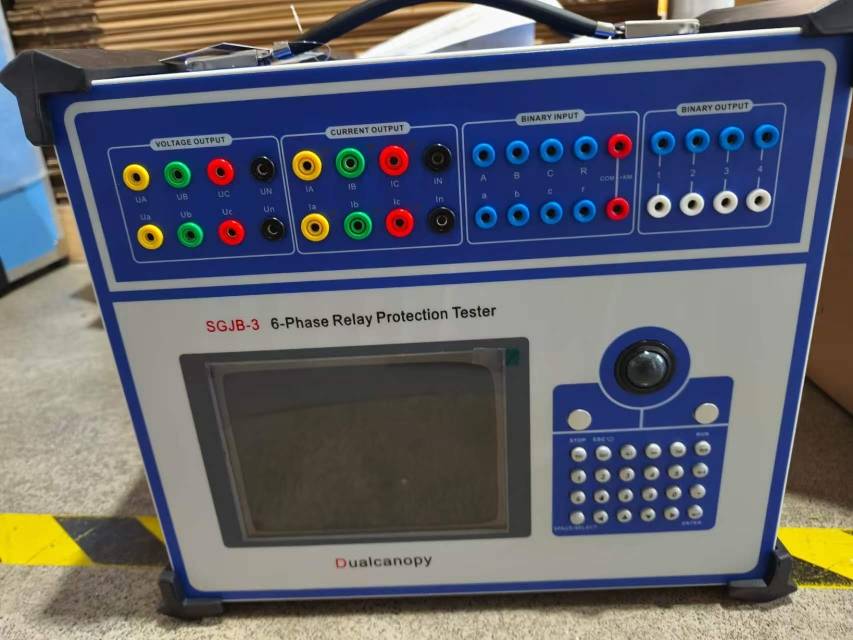
Transformer differential protection works on a simple principle: the relay continuously compares the current entering the protected zone with the current leaving it. Under healthy conditions, or during external through-faults, the two should balance. Any significant difference indicates an internal fault, and the relay must trip.
Verifying this behavior in the field requires injecting controlled currents into both sides of the transformer at once - and that is exactly where a six-phase test set becomes essential.
Why Are Six Current Channels Useful?
A three-phase transformer differential relay may receive current inputs representing more than one side of the protected equipment. Six independent current outputs can help a test engineer reproduce the required current relationships without treating every input as a single three-phase set.
For a particular test, the operator can set the required current magnitudes and phase angles, then observe the relay's response through its trip contact. The six-channel arrangement supports the injection plan; it does not automatically determine the correct transformer compensation or relay settings.
What does a typical test flow include?
Connect HV-side CT secondaries to three current channels of the test set; connect LV-side secondaries to the remaining three.
Perform a wiring check at low current (e.g., 0.5 A) and confirm the relay's displayed differential current is near zero for balanced injection.
Run the differential characteristic test: increment the "operate" side current in small steps at several restraint levels, recording trip points against the expected curve.
Verify harmonic restraint by superimposing second-harmonic content and confirming the relay remains restrained above the blocking threshold.
Test through-fault stability by injecting equal, opposing currents on both sides - the relay must remain stable.
How Can a Buyer Confirm Suitability for a Differential Test Plan?
Send the relay model, protected equipment type, number of current inputs, desired differential tests, required current range and any harmonic-test requirements. Include the relay connection diagram if available. The sales team can then confirm the relevant output configuration and software options before an order is placed.
Ask separately about the supplied leads, software version, operating arrangement and service scope; these details are not specified in the user manual.
Which Six Phase Relay Tester Ratings Matter Most for Differential Tests?
| Relevant item | Manual specification |
|---|---|
| Current output channels | Six-phase |
| AC current output in six-phase mode | 0–30 A per phase, according to the nominal parameter table |
| AC current output in three-phase mode | 0–60 A per phase, according to the nominal parameter table |
| Six-phase parallel current | Up to 180 A; maximum-output working time listed as 10 seconds |
| Long-duration phase current | 10 A listed as the allowable long-term value |
| AC output accuracy | Class 0.2 |
| Harmonic capability | Up to the 20th order |
| Digital inputs | 8 channels for contact monitoring |
| Time measurement | 0.1 ms–9999 s; stated accuracy <0.1 ms |
How Is This Different from Using a Three-Phase Test Arrangement?
| Test consideration | Three-phase arrangement | Six-current-channel arrangement |
|---|---|---|
| Current injection | Suited to tests requiring three current outputs | Provides additional independent current outputs for multi-input test plans |
| Differential applications | May need a different connection plan or added equipment, depending on the test set | Can support injection across more relay current inputs from one instrument |
| Phase relationships | Set within the available channel arrangement | Individual current outputs can be configured for the planned phase relationships |
| Compensation work | Must be addressed through relay settings or the test procedure | Still must be verified; additional channels do not remove the need for correct compensation |
What Wiring and Safety Points Should Be Checked?
Before injecting any current, the following relay settings must be checked against the protected transformer and the approved relay configuration file. None of these values should be inferred from the test instrument itself - the test set only supplies the stimulus; the relay settings define what a correct result looks like.
Vector group compensation. Enter the transformer's vector group (e.g., Dyn11, YNd1) exactly as shown on the nameplate. A mismatch here produces a false differential current that the test will "confirm" as real.
CT ratios and secondary ratings. Verify both side CT ratios and confirm whether secondaries are 1 A or 5 A, and that the relay's ratio settings match the installed CTs.
Polarity and phase rotation. Confirm the polarity of each CT connection and the phase sequence on both sides. Reversed polarity on one side is one of the most common causes of a differential relay that appears healthy but trips on through-fault.
Restraint (slope) settings. Record the pickup current, slope breakpoints, and harmonic blocking thresholds so measured points can be compared against the intended characteristic.
FAQ
What is the stated AC output accuracy?
The nominal parameter table lists Class 0.2 for AC current and voltage output. Check the calibration documentation for the supplied unit if traceability is required.
Does the instrument include eight digital inputs and four relay outputs?
The manual lists eight input channels and four output channels. Confirm the exact connection accessories and supplied configuration with the seller.
Is an external computer required?
The manual shows a front-panel display and controls, and also describes USB communication with an external computer. Confirm the operating arrangement and software supplied with the specific unit.
Hot Tags: six phase relay tester, China six phase relay tester manufacturers, suppliers, factory


