

The core principle of the transformer winding deformation tester: It determines the deformation by measuring the frequency response characteristics (sweeping frequency impedance spectrum) of the transformer winding. When the winding undergoes displacement, distortion or inter-turn short circuit, the distributed inductance and capacitance parameters change, resulting in a significant deviation in the frequency response curve.
Key evaluation indicators:
Frequency range: Determines the detection sensitivity. The wide frequency band (10Hz - 2MHz) enables comprehensive assessment of deformation at different locations.
Scanning points: Affects the resolution of the curve, typically requires ≥ 200 points
Dynamic range: Determines the ability to identify minute deformations, and should be ≥ 100 dB
Repeatability error: An indicator of instrument stability, should be < 0.5%
Anti-interference capability: For the key indicators of on-site testing, it is necessary to have a good electromagnetic compatibility design.
Transformer winding deformation tester selection method (Three-level evaluation method)
Transformer winding deformation tester
First layer: Matching of basic technical parameters
Applicable transformer range:
Voltage level: Full coverage from 0.4kV to 1000kV
Capacity range: Should cover from 50 kVA to 1000 MVA
Winding type: Capable of testing various connection types including Y, D, Z, single-phase, and auto-coupled.
Core hardware requirements:
Output impedance: 50Ω standard impedance, matching the common standard used in the power industry
Injection signal: Voltage 10Vpp, Current 20mA (typical value)
Frequency response measurement: amplitude accuracy ±0.5 dB, phase accuracy ±0.5°
Test efficiency indicators:
Single-phase measurement time: < 3 minutes (1kHz - 2MHz, 2000 points)
Data storage: Capable of storing ≥ 1000 sets of complete test data
Connection method: Supports various connection methods such as single-ended method and differential method.
Second layer: In-depth assessment of functions and performance
Analysis and Diagnosis Function:
Must-have features:
Correlation coefficient calculation (RLC algorithm)
Spectrum curve overlap comparison
Analysis of historical data trends
Automatically generate standard format reports
Advanced Features (Recommendations):
Three-dimensional spectral analysis (amplitude-frequency, phase-frequency, impedance)
Artificial intelligence-assisted diagnosis
Quantitative assessment of deformation degree
Automatic identification of fault types
On-site adaptability:
Operating temperature: -20℃ to +50℃
Protection level: IP65 (dust and water resistant)
Power supply method: Built-in lithium battery (battery life ≥ 8 hours) + AC adapter
Portability: The overall weight of the machine is less than 10 kilograms, with an integrated design.
Data Management and Compatibility:
Support the IEEE/CSV standard data format
Compatible with DL/T 911 historical data
Equipped with wireless data transmission function (Wi-Fi/Bluetooth)
Complementary professional analysis software (Windows/ mobile devices)
Third layer: Reliability verification and vendor assessment
Qualifications and Certifications:
Third-party testing report (issued by provincial-level or higher-level power research institutes)
Type test report (including EMC and environmental adaptability)
Calibration Certificate (CNAS Accreditation)
Case and Verification:
There are ≥ 50 actual measurement cases of transformers of the same type.
Verification report comparing with the results of short-circuit test
Accuracy statistics of inspection verification (should be ≥ 90%)
Technical Support System:
On-site application training capability
Diagnosis Analysis Support Team
Software Free Upgrade Promise
Typical Case Database
Transformer Winding Deformation Tester Selection Three-level Evaluation Method
Popular Products

Open Flash Point Tester
Product Introduction Features: Fully automatic flash point tester, with touch screen instead of keyboard operation.

Capacitance Test
Products Description This 50kVA single phase pole mounted transformer is exported to Canada inJuly,2024.The rated

TTR Transformer Turns Ratio Tester
Products Description The ZS6810A / ZS6810E transformer ratio tester is mainly used for measuring the turns ratio or

Single-phase relay protection tester
The single-phase relay protection tester is a new type of intelligent test instrument, primarily used to calibrate

Sweep Frequency Response Analysers
Products Description Overview The Transformer winding deformation tester transformer winding deformation tester is used
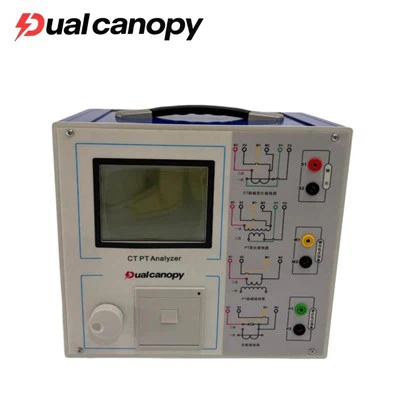
CT PT Excitation Characteristic Analyzer
Products Description The transformer comprehensive measuring instrument is an electronic device used for on-site