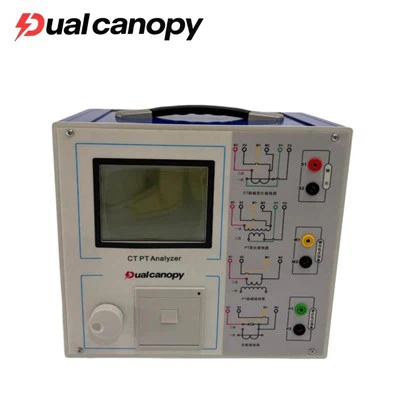
The main application scenarios of the lightning arrester resistive current tester
Handover and acceptance test: For newly installed or overhauled lightning arresters, establish the initial health record.
Preventive tests: Regular tests conducted in accordance with procedures are a routine item of preventive tests for substations.
Fault diagnosis and troubleshooting: When the online monitoring system triggers an alarm or there is suspicion of a potential problem with the lightning arrester, perform diagnostic tests.
Condition-based maintenance: By conducting trend analysis on historical test data, the rate of deterioration can be determined, providing a basis for condition-based maintenance and avoiding theness of regular maintenance.
Data analysis and judgment
Horizontal comparison: For lightning arresters of the same phase, the same model, and the same operating environment, their resistive current values should be approximately the same. If the current value of a certain phase is significantly larger (such as exceeding 1.5-2 times), it should raise a warning.
Vertical comparison (trend analysis): Compared with the initial value of the system or the data from previous years. There is a significant upward trend in the resistive current or power consumption (such as an increase of more than 50%), which is a clear sign of valve deterioration.
Absolute value judgment: Refer to the recommended values provided by the equipment manufacturer in the technical specifications or procedures. For example, for MOAs with voltages of 110kV and above, the resistive current should generally not exceed a few hundred microamperes.
Resistor Current Tester for Lightning Arresters
Standards and Procedures
The testing work must follow the following standard procedures:
National Standard
GB 11032-2020 "AC Non-Dispersive Metal Oxide Surge Arresters": Specifies the technical requirements, testing methods and inspection rules for surge arresters.
Electricity industry standards
DL/T 474.5-2018 "Field Insulation Test Implementation Guidelines - Part 5: Test of Surge Arresters": It provides detailed regulations on the wiring, methods, and precautions for on-site tests.
DL/T 393-2021 "Test Procedures for Condition-Based Maintenance of Power Transmission and Transformation Equipment": Specifies the test items and cycles based on the equipment's condition.
Q/GDW 11400-2015 "Technical Specification for Resistance Current Tester of Metal Oxide Surge Arresters": The technical requirements set by the State Grid Corporation for the testers used by enterprises.
State Grid/China Southern Power Grid Enterprise Standards
The two major power grid companies usually issue their own "Preventive Test Procedures for Power Equipment", which clearly stipulate the testing cycle, methods and judgment criteria for the resistive current of MOA. These are the direct basis for on-site work.
Note: In actual operations, the latest version of the standards and the specific regulations of the respective power grid company should always be followed as the reference.
Precautions for Using Lightning Arrester Resistance Current Tester
Safety first
Strictly implement safety measures such as power outage, voltage testing, and installation of grounding wires. Although some tests can be conducted under operating voltage, the wiring operation must be carried out safely before proceeding.
During the test, the operators should maintain an adequate safety distance from the high-voltage equipment.
Confirm that the test line is intact and free from damage to prevent electric shock.
When taking voltage signals from the secondary side of the PT, ensure that there is no short circuit on the secondary side of the PT.
Ensure measurement accuracy
The secondary voltage of the PT should be given priority as the synchronization signal, as this is the primary condition for ensuring accuracy.
Selecting the correct reference phase: For three-phase arresters, when testing phase A, the voltage of phase B is usually taken as the reference; when testing phase B, the AC line voltage is used as the reference (i.e., the "angle method"). The specific wiring must be carried out strictly in accordance with the instrument manual.
Reduce interference:
Place the current clamp near the base of the lightning arrester. The leads should be naturally extended and not tangled.
In a highly interfered environment, the method of averaging multiple measurements can be adopted.
Make sure that the jaws of the current clamp are clean and closed properly.
Environmental conditions: Avoid conducting tests in adverse weather conditions such as rain, fog, or high humidity, as surface leakage current can affect the results. If necessary, measures should be taken to clean the surface of the lightning arrester.
Other important points to note
Preparation before testing: Record the model of the lightning arrester, operating voltage, environmental temperature and humidity, etc.
Instrument calibration: Regularly send the tester and current clamp for inspection to ensure their measurement accuracy.
Data recording and analysis: Detailed recording of test data and comparative analysis with historical data are necessary to draw scientific conclusions. The absolute value of a single test has limited significance.