

I. Objectives of the Experiment
Check whether the mechanical operation characteristics of the high-voltage circuit breaker comply with the technical specifications of the manufacturer.
Check whether there are any potential hazards such as jamming, refusal to operate, or excessive bouncing in the operating mechanism.
Verify whether the key parameters such as three-phase synchronization, opening and closing times, speed, and stroke are within the allowable range;
Provide data support for condition-based maintenance to prevent accidents caused by mechanical failures such as malfunctions or false activations.
II. Applicable Objects
Vacuum circuit breakers (such as VS1, ZN28, ZN63)
SF₆ circuit breaker (such as LW36, LW25, HPL245B1)
Low-oil circuit breaker
The circuit breaker unit in the GIS combined electrical apparatus (requiring sensor compatibility)
III. Preparations Before the Experiment
Safety measures
The circuit breaker is in cold standby or maintenance mode, and the grounding switches on both sides have been closed.
The control power supply and the energy storage power supply have been disconnected.
Set up fences in the test area and hang "High Voltage Hazard" warning signs.
The testers wore insulating gloves and safety helmets.
High-voltage Switch Dynamic Characteristics Tester
2. Instruments and Tools
High-voltage switch dynamic characteristic tester (such as KJTC-307) main unit and accessories;
Linear/rotary/acceleration sensor (select according to switch type);
Special test cables (breakout signal cables, control cables, power cables);
Grounding wire, multimeter, tape measure, record form.
3. Data Preparation
Factory manual of circuit breaker (including standard parameters: opening and closing time, speed, travel distance, etc.)
Last test report (for comparative analysis);
Equipment ledger information (model, rated voltage, operating mechanism type).
Test items and steps
Step 1: Single trip test (trip time, speed, bounce)
Energy storage completed (spring mechanism) or hydraulic/air pressure is normal;
Select the "Single Division" mode in the instrument menu;
Start the test. The instrument automatically triggers the circuit breaker to open and records the waveform.
Record: Trip time, initial separation speed, bounce time, rebound amplitude.
Step 2: Single closing test (closing time, overtravel, bounce)
The circuit breaker is in the open position.
Select the "Single Merge" mode;
Start the test;
Record: Closing time, closing speed, number and duration of closing bounce, total travel distance, overtravel distance.
Step 3: Merge - Split (Re-activation) Test
The reclosing process after an instantaneous fault in the simulation line;
Record: Closing time, no current time, opening time, golden period.
Step 4: Low Voltage Action Test (Optional)
Adjust the output DC voltage of the instrument (for example, gradually increase from 30V to 250V);
Test the minimum reliable closing/opening voltages (generally, the opening voltage should be ≥ 30% of Un, and the closing voltage should be ≥ 85% of Un).
Step 5: Three-phase Synchronization Analysis
Automatically calculate the time difference between the opening/closing of phases A, B, and C;
Standard requirements: Vacuum circuit breaker ≤ 2ms, SF₆ circuit breaker ≤ 3ms.
Parameters Vacuum Circuit Breaker (Typical Value) SF₆ Circuit Breaker (Typical Value) Criterion
Opening Time 20 - 60 ms 20 - 50 ms Complies with manufacturer's specifications ±10%
Closing Time 40 - 100 ms 60 - 150 ms Same as above
Initial Opening Speed 0.6 - 1.5 m/s 2.0 - 5.0 m/s ±0.1 m/s tolerance
Closing Jounce ≤2 ms (≤2 times) No jounce requirement Exceeding standard requires checking contact pressure
Phase Discrepancy ≤2 ms ≤3 ms Exceeding standard requires adjusting transmission mechanism
Test report content
Subject equipment information (name, model, number, installation location)
Test date, environmental temperature and humidity
Use the model and serial number of the instrument
Various test data tables (including printed waveforms)
Comparative analysis with historical data or standard values
Conclusion: Qualified / Unqualified / Requires Monitoring and Tracking
Signature of the tester and the reviewer.
Standard Test Scheme For High-Voltage Switch Dynamic Characteristics Tester
Popular Products

Open Flash Point Tester
Product Introduction Features: Fully automatic flash point tester, with touch screen instead of keyboard operation.

Capacitance Test
Products Description This 50kVA single phase pole mounted transformer is exported to Canada inJuly,2024.The rated

TTR Transformer Turns Ratio Tester
Products Description The ZS6810A / ZS6810E transformer ratio tester is mainly used for measuring the turns ratio or

Single-phase relay protection tester
The single-phase relay protection tester is a new type of intelligent test instrument, primarily used to calibrate

Sweep Frequency Response Analysers
Products Description Overview The Transformer winding deformation tester transformer winding deformation tester is used
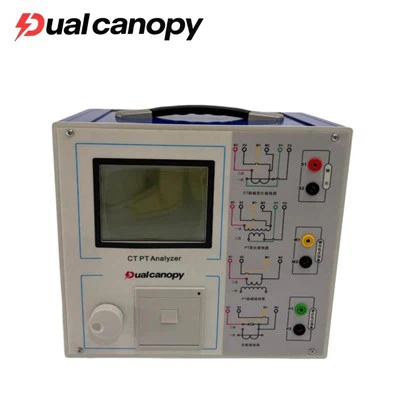
CT PT Excitation Characteristic Analyzer
Products Description The transformer comprehensive measuring instrument is an electronic device used for on-site