

To select an appropriate transformer comprehensive characteristic testing platform, several key factors need to be taken into consideration comprehensively:
Specify the test subjects
Transformer type: Is it a distribution transformer, power transformer, rectifier transformer or reactor?
Voltage level: 10kV, 35kV, 110kV, 220kV, 500kV? The voltage level determines the test voltage and accuracy requirements.
Capacity range: From several kVA to several hundred thousand kVA. The capacity determines the test current and power.
Winding type: Double-winding, triple-winding or autotransformer?
2. Determine the core testing project requirements
Basic requirements: If it is mainly used for commissioning and preventive tests, the following parameters are mandatory: DC resistance, transformation ratio, insulation resistance, and no-load test.
High-end/Factory Requirements: If used for the factory tests of transformer manufacturing plants, it must include the functions of induced voltage withstand test and partial discharge measurement. This is the key indicator that distinguishes mid-range and high-end testing platforms.
Transformer Comprehensive Characteristic Testing Station
3. Pay attention to key performance indicators
Output capacity: The power output capacity during both no-load and load tests must be greater than the maximum no-load loss and load loss of the tested transformer to ensure that it can smoothly rise to the rated voltage and current.
Measurement accuracy: The accuracy of all measurement channels (voltage, current, power, resistance, etc.) must meet or exceed the requirements of relevant national standards. For instance, the accuracy of loss measurement is typically required to reach 0.2 grade or higher.
Measurement range: The measurement range for each test item must cover the parameter ranges of all the transformers to be tested, and a certain margin should be left.
Partial discharge measurement level: If this function is included, attention should be paid to its minimum measurable discharge quantity (e.g. ≤ 5 pC), anti-interference capability, measurement frequency band, etc.
4. Evaluation of Automation and Software Functions
Operation procedure: Does it support "one-click" completion of all the planned tests? Is the wiring process simple?
Report generation: Can the software customize the report format and is the export process convenient?
Data Management: Does it have a robust database that supports historical data querying, comparison, and trend analysis?
5. Consider portability and working environment
Mobility: Do you need to move frequently? Is it to be fixed in the laboratory or do you need to take it to different sites? This determines whether you need a stand-alone unit, a cabinet-style device, or a vehicle-mounted system.
Environmental adaptability: What are the power supply conditions (220V/380V), temperature and humidity at the work site?
6. Brand, Service and Budget
Brand and Reputation: Choose brands with good reputation within the industry and strong technical capabilities, such as Wuhan Hezhong Electric.
After-sales service: Ensure that the supplier can provide timely technical support, training and maintenance services.
Budget: While meeting all technical requirements, select the product with the best value for money. Do not sacrifice core functions and measurement accuracy for the sake of low price.
Summary and Suggestions for Transformer Comprehensive Characteristic Test Bench Selection Process
Prepare a requirements list: Provide a detailed list of all the transformer models, voltages, capacities, and the specific test items that must be conducted for each transformer you are testing.
Initial screening: Based on the requirements list, request technical solutions and product catalogs from multiple suppliers and conduct a preliminary comparison.
Technical Communication: Have in-depth discussions with the technical engineers of the suppliers to ensure that they understand your specific requirements (such as the testing of three-winding transformers, special tap positions, etc.).
On-site demonstration: If conditions permit, it is required that the supplier conduct an on-site demonstration, actually operate the key testing procedures to verify the usability and stability of the equipment.
Evaluate the total cost: Take into account the equipment price, subsequent maintenance costs, training and service support, and make the final decision.
We hope that the detailed explanations above will help you have a comprehensive understanding of the transformer comprehensive characteristic testing platform and provide clear guidance for your selection process.
Selection Method For Transformer Comprehensive Characteristic Test Bench
Popular Products

Open Flash Point Tester
Product Introduction Features: Fully automatic flash point tester, with touch screen instead of keyboard operation.

Capacitance Test
Products Description This 50kVA single phase pole mounted transformer is exported to Canada inJuly,2024.The rated

TTR Transformer Turns Ratio Tester
Products Description The ZS6810A / ZS6810E transformer ratio tester is mainly used for measuring the turns ratio or

Single-phase relay protection tester
The single-phase relay protection tester is a new type of intelligent test instrument, primarily used to calibrate

Sweep Frequency Response Analysers
Products Description Overview The Transformer winding deformation tester transformer winding deformation tester is used
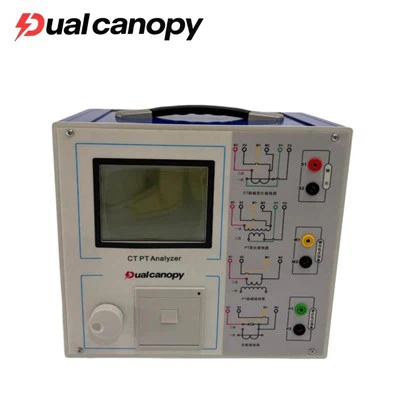
CT PT Excitation Characteristic Analyzer
Products Description The transformer comprehensive measuring instrument is an electronic device used for on-site