

The selection method for transformer comprehensive testers: Selection is the first step to ensure the efficiency and accuracy of the testing process. It requires comprehensive consideration based on the test object, test items, and future requirements.
Specify the type of the test subject
Current transformer: The key points to focus on include current error, phase error, excitation characteristic, turns ratio, secondary winding resistance, etc.
Voltage Transformer: The key points to focus on include voltage error, phase error, excitation characteristic, turns ratio, no-load current, secondary winding admittance, etc.
Protective class transformers: such as TPY, P class, etc., must have their excitation (voltage-current) characteristic curves tested, and the composite error and accuracy limit coefficient must be evaluated.
Measuring-type transformers: such as 0.2S, 0.5 class, etc., have extremely high requirements for the testing accuracy of current/voltage errors and phase errors.
Electronic transformer: Requires the test function that supports digital output (such as IEC 61850-9-2LE, FT3).
2. Core Functional Requirements
Basic functions:
Ratio difference and phase difference test: Core function, used to verify the accuracy class of the transformer.
Polarity check: Ensure that the transformer wiring is correct.
Measurement of secondary winding resistance: This is crucial for calculating the load and temperature rise of the transformer.
Load box test: Measures the actual secondary load borne by the transformer.
Transformer Comprehensive Tester
Key advanced features:
Excitation (voltage-current) characteristic curve test: This is of vital importance for protective CTs, and is used to calculate the inflection point voltage, saturation point, accurate limit factor (ALF), etc.
Transient characteristic test: For TP-level protective current transformers, test their anti-saturation capability and transient error.
Demagnetization function: Before the test, the transformer is demagnetized to eliminate the influence of residual magnetism on the test results.
Secondary circuit load test: Directly measure the impedance of the entire secondary circuit to assess whether it is within the allowable range of the transformer.
Data storage and management: Capable of storing a large amount of test data and supporting export to a computer, facilitating the generation of reports and archiving.
3. Technical Parameter Consideration
Output capacity:
Current output: For testing the excitation characteristics of large-scale protective CTs, a higher output voltage and current (e.g. 0-3000V, 0-20A) are required to ensure that the saturation point can be accurately measured.
Voltage output: For PT testing, a sufficient voltage output range is required (e.g. 0 - 3 kV).
Measurement accuracy:
For the ratio and phase difference tests of metering transformers, the instrument's accuracy must be much higher than that of the tested transformer (typically, the instrument's accuracy should be at least 3 times higher than that of the tested object). For example, when calibrating a 0.2-class transformer, the instrument's ratio accuracy should be better than 0.05% and the phase difference accuracy should be better than 2'.
Portability and Power Supply:
The instruments used on site need to be lightweight and sturdy.
Consider the power supply method (220V AC or built-in lithium battery). The lithium battery is more suitable for passive sites.
Selection Method For Current And Voltage Transformer Comprehensive Tester
Popular Products

Open Flash Point Tester
Product Introduction Features: Fully automatic flash point tester, with touch screen instead of keyboard operation.

Capacitance Test
Products Description This 50kVA single phase pole mounted transformer is exported to Canada inJuly,2024.The rated

TTR Transformer Turns Ratio Tester
Products Description The ZS6810A / ZS6810E transformer ratio tester is mainly used for measuring the turns ratio or

Single-phase relay protection tester
The single-phase relay protection tester is a new type of intelligent test instrument, primarily used to calibrate

Sweep Frequency Response Analysers
Products Description Overview The Transformer winding deformation tester transformer winding deformation tester is used
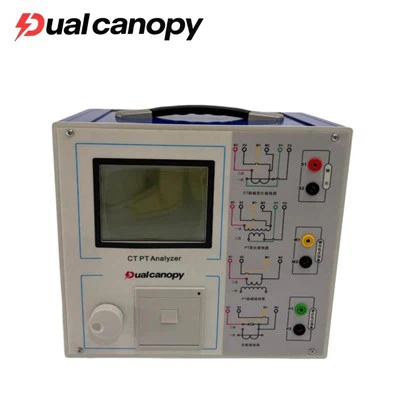
CT PT Excitation Characteristic Analyzer
Products Description The transformer comprehensive measuring instrument is an electronic device used for on-site