Precautions during the power frequency withstand voltage test
(1) As the power frequency withstand voltage test is a destructive test, the test voltage applied is often several times the rated voltage of the transformer. Excessive voltage will increase the loss of the insulating medium, cause overheating, and accelerate the development of insulation defects. Therefore, when conducting the power frequency withstand voltage test on the transformer, the corresponding test voltage should be selected according to the different insulating media and the operating condition of the transformer, in accordance with relevant regulations and test standards.
(2) After connecting the test wiring, it should be checked by another test personnel to ensure there are no errors before applying the voltage for the test.
(3) Before applying the voltage, first check if the regulating device is at zero position. The voltage can be applied only when the regulating device is at zero position. During the voltage rise, verbal communication should be conducted. It is not allowed to perform an impulse closing above 1/3 of the specified test voltage value. Generally, the test equipment has limited the voltage rise from non-zero position on the internal control circuit. The voltage should be increased as quickly as possible to the test voltage value. When the test voltage rises to above 75% of the specified value, generally, it should be increased at a rate of 2% of the test voltage per second. This is to prevent the withstand voltage time of the transformer from being too long when approaching the specified test voltage value and to facilitate the observation of the test voltage. During the voltage rise process, observe and measure the indication of the measuring device to ensure it is normal. After the protection action, analyze the cause and eliminate it before conducting the test. After the specified time, without special requirements, it is 60 seconds. The voltage should be rapidly reduced to below 1/3 of the test voltage value before disconnecting the power supply and opening the switch.
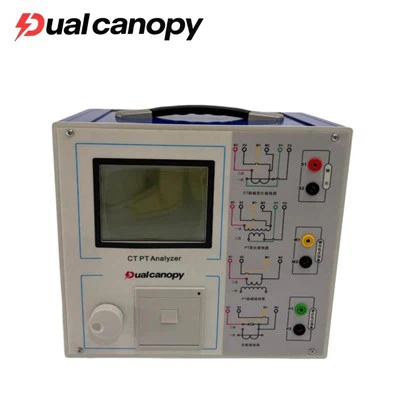
Power frequency withstand voltage test equipment
The power frequency withstand voltage test is a destructive test. The withstand voltage time should not be too long to avoid unnecessary insulation damage. It is prohibited to cut off the power supply when the voltage value is high. To avoid possible transient processes that may cause the specimen to discharge or break down and damage the measuring instrument, overvoltage should be avoided.
(4) During the test, if the specimen surface flashover discharge or air breakdown occurs due to the influence of air humidity, surface dirt, etc., it should not be considered as unqualified. The test should be conducted again after cleaning and under suitable environmental conditions. If discharge or breakdown occurs during the test, the power supply should be cut off immediately because high-frequency overvoltage will be generated after discharge or breakdown, equivalent to being impacted by the wave, and continuous action will damage the longitudinal insulation of the transformer, causing inter-turn, inter-layer, and inter-break breakdown.
(5) The power frequency withstand voltage test should use any appropriate frequency not less than 80% of the rated frequency, and the waveform should be as close as possible to the single-phase AC voltage with a sine wave. The peak voltage should be measured, and the test voltage value should be the peak voltage divided by.
(6) Judgment of the results of the power frequency withstand voltage test of the transformer. According to the provisions of GB1094.3-1985, "If no internal insulation breakdown or local damage is found, the test is qualified." While the new standard GB1094.3-2003 stipulates that "If the test voltage does not suddenly drop, the test is qualified."
(7) Special attention should be paid that when the specimen is an organic insulating material, it should be touched immediately after the test. If there is general or local heating, it indicates poor insulation, and it should be dealt with promptly before conducting the test. The insulation resistance of the specimen should be measured before and after the withstand voltage test. For equipment with interlayer insulation or organic insulating materials, if the insulation resistance after the withstand voltage test is 30% lower than that before the test, the cause should be investigated. If the porcelain sleeve insulating layer of the specimen surface is damaged, aged, or has cracks, it should be regarded as unqualified.
(8) When conducting power frequency withstand voltage tests on multiple transformers, obvious and non-removable warning signs should be placed on the transformers that have broken down.