

Oil-filled circuit breaker
The tanδ value of the oil-filled circuit breaker is measured using a dielectric loss tester, mainly to check the insulation condition of the insulating components inside the bushing and oil tank (such as the arc extinguishing chamber, lifting rod insulation guard screen, and insulating oil, etc.). The on-site test can be carried out according to the following steps.
Test steps
Measure the tanδ and capacitance values of the three-phase as a whole (including the insulating lifting rod and bushing) separately in the closed state (this measurement is carried out when necessary).
In the open state, measure the tanδ and capacitance values of each bushing and arc extinguishing chamber. When the measured tanδ value exceeds the test standard or significantly increases compared to before, a disassembly test should be conducted, which includes:
a) Lowering the oil tank or removing the insulating oil (for those where the oil tank cannot be lowered) to expose the oil surface of the arc extinguishing chamber. If the tanδ value decreases significantly, it indicates poor insulation of the insulating oil and the insulation screen of the oil tank;
b) If the tanδ value shows no significant change, clean the surface of the porcelain sleeve of the oil tank again for testing. If the tanδ value decreases significantly, it indicates that the bushing is dirty;
c) If the tanδ value shows no significant change, remove the screen cover of the arc extinguishing chamber for testing. If the tanδ value decreases significantly, it indicates that the screen cover is damp; otherwise, remove the arc extinguishing chamber;
d) If the tanδ value decreases significantly after removing the arc extinguishing chamber, it indicates that the arc extinguishing chamber is damp; otherwise, it indicates poor insulation of the bushing.
Dielectric loss tester
When using the M-type dielectric tester, measure the difference in active power (mW) in the closed and open states to determine the insulation area; the difference between the milliwatt value of the closed state and the milliwatt value of the two-phase in the same phase of the open state is the difference value. When this difference value is positive, it indicates that the lifting rod and guide plate are damp. When the difference value is negative, it indicates that the arc extinguishing chamber is damp or dirty.
Test standard
DL/T474.3-2006
The tanδ value (%) of the non-pure porcelain bushing and the circuit breaker of the oil-filled circuit breaker as specified in DL/T596 is the standard.
During the step-by-step test, a difference value within ±9mW is considered qualified, and a difference value within ±(9mW to 16mW) is still usable. If the difference value exceeds ±16mW, it should be immediately dealt with and cannot be used any longer.
Interference influence and elimination methods for on-site measurement
Electrical field interference
There is capacitance coupling between the charged bodies of different phases (such as A, B, and C phases) and different parts of the tested equipment. The coupling capacitance current (interference current) of these different parts flows along the tested equipment and the bridge measurement circuit (positive, reverse, and side connections) to form electrical field interference, which causes errors in the on-site tanδ measurement. Due to the different structures of the tested equipment, the situation of being affected by electrical field interference is also different.
Elimination methods for electrical field interference influence Block
At the site with partial power outage, for the test samples that may be affected by the electric field of nearby charged objects, especially the exposed test electrode directly connected to the bridge, under possible conditions, they should be shielded with an insulating layer on the inner side, such as metal covers or aluminum foil. The shielding cover should be grounded to reduce the influence of electric field interference.
Phase selection and inversion method
When the interference power supply and the test power supply have the same frequency, the phase selection and inversion method can be used. Through calculation methods, the influence of the interference current on the test sample from the high-voltage end, the intermediate capacitor screen, or the terminal capacitor coupling can be eliminated. Generally, during measurement, the power supply can be connected in positive or reverse phase for measurement once. If the reverse connection method is used for measurement and the tanδ value obtained is greater than 15%, the power supply should be selected for testing in another phase to make tanδ ≤ 15% until the condition is met.
Measurement Methods And Procedures For Dielectric Loss Factors Of Oil-filled Circuit Breakers
Popular Products

Open Flash Point Tester
Product Introduction Features: Fully automatic flash point tester, with touch screen instead of keyboard operation.

Capacitance Test
Products Description This 50kVA single phase pole mounted transformer is exported to Canada inJuly,2024.The rated

TTR Transformer Turns Ratio Tester
Products Description The ZS6810A / ZS6810E transformer ratio tester is mainly used for measuring the turns ratio or

Single-phase relay protection tester
The single-phase relay protection tester is a new type of intelligent test instrument, primarily used to calibrate

Sweep Frequency Response Analysers
Products Description Overview The Transformer winding deformation tester transformer winding deformation tester is used
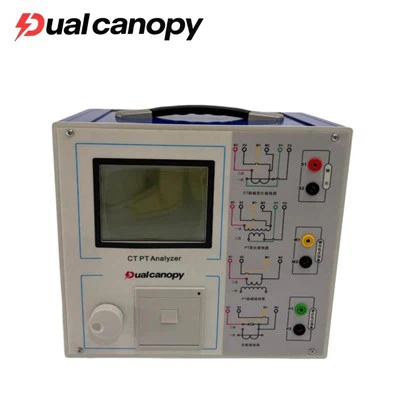
CT PT Excitation Characteristic Analyzer
Products Description The transformer comprehensive measuring instrument is an electronic device used for on-site