Although the insulation resistance test can effectively reflect certain conditions of the transformer's insulation, due to the significant influence of various factors, the measured results have a great degree of dispersion, and thus there is no absolute judgment standard basis.
Comparative analysis method
Comparing devices of the same type with each other;
2. Compare the results of all previous tests conducted on the same equipment;
3. Comparative analysis of test results before and after major overhaul;
4. The results of the installation and commissioning tests should be converted to the same temperature and should not be lower than 70% of the initial value. For the test results after major overhaul, they should be converted to the same temperature and should not be lower than 70% of the previous test value.
Extend the testing time
That is, measurements of the absorption ratio and the polarization index will be conducted.
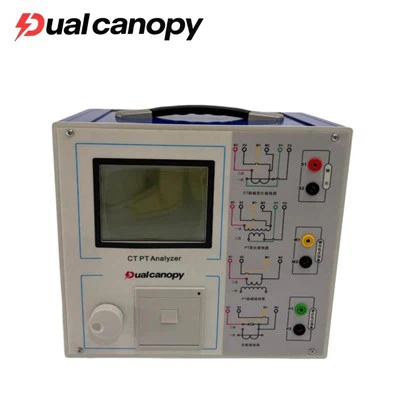
Insulation Resistance Tester
The insulation resistance value is evaluated based on the resistance value at 1 minute. The insulation resistance of the coil at 20℃ should not be less than 2000 MΩ. The insulation resistance of the core should not be less than 200 MΩ. If it is lower than the above requirements, the cause should be investigated. When the insulation resistance is low, it is generally related to the drying quality of the transformer body during baking, and also related to the quality of the transformer oil. When the insulation resistance of the transformer is low, oil filtration and hot oil circulation treatment can be carried out, and the effect is usually quite obvious. If the oil filtration effect is not obvious, the transformer body needs to be re-dried.
When the air humidity is high in summer, the assembly time of the transformer is too long, and the transformer body is exposed to the humid air for a long time. The insulation resistance will decrease significantly. The faster the assembly is completed, the shorter the exposure time will be, so as to ensure that the insulation of the transformer does not decrease.
The absorption ratio measurement of transformers often fails to meet the standard of 1.3. This requires a comprehensive analysis. When the absolute value of the insulation resistance is extremely high, the absorption ratio often fails to meet the requirements. However, this does not indicate that the insulation is defective or damp; rather, it is a sign of good insulation condition. The temperature of the transformer can be increased to make a judgment.
When the temperature rises, the insulation resistance value decreases while the absorption ratio increases. When the absorption ratio fails to meet the requirements, the polarization index measurement can be conducted. When the polarization index reaches 1.5, it indicates good insulation. When the insulation resistance value is very low and the absorption ratio or polarization index fails to meet the requirements, it indicates that the transformer is severely damp and should be dealt with.
The insulation resistance of transformers in summer is often not very high. This is also related to the moisture on the surface of porcelain bottles (terminals). When measuring insulation, shielding should be applied on the surface of the porcelain bottle. The shielding ring is connected to the shielding terminal of the multimeter, which can eliminate the influence of surface moisture. In addition, the insulation of the measuring wire of the multimeter should also be good. When the multimeter is shaken with the measuring wire connected, the pointer should indicate at the ∞ position, eliminating the influence of the multimeter wire on the insulation resistance.
Transformers often encounter problems such as poor insulation of the core and components, or even complete insulation failure. The main causes of these issues are moisture in the core insulation parts, presence of foreign objects in the transformer, and displacement of the fixed insulation parts.