


Dual Canopy Mechanic Electrical Engineering Co., Ltd. is one of the leading manufacturers and suppliers of primary lnjection test set in China. Please feel free to wholesale discount products for sale here and get quotation from our factory. Customized orders are welcome.
What Is a Primary Injection Test Set?
A primary injection test set (also called a primary current injection tester or PCIT) is a specialized high-current source that injects a controlled, high-amperage current directly into the primary conductor of a power circuit. By reproducing the real fault-level current that equipment would see in service, it verifies the entire protection chain end to end - the current transformer, wiring, connections, protective relay and the circuit breaker's trip mechanism - rather than testing any single component in isolation.
A high-current primary injection tester engineered for current-transformer (CT) ratio and polarity verification, low-voltage circuit-breaker trip testing, and full protection-chain commissioning. Built for wholesale distributors, panel builders and testing contractors who need dependable output, repeatable accuracy and factory-direct pricing.
Factory-direct wholesale supply for circuit breaker verification, relay commissioning, and CT ratio testing. Built to IEC 61010 / IEC 60255 standards with ±0.5% measurement accuracy, up to 20 kVA output, and full OEM customization for global distributors.

What are the available technical specifications?
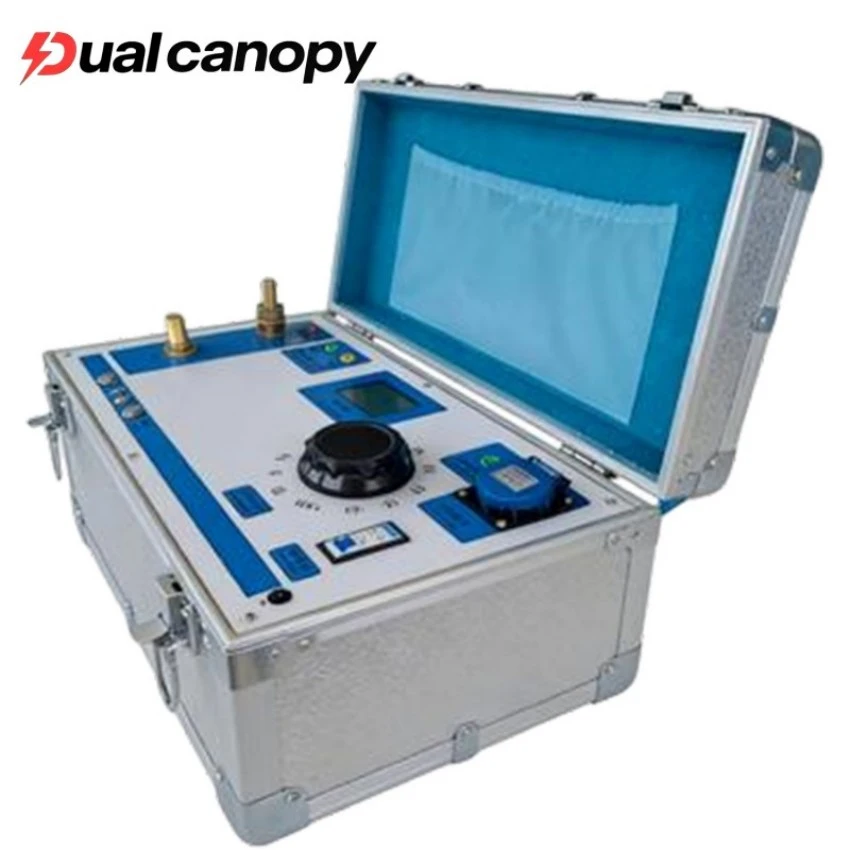
| Parameter | Typical Range |
|---|---|
| Input supply | 220/230 V single-phase or 380/415 V three-phase, 50/60 Hz |
| Output current | 0–1000 / 2000 / 3000 / 5000 / 6000 A (custom up to 25,000 A) |
| Capacity | 3 kVA – 20 kVA (higher on request) |
| Output voltage | Multi-tap low voltage (e.g. 3.3 V / 6.6 V busbar) |
| Current accuracy | ±0.5% – ±1% of reading (true-RMS) |
| Timer range / resolution | 1 ms – 9999 s / 1 ms, accuracy ±0.05% |
| Duty cycle | Intermittent (e.g. 5 min ON / 5 min OFF); continuous loading versions available |
| Regulation | Manual, motorized or PLC/HMI with data logging |
| Protection | Overload, over-temperature, open-circuit, auto trip-off |
| Operating environment | −10 °C to +50 °C, ≤95% RH (non-condensing) |
| Standards / compliance | Designed to CE, ISO 9001; supports IEC 61869, IEC 60255, IEEE C37.90, NETA workflows |
What kind of after-sales support is available?
Pre-Sales
Application & specification consulting to match current/duty to your customers' needs
Custom configuration (output, control type, accessories, labeling)
Fast quotations, samples and volume pricing tiers for distributors
Installation & Commissioning
Illustrated user manual, quick-start guide and wiring diagrams
Remote setup guidance via video call; on-site support available for large orders
Operator training on safe injection procedures and reporting
After-Sales
12-month warranty against manufacturing defects (extendable)
Spare parts stock and fast dispatch to keep fleets running
Factory calibration/repair service and multilingual technical support
What are the key technical features of the primary injection test set?
Every claim below is paired with the engineering reason behind it, so your customers understand why the feature matters - the fastest way to build trust and close a wholesale order.
1. High, stable current output (1000–6000 A, custom to 25,000 A)
A double-wound step-down transformer with a bare-copper (electrolytic-grade) secondary busbar delivers high current at low voltage. Heavy copper cross-section keeps I²R losses and heat low, so the output stays stable throughout the test window instead of sagging as the winding warms up.
2. Precise, true-RMS measurement (±0.5% of reading)
A 0.5-class internal metering CT and true-RMS digital ammeter give ±0.5%–±1% accuracy. True-RMS matters because real fault currents are not perfectly sinusoidal; average-responding meters would under-read and produce misleading trip results. Accurate readings are essential for CT-ratio work governed by IEC 61869 (instrument transformers).
3. High-resolution digital timer (1 ms resolution, ±0.05%)
Trip-time is the whole point of a breaker test. A millisecond-resolution timer with multiple start/stop modes (voltage, dry-contact, or current-removal) captures long-time, short-time and instantaneous curves precisely - the response characteristics defined in IEC 60255 / IEEE C37.90 for protective relays.
What are the operating precautions and safe usage guidelines?
1.Isolate the breakerfrom the system and verify zero energy with an approved voltage detector. Primary injection must only be performed on de-energized equipment.
2.Inspect cables and lugs.Damaged insulation on 50 mm² or larger cables can cause arcing at 500+ A. Check for frayed cotton braiding and loose lug bolts (torque to 45 N·m).
3.Confirm duty cycle.Do not exceed 5 minutes continuous ON for standard models. For intermittent work (e.g., multiple breaker tests in sequence), limit ON time to 2.5 minutes with a 10-minute cooling interval.
4.Connect ground first.Ensure the test set chassis is connected to the substation ground grid before applying current. A floating chassis can induce touch voltages above 50 V.
5.Set current stepwise.Start at 20% of target current, verify meter stability, then increase in 25% increments. Sudden full-current application can cause electromagnetic stress on relay coils.
6.Record ambient temperature.Accuracy degrades by approximately 0.02% per °C above 25 °C. If ambient exceeds 45 °C, derate maximum current by 10%.
What are the maintenance and care procedures?
Keep it clean and dry. Wipe down after field use; store in a dry, ventilated area to protect windings and contacts from moisture and dust.
Inspect cables & terminals. Before each job, check leads for insulation damage and clean/tighten copper terminations to maintain low contact resistance.
Check cooling. Keep ventilation grilles clear; ensure fans (if fitted) run freely so the loading transformer stays within thermal limits.
Annual calibration. Recalibrate the ammeter and timer at least once a year (or per your quality system) against traceable standards to preserve stated accuracy.
Fasteners & castors. Periodically verify busbar bolts, lifting handles and castor locks; retorque as needed.
Our address
Baoding Cloud Center, Hebei, China
Phone Number
+8613603329412
dylan@dualcanopy.com

FAQ
Q1: What is the difference between primary and secondary injection testing?
A:Primary injection injects high current (hundreds to thousands of amps) into the primary circuit and tests the complete protection chain - CT, wiring, relay and breaker - under a simulated real fault. Secondary injection injects a small current only into the relay terminals and tests the relay logic alone. Primary injection is the standard for commissioning; secondary injection is common for routine relay maintenance.
Q2: Can this test set be used for DC primary injection (e.g., for battery protection relay testing)?
A: Standard AC models are optimized for 50/60 Hz sinusoidal output. For DC injection requirements (common in energy storage and railway DC breaker testing), we offer DC-capable modules with rectified output and ripple control below 5%. These modules are available as factory options for orders of 5+ units or as retrofit kits for existing AC sets.
Q3:Why does the set use high current at low voltage?
A: Protection systems respond to current, so the test must reproduce fault-level amperage. A step-down transformer converts mains voltage into very high current at only a few volts, which is exactly what is needed to drive current through the low-impedance primary circuit safely and efficiently.
Hot Tags: primary lnjection test set, China primary lnjection test set manufacturers, suppliers, factory, Primary Current Injection Testing System, ac resonant test system 75kva, ac hipot tester resonance test


